Vacation Wrap-Up: Korea.
I didn’t really begin to scratch the surface of what Japan was like in the previous post. Everyone was friendly, but from what I’d describe as a professional distance. In Japan, people didn’t volunteer to help us. But if we asked, they helped without reservation, though seeming slightly startled, as though being asked for help didn’t really happen there. Which, for all I know, it may not. Everyone we interacted with seemed to like their job, and do it professionally and with a smile.
In Korea, if we stood there looking lost, people would approach us to help. There was a lot more barging in Korea. People didn’t wait for passengers to exit the subway or bus before pushing on. They crowded up against us in lines and shops. There seemed to be less in the way of personal space. In Japan, while the personal space-bubble seemed smaller than our own, it was inviolate. Whereas in Korea, it just kind of didn’t seem to exist.
Koreans, the older men, anyway, were really into my beard. I got a lot of fawning compliments. Having a thick beard is apparently peacocking age and power. Once, some older men made a joke of offering to stand so I could sit on the subway, since my beard indicated I was elderly and important. When BB scratched my beard in response, they were shocked and laughed, as if she’d done something terribly taboo.
We spent the first night in a sleazy little motel by the airport, because we got in at 11pm, and didn’t want to try to negotiate the hour-long trip into Seoul from Incheon Int’l. When we did get into Seoul, we found a bewildering dervish of a city, with eight-lane highways right at street level, and unfathomable sprawl. Tokyo sprawled, but we never really saw how from the air. Seoul, we climbed a park in the middle of the city, and saw the urban landscape spread in every direction.
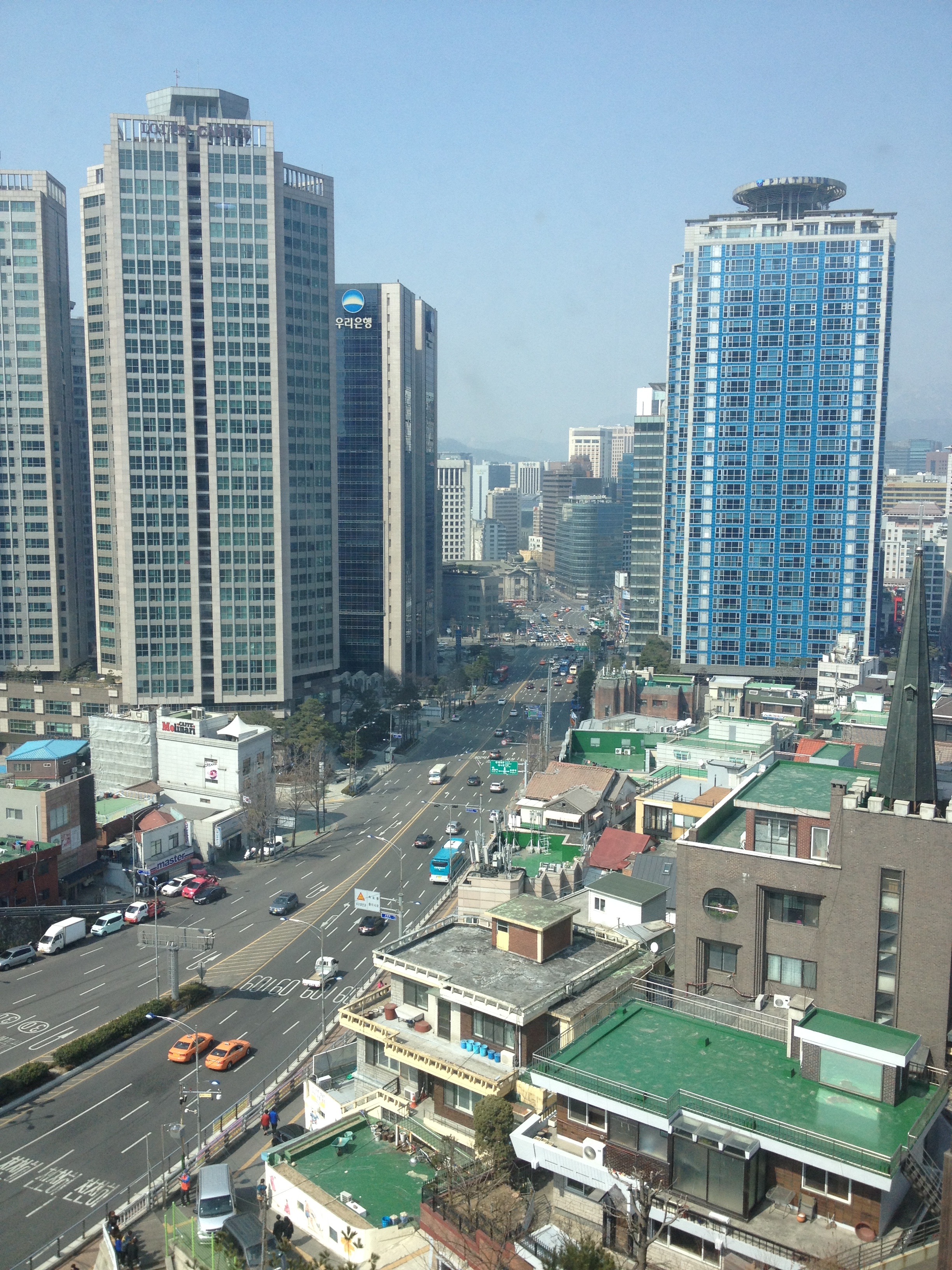
In the middle of Seoul is a fabulous palace called Gyeongbokgung. It’s enormous and imposing and astonishingly well-preserved.

We followed this up with a trip to the Confucian Shrine. It’s so large that one cannot get all of it into a photo. It’s where the spirit boxes of ancient monarchs are kept, for the resting place for their souls.
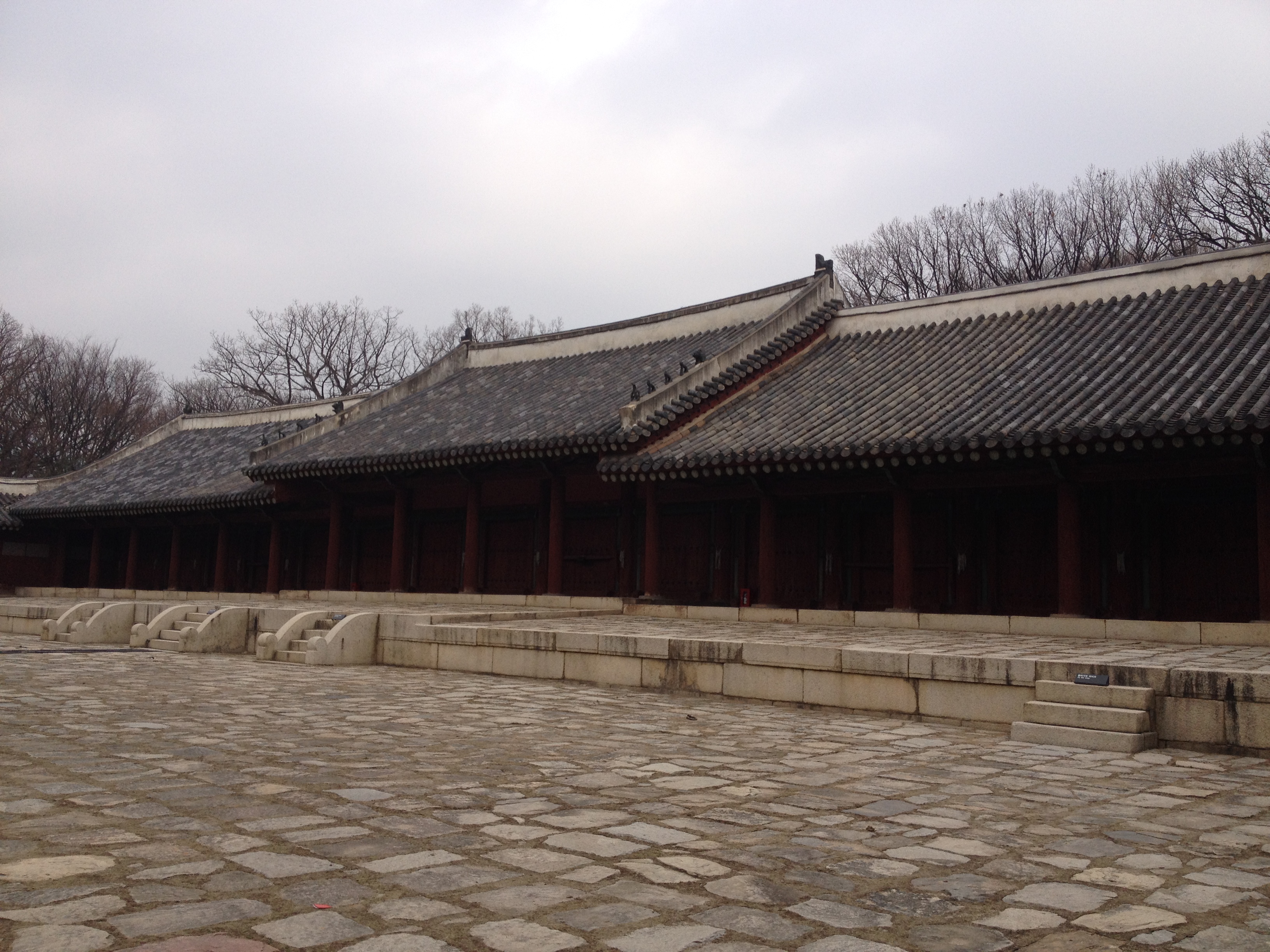
After Seoul, we rode on the high speed train to a smaller town called Gyeongju. There, we saw some amazing sites, as it is one of Korea’s best preserved locales, with some standing temples dating from the 8th century. Others, like Anapji, were more recently, but still long-ago, restored.

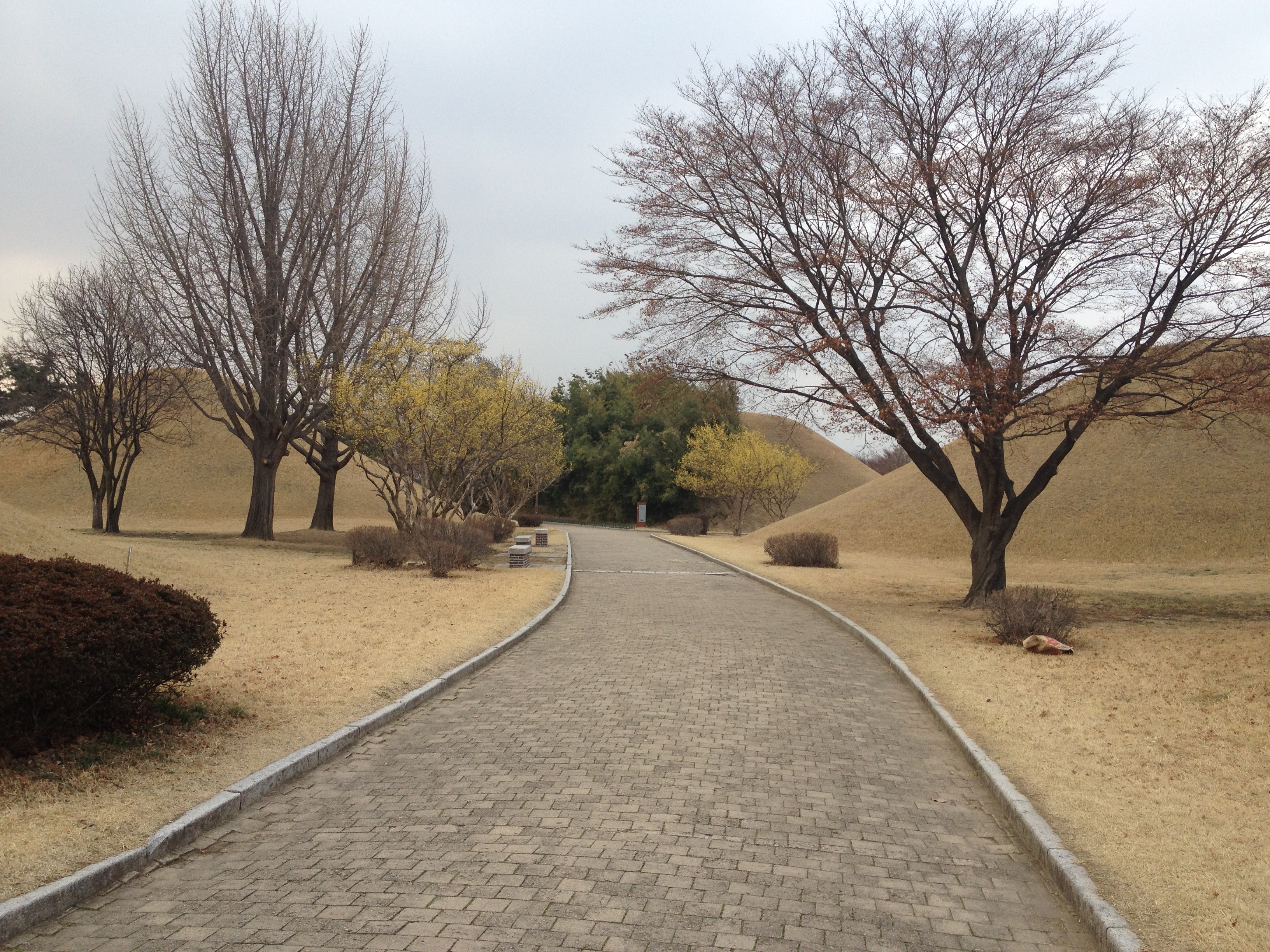
And these incredible third-century tumuli.
From Gyeongju, we took a bus out to Bulguksa, on of the UNESCO world heritage sites. An 8th century temple in all its glory, though rebuilt in the 16th century after being destroyed in one of the many, many Japanese pillagings of Korea.

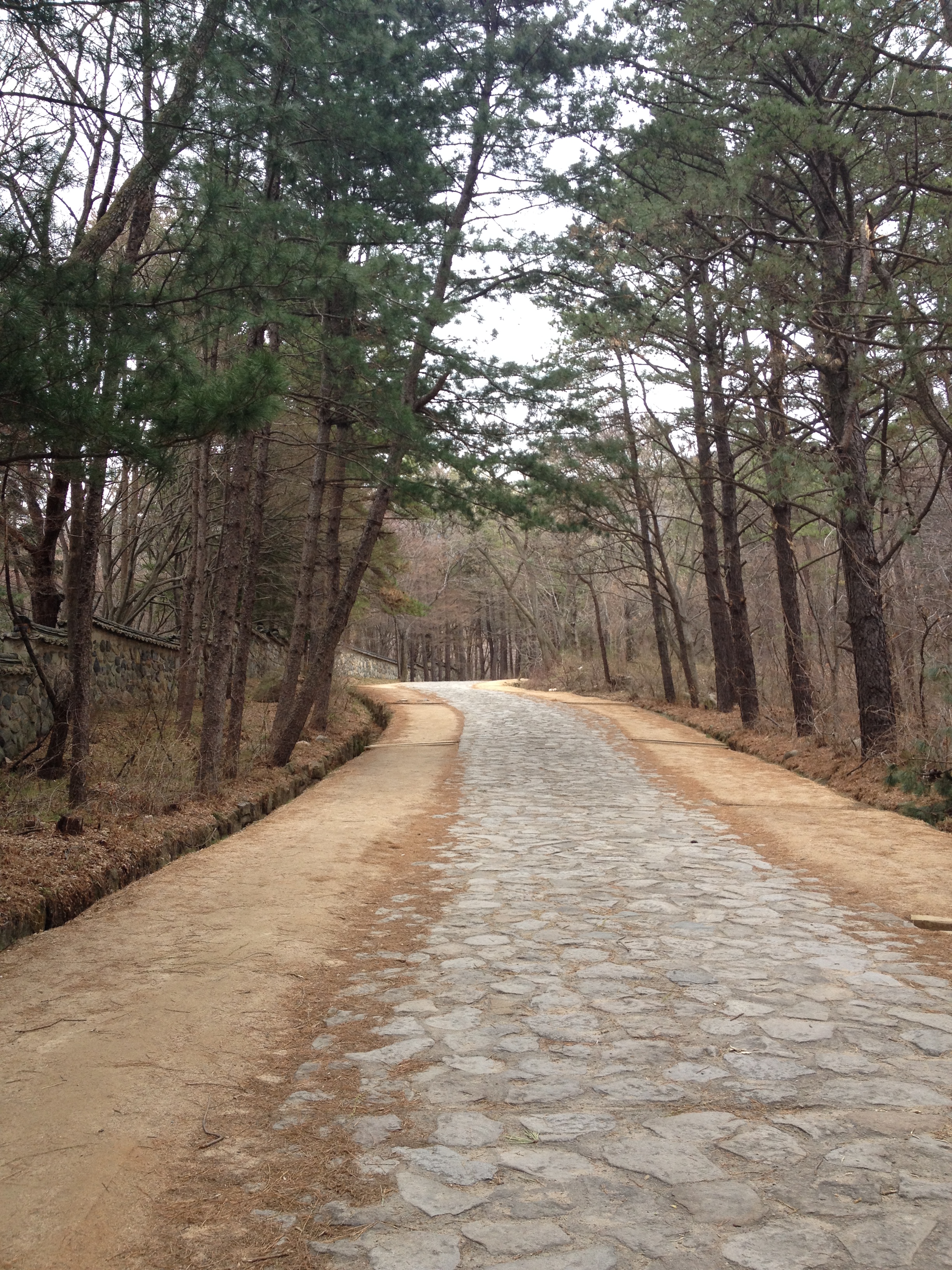
From Bulguksa we climbed and climbed hiking up a well maintained path that was nevertheless pretty brutal to me. The picture does no justice to the steepness.

At the top, we rang this bell for mercy. Literally. It’s a bell to be rung for mercy, pealing astonishing gongs throughout the valleys.

From Gyeongju, where we stayed in a tiny 120 year old guest house with bare floors and a mat to sleep on, we went to Busan, the thriving seaport.
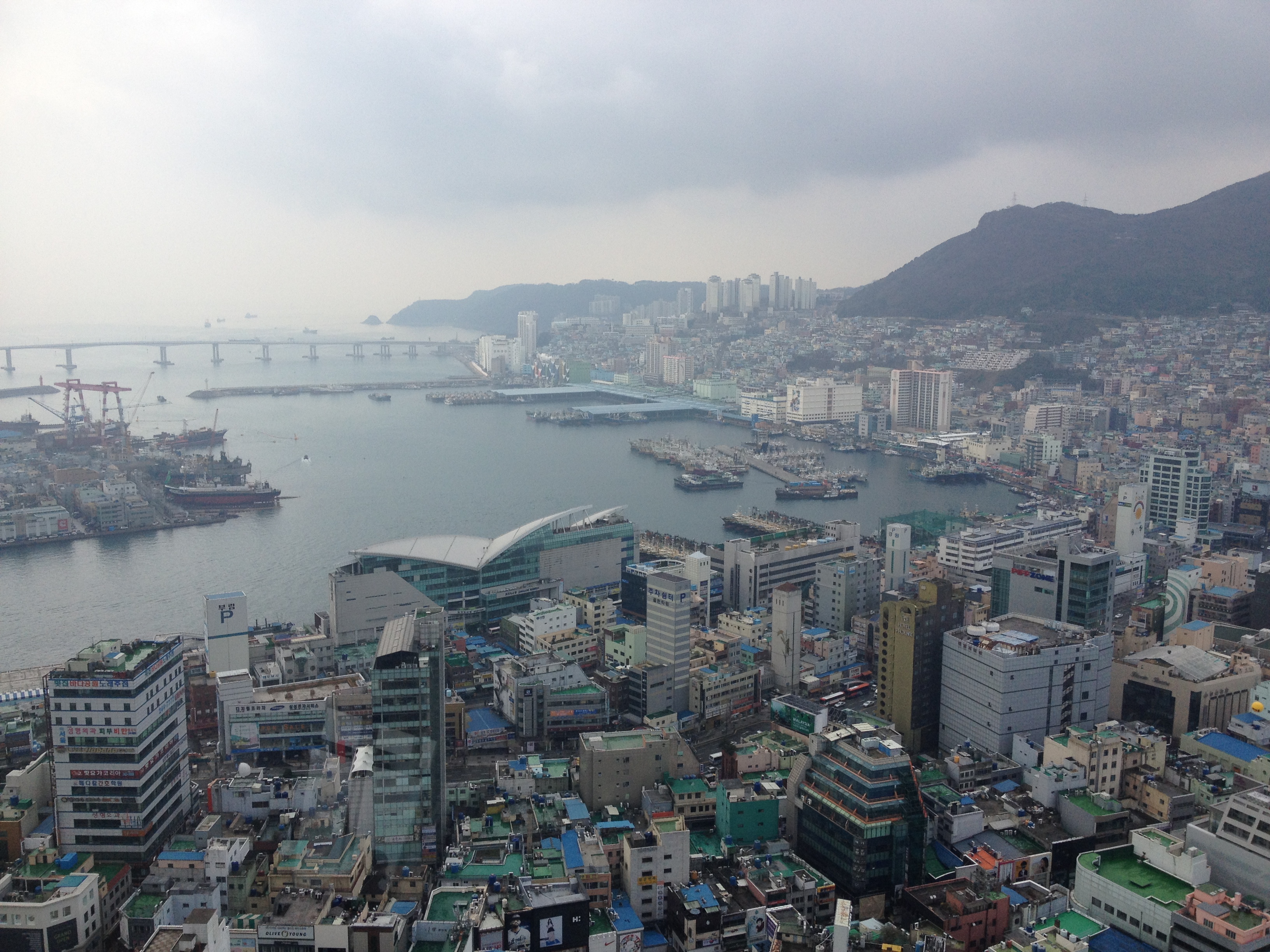
And from there, we came home. All in all, an astonishing, wonderful, mysterious, and exciting vacation. You should go.
Vacation Wrap-Up: Japan.
Oh my goodness. What an incredible trip. The first and best thing was that my new relationship flourished throughout. BB is an excellent and intrepid traveler. It took her about 48 hours to learn everything I’ve ever known about traveling and by day three she was taking charge of subway navigation and map-reading. It was impressive and excellent. Especially because while I can always get those things done, I’m never fond of them.
We landed in Japan, at Tokyo Narita Airport, on the evening of March 9th. The airport is a million miles from Tokyo. We took the Skyliner in, which is a fast-rail, and then navigated the Subway until we found our hotel in the Ginza district. Ginza (hard “G”), is the glittery shopping district of Tokyo. Central, shiny. But our hotel was not too expensive and very comfortable. Small room, but perfectly good. We found that to be true everywhere we went. The rooms were smaller than Americans are used to, but perfectly acceptable.
We spent two days in Tokyo, and saw a couple of truly amazing sights. Especially the Shinto shrine Meiji-Jingu, and the Palace grounds.


After Tokyo, we took the Shinkansen (Bullet Train) to Kyoto, from which Mt. Fuji towered over the lowlands. The amazing thing was how little of the trip was farmland or countryside. For the most part, the trip from Tokyo to Kyoto, about 3 hours on a train that went 200 mph, was solid city.

The first plum blossoms were just starting to bud. I bet right now, all of Kyoto is on fire with pink and vermillion. We missed the great flowers, but we also missed the crowds. We had most of the places we went to ourselves, which is one reason I love to travel off-peak season. It was cold, and occasionally wet. My favorite sights in Kyoto were the Golden Pavilion and the Bamboo Groves.
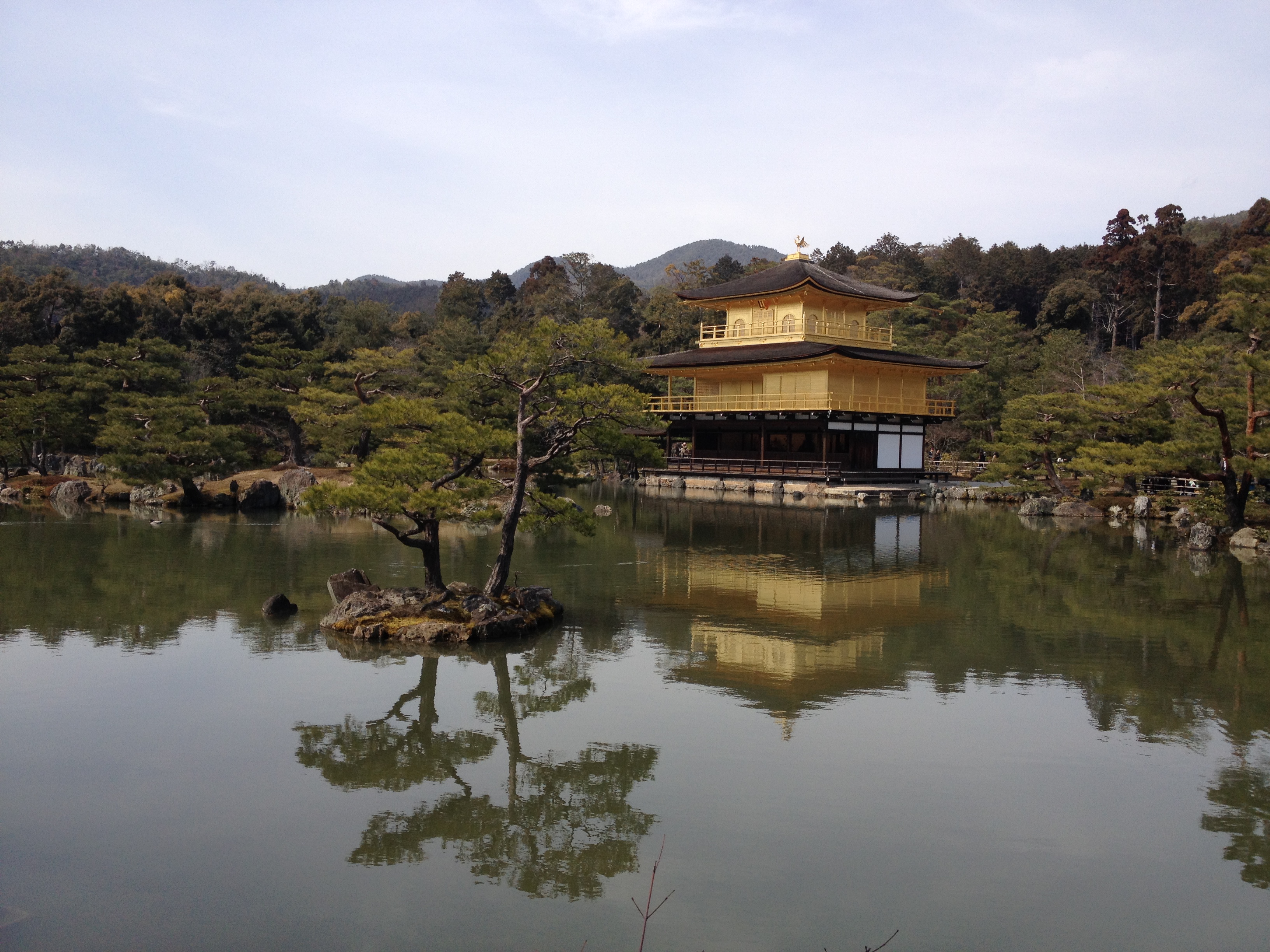

But we had no problem finding places to stay, and we got to see things like this 150 meter five-tiered pagoda, in Nara, alone.

Nara, a small city near Kyoto, is the original capital of Japan, before Kyoto, which was before Tokyo. It has some of the most amazing Buddhist temples I’ve ever seen. Including this one, Todai-ji.

I can’t begin to describe the sheer size of this. The Buddha inside is five stories high. The day we visited Nara was grey and rainy, but the scenery was astonishing regardless.

In Nara, we also saw the “Ceaseless Ritual“. A fire-ceremony that has been going on, uninterrupted, for two weeks every year in March, since 752. I didn’t get pictures, because it was pouring freezing rain, but you can find them easily by clicking the link, or doing an image search for “Omizutori“.
Next we went to Osaka, where we saw the aquarium! It’s one of the world’s great aquaria, and I’ve seen a few, including Seattle, Georgia, and Sydney. Osaka ranks well among those stellar institutions.

In addition to the penguins, there was a tank that was about five stories high with a whale shark and hammerheads and gigantic rays in it, with gorgeous soothing music playing.
And that, dear friends, was Japan. In Tokyo, in Rippongo, we even ate at the restaurant that inspired the big fight scene in Kill Bill, which was at least three steps past awesome. And I almost certainly didn’t eat the critically endangered bluefin tuna sashimi. Almost certainly.
After Japan, we hopped on a plane and flew to Incheon International Airport in South Korea. For an entirely different experience. Which I’ll describe tomorrow.
Heading Home.
This has been an amazing trip. We’ve had a stellar time and describing it will be a task for another day. We are now on a KTX leaving Busan headed for Seoul. Thence to SFO and then to ECC. We’ll be home in like 28 hours. Then sleep for a month. And back to work and life.
Heading on from Japan
Well, Biochem Belle and I are back at the Tokyo airport heading on to Seoul. Japan was amazing. So many incredible things to describe. Right now typing on a phone is too arduous. So I’ll just say that this has been amazing so far and I am excited for Korea!!
Breadth of Potential.
The past three months have been really florid for me professionally. I’ve had three papers come out, and given about 4 talks to audiences of varying size and background. The professor at VFU who oversaw the funding of my grant and I had a conversation about me possibly teaching a class there in the department of health management. Which would allow me to put another “Adjunct Professor” title on my CV. My current adjunct position at ILU is being extended, and my collaborator there is trying to get funding for further development and academic ventures (i.e., my salary).
Tomorrow, I’m meeting with a local research director of the hospital, also associated with VFU, which is part of the same chain of hospitals as my former institution. I wrote an R01eq a few cycles ago that got very well reviewed – but just missed funding – and is still eligible for resubmission. This is the R01eq I wrote for 3 years and about $500,000, for which many told me I was totally insane. But I was specifically told in the summary statement that the budget and timeline were strong factors in my favor. My philosophy being that cheap, innovative science might get a little bit of a boost.
However, MECMC’s mission and the research department I’m meeting with tomorrow are not entirely compatible. I’m reasonably certain that MECMC is not up for selling my time. I could go to 125%, but I’m not sure I want to. Especially if I’m sort of already at 125% because of my gig at ILU. Mostly, I want to impress upon the local other hospital that I can be of use to them. It’s a plan B situation.
But I have a lot of possibilities. And I feel like I’m doing well where I am. I keep getting talked about at the highest levels of MECMC’s administration. In good ways. I’m hopeful of many things flourishing. I’m putting in an R18 here in the spring. I’m looking to meet with the other affiliated hospital at VFU, in order to see if some of my ideas for emergency department analysis would be of value there.
And it looks like a serendipitous tweet exchange will result in a small project and publication! Which is super exciting! I love working in the world of ideas that impact lives. It’s exciting. I think I’m at least reasonably good at it. But right now, I’m deeply ready for a major vacation.
Travel!
Infactorium is about to go on a reasonably long hiatus, probably. On March 8th, at 6am, @biochembelle and I will be winging our way from the East Coast of the USA to fair Japan. We have made essentially no plans. Booked the first night’s hotel in Tokyo. Bought the Lonely Planet. After 7 days in Japan, we fly to South Korea for 6 more days. So from late next week until somewhere around the end of March, expect light-to-no blogging. As usual, if you email me your address I will likely send you a postcard. Don’t assume I have your address. I had a phone apocalypse and lost everything.
The Third Clause of Step Twelve.
In the program of Alcoholics Anonymous, steps ten, eleven, and twelve are often called the “maintenance steps”. They encompass all of the previous nine, essentially. Step twelve is often invoked when we talk about working with other alcoholics. When we’re talking to active drinkers, and describing the program to them, or to newcomers, we say we’re doing “twelfth step work”. But the twelfth step actually has three clauses. In its entirety:
“Having had a spiritual awakening as the result of these steps, we tried to carry the message to other alcoholics, and practice these principles in all our affairs.”
I know that many people think that the spiritual nature of AA means that it’s not welcoming to atheists. And while I obviously can’t speak for every meeting, I have never heard anyone say they were uncomfortable in the rooms because they were an atheist. I’ve heard many, many people discuss their atheism in the rooms with no dissent. I use spiritual language sometimes, but I don’t pray. I don’t identify as atheist. But I don’t identify as anything. I generally reject labels for myself, and I generally accept whatever label anyone chooses for themselves.
The second clause is that we try to make sobriety available to anyone and everyone who needs it. Anyone with a desire to stop drinking is welcome at AA. Of course, my own opinion is that not everyone who has a desire to stop drinking necessarily needs AA. When people say “AA doesn’t work for [Some Person or Group]!”, I tend to think they’re right. Because AA doesn’t make people sober. AA provides a framework that, if engaged with willingly, allows us to address the facts of and reasons for our drinking. And a program for living life freely and happily, in whatever circumstances we find ourselves.
Which brings me to the third clause: we practice these principles in all our affairs. The principles of sobriety. I am not likely to relapse because I really want to get drunk. Because, frankly, I don’t want to get drunk. I’m over being drunk. I am not likely to relapse because I want to try a particular type of alcohol. It’s not worth it to me. If I’m going to relapse, it will be most likely, I think, over something like what happened Saturday afternoon.
Saturday afternoon, I got a piece of mail. It was addressed in my handwriting. But my address was the return address. It was my property tax bill, which I had mailed to my mortgage company to pay. To the address they gave me. It was returned-to-sender, unopened. I’m furious about it. I hate paperwork and administrative processes. I am utterly bad at them. The first thought that popped into my head was, “Fuck them, with a bottle of vodka, straight down my throat.”
I know that that won’t make a lot of sense to the non-drinkers in my audience. But we alcoholics, I’m guessing, are pretty much all on a similar wavelength here. I couldn’t fix the problem until Monday. Which meant I had like 36 hours to fret and rage and stomp uselessly. I stormed about ECC and tweeted relentlessly about alcohol and my process in dealing with triggers. I ate really hot Thai food and sweated it all out.
At some point, it occurred to me that the reason that drinking occurs to me in those moments is the anesthesia, and temporal distortion. Getting drunk would numb me, and get me to Monday faster so I could deal with it. At least, that’s what my diseased brain would like me to believe in those moments. It’s a trick. A trap I set for myself to derail everything I’ve accomplished and all the things I’ve achieved and the sobriety I rely on to do it. I have a disease that wants me miserable and then dead. I am powerless over it. Because I know that, I can shrug its weight.
But if I practice the principles of recovery in all my affairs, it becomes much easier. I cannot solve this problem until Monday. I know that come Monday, if I’m sober, I will be able to solve it. I’m powerless until then. Do the things I can do when I can do them. Let go of the rest. And Monday came, and I fixed it when I could, by relying on people who know more than I do.
Then, Monday evening, I noticed that my master bathroom is leaking into my spare bedroom. That’s not ok. I have a plumber coming out today. There’s nothing I can do about the facts. All my stomping and frustration and anger won’t solve it, and just makes my chest contract. My old solution – drink and ignore – won’t fix it either. I have a problem and I know how to fix it. It’s a hassle. But that’s all. I don’t want to spend money on a plumber, but if I have to, I have to. Let go.
I don’t stay sober because I fight my drinking. I have stayed sober because I relentlessly pursue serenity, through a program of action and accountability. Resentment, frustration, control; these are the triggers for my relapse. Surrender, meditation, release; these are the antidotes. Pause and think. Rest and consider. Give up and move on. Do what I can with what I have to make my life better today. And go to bed sober.
When Can an Alcoholic Take Prescription Drugs?
OK. I need to start this off with a great big disclaimer. I am not a physician. Being an alcoholic in recovery does not give me special insight into the medicine of addiction. AA’s literature is very clear on this point. It says, “We are not doctors.” It says that in the context of saying that alcoholics should be honest with and listen to physicians. Opinions from members of AA about medicine are not to supersede the medical opinion of an informed physician. This is my opinion based on my experience. Your experience may vary.
The reverberations of Phillip Seymour Hoffman’s death continue to sound in many places. I wrote then that “Physicians keep prescribing opiates to addicts. And it keeps killing us.” Hoffman died in some part (as I understand it) because he was legally – and presumably appropriately – prescribed opiates for pain. This led to abuse of the prescription drugs. Which led to heroin. Which led to death.
I’m not anti-opiates as a medication. As I understand it (poorly) they are a godsend for people who have intense acute pain. I have heard there are serious concerns about prescription opiates being used chronically, and my experience jibes with that. As an alcoholic, I could never, ever take opiates for long-term pain management. I have absolutely no doubt that that would kill me. Similarly, I can not take benzodiazepines. I love them. They’re awesome. They’ll kill me.
But if I were to have major surgery? I’m almost certain to need major surgery at some point in my life. Most of us do and I have a (very) minor heart condition that is likely to require surgical correction at some point in my life. If I have to get my chest cracked, chances are I’ll need opiate drugs to manage the pain acutely after surgery. I’ve had codeine before, as a kid when I had my wisdom teeth removed. I’m pretty sure I’d love to take a fistful of codeine and see where it can take me.
So, how do we manage this? What does it mean to be “clean” and “sober” if we take prescription opiates or narcotics or benzoes? My opinion, which is the one that I have taken from hearing it espoused in AA meetings, and at my rehab, is fairly, I hope, straightforward. I can still consider myself “sober” while taking opiates, narcotics, or benzoes if all of the following are true:
1. The medication is legally and appropriately prescribed by a physician.
2. The physician knows that I am an alcoholic in recovery.
3. I take the medication precisely according to the physician’s instructions.
4. I stop taking the medication as soon as is possible. i.e., as soon as I can endure the pain without anesthesia.
5. I never take the medication with the intent of experiencing mind-altering effects.
Additionally, the following is incredibly highly recommended, but may not be possible in all circumstances (such as acute injury)
6. The physician has experience treating patients with addictions.
Now, obviously, if I am in an accident and an emergency medical technician doses me with morphine at the scene, that’s not a breach of sobriety. Breaches of sobriety require intent. But opiates, narcotics, and benzoes cannot be prescribed to us “PRN”. There needs to be a schedule. It needs to be followed.
My intention for myself is that I will never take any of those medicines as an outpatient. If my pain is severe enough to need opiates, then I need to be an inpatient, under the care of a hospitalist. But the time I’m ready for discharge, I’ll need to be able to take alternative pain medicine. I will suffer pain rather than take any opiate or narcotic. I will suffer anxiety rather than take any benzo. I simply don’t have the option to take these drugs outside of an inpatient environment. They will kill me. I had a root canal with nothing but lidocaine and ibuprofen. I was fine.
I have seen many alcoholics die after being legally and appropriately prescribed pain medications. Even alcoholics with no prior history of abusing anything but alcohol. I have little doubt that I might well number among them if a physician gave me a 30-day supply of hydrocodone with three refills.
Engaging with medical care is always a dicey proposition. As addicts, it is a matter of life or death. We are, almost uniformly, tempted by the “free high” of appropriately prescribed opiates. Because we are addicts and alcoholics. We are tempted by death. I have never found a way to describe just how enticing an alcoholic death can be. But every alcoholic I know understands it.
Case Studies and Evidence.
OK. I’m going to stipulate up front that many of my readers know far, far more about this than I do. My educational background is in engineering, not medicine or epidemiology. I have, however, worked in direct collaboration with professional epidemiologists for many years, and with physicians for two decades, and I’ve taken a short course in epidemiology from the University of Michigan summer sessions. I say this not to argue from authority, but merely to say that I’m not talking entirely out of my ass. I have a minimal background. I do not claim to be an expert.
The course I took at UMich was “reading the medical literature”. Basically, it was a course for med students, residents, and other non-epidemiologists who work in medicine or medical research and need to be able to read and interpret medical papers. Can we critique papers for the quality of their evidence? What are the gold standards? How can we tell if a paper really supports its claims? What makes good a good basis for treatment?
I’m not going to rehash all of that today, but a couple of comments on yesterday’s post got me interested in reviewing the quality of evidence from case studies. Case studies are, by their very natures, anecdotes. There’s a big group of people out there who sort of rally around the cry, “the plural of anecdote is not evidence.” Well, certainly not always, but there is more to evidence than simply the peer-reviewed result of a double-blinded randomized controlled trial too. Evidence comes in many forms. I just learned, 20 minutes ago, of an aphorism (Thanks @amfeinman!) in statistics: “If you have a talking pig, you only need one.”
It is certainly true that the double-blinded randomized controlled trial is the gold standard of medical evidence. But there are other types of studies, like case control studies, which can provide crucial and important evidence. Like, you know, that smoking causes lung cancer [1]. But what kind of evidence do case studies provide?
In my course at UMich, the lecturer (a rather famous Canadian physician and epidemiologist) was adamant: Case Studies are not Evidence. His point was that you can’t generalize from case studies to general practice, and insofar as I’m qualified to argue the point, I agree. A case study is a single event. The information it provides is: “This thing has happened, and therefore can happen.” It does not provide any information about prevalence.
In logic, taking information from a single event and applying it generally is called “specious generalization”. Essentially, it means mixing up an “existence” statement and a “for all” statement. If we have successfully demonstrated that a particular element of a set has a property, it is a specious generalization to say that therefore all elements of the set have that property. While this seems obvious in plain language, it can be subtle in propositional calculus.
In disciplines that aren’t as rigorous – by necessity – as logic is, specious generalization may be required. After all, it is very difficult to prove that anything will be true in medicine for all people. We have to generalize and make assumptions, and apply specific knowledge generally. Also from my UMich course, the instructor said: “The only population that any study applies to for certain is the original study population.” And frankly, even then it may not be so certain. Confounders abound.
So case studies aren’t really evidence, unless they provide a counter example. If we believe that something is always true, and we have a case study where it isn’t, we have evidence that disproves our hypothesis. But that’s rarely the case in medicine. Case studies can also provide important safeguards. A case study of a complication may prove valuable in demonstrating that a technique is flawed, in surgery or anesthesia, for example.
If there are enough case studies that all say the same thing, then yes, they do become evidence of a sort. But generally, they become evidence that an event is worth research. Not necessarily evidence that we should immediately change practice or care delivery. So, those who claim that anything not properly randomized and controlled is nothing but useless anecdote are wrong. Anecdotes are not useless. Evidence comes in many flavors.
So, my take? Case studies are information. Information is valuable. Information can become evidence with further research. And dismissing case studies because they’re anecdotal is foolish.
***************
[1] Doll R, Hill AB, Smoking and Carcinoma of the Lung. Br Med J. 1950 September 30; 2(4682): 739–748.
Vanity Academics.
I have absolutely no reason to participate in academics. I am not faculty. My job doesn’t require it. In fact, my job is full-time with no academic pursuits whatsoever. Anything I choose to do with regard to publishing, grant writing, mentoring, etc., I do in addition to my regular duties. I don’t have to produce my salary (at least, not with grants), and I don’t have the kind of freedom that being a “real” PI with grant money has. Even if I’m flush with external dollars and paying my own way, I still need permission to attend conferences and whatnot.
No one really reads the papers I write. At least, I don’t think. A paper I published in 2010 on simulation now has a total of three citations, and one of them is me. Another published in 2012 has 5, and I think 3 of them are me. Other simulation work gets cited. Mine is just, well, unimportant. Apparently. It’s not particularly insightful or generalizable. It’s just work. Here’s a thing I did. Essentially case studies. Case studies aren’t evidence.
I can make a difference just doing my work in my hospital. Why am I taking up space in journals? Why am I writing grants and competing with real academics for finite funding resources?
Vanity. I want to be important. I want to be special. I want my friends on twitter to think I’m one of them: an academic producing valuable insights into the world and pushing back the frontiers of ignorance. But I’m not. I’m just a quality improvement engineer who models health care and tries to make his hospital go a little better. I can do that without wasting everybody’s time writing unread reports in minor periodicals. Without siphoning off much-needed grant money from people for whom it represents their livelihood.
I have vague ambitions that I will one day have a real academic post, or that my position here will turn into one. To do that, I’ll need to demonstrate academic credibility. But I don’t actually need any of that. I’m effective and comfortable where I am. I’ve written before that if I have this job for the remainder of my career, I’ll be happy with it.
I just don’t want to leave this world with no written record of my existence in it. I want to have a bibliography that says I was here. I did something useful, for a while. I wasn’t just a drunk who wasted space and time and talent and potential. I was here. That’s my vanity. I want people to know I was here.


