When to Walk Away.
I’m doing it wrong. AA is a place full of catchphrases and mantras, aphorisms. One of our basic sayings is: “We have ceased fighting anyone and anything.” Because when alcoholics battle, alcoholics die. We cannot win the fight against alcohol, or against alcoholism. I was born an alcoholic. I drank like an alcoholic. I will die an alcoholic. I am no less addicted to alcohol than I was on February 16th, 2008. I lost the battle, and I gave up fighting. That’s why I’m free.
I think my last post was deeply emblematic of how I’m doing it wrong. I stand by the core content of it. I think people online are too quick to judge. I think there’s too much vitriol. I think it’s both ineffective and unbecoming. But you know what? It’s none of my business.
I’ve been getting involved in way too many arguments that aren’t my business. I’ve been focusing on problems and issues that only make me unhappy. I have no hope of influencing the timbre of the online debate. Not even in my own tiny little corner of the internet. And it is neither my role nor my responsibility to do so. The only effect I can achieve by wading into that water is to rail against a throng until I am hoarse and miserable. I cannot change the course of the crowd. I can only choose to be a member of it, or to step out to the margin.
I’ve written so many times here about the wonderful community on twitter. And there is a wonderful community there. And I’ve lost my footing in it somehow. I don’t feel like I’m participating the way I used to. I’m arguing more. I’ve been violating my own principles of being measured and circumspect before talking. As a result, I think I’m connecting less with people. Yesterday’s post is a great example of me doing exactly what I was complaining about in others: telling other people how to behave.
I’m realizing that I don’t know how to state an opinion without trampling on someone. Or at least, without someone feeling trampled. I don’t know how to assert my own beliefs and desires without feeling like I’ve crossed someone else’s boundaries. And I hate that feeling. I hate feeling like I am in eternal, irreconcilable conflict with others. But humans always conflict. There’s no way around it.
And so, as I attempt to participate more, I feel like I’m contributing less. I feel like I’ve been a negative in the community that I care so deeply about, and that has given so much to me. So I’m going to take a step back for a while. I need to readdress the rigor with which I adhere to my guidelines for myself, which have led me to peace. I’m not leaving forever. It may not been all that long. But for the moment, I need to walk away. Infactorium will proceed as usual.
Tone, Respect, and Giving Offense.
AA does not promote itself. There are no advertisements, etc.. We just go live our lives, and the word gets around that AA works. Because we also, generally, don’t hide our involvement. Many, many people in my personal life knew I was a problem drinker. Now, everyone knows that I am not a drinker. People who never saw me turn down a drink now see me sober and sane and productive. Or, they simply don’t see me at all, because drinking was the only reason I interacted with them. When people ask me how I went from being a drunk to not being a drunk, I tell them.
And you know what? Every single time, they have a supportive comment, and almost as frequently they tell a story about another drunk in their lives. Sometimes, that other drunk is them. And so I talk about my experience in AA. I talk about what I saw, and what I did, and how I felt. I don’t tell them what they have to do, or what they will experience. I don’t proselytize. I don’t go out and try to lasso drunks, and drag them into the rooms of AA. But sometimes, people hear something they need to hear, and connect to something they need to connect with, and they decide to explore AA for themselves.
The result of this is that now, some 80 years after Bill Wilson sat down with Bob Smith (Are there two more anonymous sounding names?) and had what is generally considered the first AA meeting, there have been millions of lives saved, and many millions more impacted because a drunk in their lives became a sober person. Through a quiet process of word-of-mouth, and the plain-to-see results of people reclaiming lost lives and returning to productivity and societal participation, AA has become known worldwide as a place to go to recover from alcoholism, and has spawned devotee organizations for all manner of addictions and even other problems. Recovery has become something within the grasp of anyone.
I’m writing about this today because I feel it’s relevant to a couple of discussions I’ve been having off and on about political debate, and religious debate. The one thing I’m not particularly fond of about the online community as a generalization is how strident it is. How quick to offense and how immediate irrevocable judgements are made. Sometimes those judgements end up correct. Sometimes they don’t. But real people end up caught in them no matter what.
I’ve written a lot about the tenor of what passes for debate. Often, when I do, people immediately dismiss it as simply being what is called a “tone troll”. That is, someone who derails a debate because they don’t like the harsh tactics of their opponent. And that is a real tactic that is used to disrupt debate. Just like shouting down an opponent with obscenities is a real tactic. Neither is effective at moving people. Neither is effective at introducing controversial topics and actually trying to move minds.
However, I wonder what the whole point of online debate is? Are we trying to convince people? Do we want to change people’s minds and behaviors? If so, then I don’t understand the tactic of mockery and viciousness. I’ve never seen someone change their mind because they were effectively derided and mocked. In fact, I’ve rarely seen anyone change their mind by being told what they must do, and how they must think, no matter how politely it’s put.
So, while I find the viciousness and cynicism unpleasant, I don’t think that my point is really about tone at all. Though I am far less likely to engage in a conversation with a person who is intemperate, politely phrased exhortations that other people change their behavior are not particularly effective either, in my opinion. I’ve never seen a drunk give up their drinking because they were told they drink too much. No matter how rudely or kindly it was said.
What I believe changes hearts is the connection to others. And yes, I think tone has something to do with that, with our ability to connect, but it doesn’t guarantee it. What does is finding common experience. Common emotional ground. Tell me about your experience. Tell me how your life changed, or would change, when a policy or cultural norm shifted, or should shift. Let me put the pieces together for myself.
When I go to talk to an active drunk, I tell him or her how I drank. I tell them about my experience, my strength, my hope. I tell them how my life changed. What I did, how it works for me. And I’ve seen, first hand, many times, the connection that that person made inside themselves with the things I was saying about myself. And I think that the reason we can make that connection is, yes, shared experience, but at a deeper level it is about the respect I have for that person’s autonomy and capacity to understand.
So, it’s not about tone. It’s about respect for persons. My opponent in a debate is not less human than I am for having a different opinion. And sometimes, giving offence is a crucial tool in a debate. Sometimes, I have to offend someone because I respect them. Because it is the only way to remain engaged with them. Offence is powerful when it is used to strengthen connections, rather than derail them. But the only way I see it used these days is to stifle discussion and round up supporters who need no convincing.
Why do we write what we write, when we perceive injustices? So much of what I read isn’t aimed, it seems, at correcting injustice. It’s just designed to satisfy the primal urge to howl at the wrong. To collect a pack of dogs to howl louder. But when I accept that someone who disagrees with me, or who simply is cautious in accepting my position, is not less noble, not less intelligent, not less human, than I am, and when they do the same, then, I believe, there exists the opportunity for meaningful interactions.
When you tell me your story, I find, more often than not, that the same thread binds the seams of my life.
Ahh. I am just back from a long weekend in Maine with my new girlfriend. It was wonderful. We stayed in Wiscasset, in the Snow Squall Inn, and in Bethel, in the Bethel Hill Bed and Breakfast. Both were lovely, but the former was really special. Incredible food, comfortable room, helpful, friendly staff. We took a boat ride on a harbor and saw some seals, and a drive through the White Mountains. In Bethel we happened upon a little piano festival for gifted international students, held at Gould Academy. We watched a bunch of adorable kids play incredible music. It was a lovely trip. Though I will say that I hate everyone with a car in New England. Seriously.
New relationships are exciting and wonderful. This one feels incredibly special. We’ve been together for only a few months, and because she lives in a different city, we only get to see each other every other weekend or so. But for all of that standing in the way, it feels natural and comfortable and right. I swore to myself I wouldn’t get into another long-distance relationship. But my heart hasn’t given me a choice here.
At work, things are going well. I’ve finished the first draft of a manuscript and will be planning on submitting it soon. I have another manuscript out for review. This one is such a pain in the ass. It’s been through the ringer already, and it just got a desk-reject from a big-name journal with an 80% reject rate. So I’ve resubmitted it to a big-name journal with an 80% reject rate. It’s so difficult finding the right place for my work sometimes. Some pieces find a good home right away. Or at least they have a good subset of obviously appropriate journals. This paper is a wildling. Not sure what to do with it, really. But I know that it will eventually get out there. I’m not really in a hurry anymore.
I know I haven’t been blogging as much lately. I’m not entirely sure what that’s about except that I’m really busy, and frankly happy, and generally content. Blogging is a great way to exorcise ill feelings. But I’m not feeling ill. I’m feeling wonderful. And so I’m just not as prolific here. And that’s as may be. I’m comfortable with where I am. Though I do have a few thoughts that are percolating. And thus, hopefully, I’ll have a few sobriety posts eventually.
Why are you Reading This?
Most of my blog traffic comes from twitter, where I mostly engage with scientists and academics of various stripes. Many of them are bloggers too. I read lots of their blogs. Sometimes I comment on them. Sometimes they comment here. In general, I don’t get so many comments on my blog. But I know it’s not that people aren’t reading. I get a reasonable amount of feedback over on twitter about posts that people appreciate.
It’s a little puzzling to me that some of my least-read posts are the science ones. But, truth be told, I’m not a very good scientist. And my posts about science don’t begin to approach the rigor of, say, Scicurious. And also because I somehow fell primarily into a crowd of biology-oriented folks who quite reasonably have no real reason to be interested in healthcare delivery engineering. And healthcare delivery engineering is a small enough field that there isn’t a huge community of us.
When I write about alcoholism, I get a few more readers. And the previous post to this one, about abortion, was the most-read post I’ve ever written. Meta-science will occasionally draw readers – grantsmanship, paper-writing, why not to get a PhD – but for the most part, I don’t really know what people want to read or why. I know that writing about alcoholism has led to a number of people contacting me for help. People who have become very important to me.
Last night I had dinner with @girlscientist. She was visiting ECC and we decided to go grab a quick dinner in a brief open moment in her very busy schedule. We talked a little bit about this blog, and she asked me what I get out of it. And you know what? I’m not sure. I told her: “I think it’s less about what I get out of it, and more about what I put into it.” So she said: “So it’s more like and online diary.” It wasn’t a question. And she’s right.
Why am I writing my diary out loud on the internet? I don’t want to be alone. I’ve spent most of my life lonely. In recent years, I’ve learned how to be less lonely even when I’m solitary. I’ve learned how to bring myself to a relationship, rather than expecting another person to change how I feel.
I am now a man in the middle of his life. I am still youthful, but I am not young. It took me longer than most people to figure out how to cut through the reflections and echos. How to see people as themselves and not as imagos and caricatures, contorted into shapes I assign for them. I’ve never been great at empathy. I remain unclear about what the world wants from me. I remain unsure about what I want from the world. Though I don’t necessarily envy those who are clear, who are sure.
What is this space for? Am I just howling into the digital dark? And, if I am, does it serve me? Why are you reading this? Why am I writing it? I’m not sure what we’re doing here.
My Abortion Story.
I begin writing this post uncertain I’ll publish it. No. I will. But I hold on to the uncertainty. I need it right now. I need to not know if anyone else will read this so that I can keep writing it. Yesterday, a woman running for the senate in Texas spent many hours filibustering a bill limiting reproductive rights. I don’t know, really, what it was all about because I didn’t watch. I know that my twitter stream was vibrating with support for her, and with righteous anger. People were being entreated to “send her [their] abortion stories”. Stories of how abortions had saved lives and families, and spared pain and agony. There are millions of such stories. And I support the right to safe, legal, and reasonably (i.e., minimally but not un-) regulated termination of pregnancy.
But my abortion story does not fit that narrative.
When I was about a year-and-a-half sober, my life was going well. I’d been employed for more than a year. I was already being promoted to Principal Investigator. The turbulence from my drinking days had subsided. My then-wife and I were getting along very well. My stepson was doing well in school. I thought that my life was finally settling into a groove that would last for the rest of it. I was happy. My wife and I talked about having a baby.
We more than talked about having a baby. We deliberated it. At first, I wasn’t sure. She told me that she thought I’d be a wonderful father. I said I thought we’d have a beautiful and brilliant baby. I was nervous. I knew she wanted a career, but she also believed in staying home while babies were small, for a couple of years, at least. She’d worked hard to get her master’s degree, and was just starting to look for jobs. Her own child was twelve. There’d be a large age difference.
I don’t know precisely when the decision was made. I know that we agreed that we wanted a child. And I remember vividly, one night, on the sofa, when she told me: “I stopped taking my birth control.” I remember being flushed with excitement and slightly terrified.
It took about three months. But it wasn’t like I imagined it would be when she told me she was pregnant. She was distant for days. Then, one day, she was crying. She told me she was pregnant. Then she told me that I had a choice. We could have an abortion, or she would divorce me, and take the child away to the city her parents lived in, and raise it alone. This was a lot of information to get in three minutes. She just said over and over again: “I can’t raise a child with you.”
You know what though? I don’t blame her for anything. I can’t imagine what was in her mind that brought her to that decision. That convinced her that laying out that ultimatum for me was the best thing for her to do. Whatever I went through, I’m sure what she went through was worse.
I wanted to save my marriage. I wanted to save this life I suddenly had. A family, a career, a home. The things I’d been in a continuous battle to save since they started. The prospective loss of my family had been the catalyst to my sobriety. I would do anything I could to preserve it. Even if it meant shredding my own heart. And so I sat down on the floor with her and looked her in the eyes and I said: “You’re right. We can’t have this baby.”
We rationalized it in several ways. She was still taking an anti-depressant. That probably wasn’t good for a fetus, right? All the glib things I’ve said and written about not having children I said earnestly then. And then I drove her to Planned Parenthood, and held her hand, and talked to the counselors. And then a few days later we returned, and I sat in the waiting room while she had the procedure. The counselors told me that it wasn’t set up for me to go back with her. But the real reason was that they were ensuring she wasn’t being coerced into the abortion. It’s an appropriate precaution.
I brought her home and she convalesced for a few days. We cried a lot. I talked to my sponsor about it, before and after. He told me the stories of his abortions. That was the beginning of the end of my marriage. For me. I think for her it began before that. But I lost my will to fight to be with someone who didn’t want to be part of a family with me.
I don’t blame her. I made my decisions, and I had different ones I could have made. Maybe she wouldn’t have followed through, if we’d decided to keep the baby. Maybe she’d have stayed and we’d have raised the child and been happy. But I doubt it. What it comes down to is, I made the decision to have an abortion of convenience in order to not have a child being raised far away by a person I feared was emotionally unstable. And that was the choice I made.
So I support reproductive freedoms. I am glad that the government didn’t make those choices for me. But I can’t celebrate them. I don’t see abortion as a casual freedom. Not when, in the long fabric of my life, there’s a poorly-sewn gash where a child might be.
“AA Should…” is Always Wrong.
I just read a horrifying and tragic story on ProPublica about a young woman murdered by a violent felon who was court-ordered to AA. Whenever anything like this happens, I am saddened and shaken. I love AA, and it is in general a wonderful, supportive, inclusive, and welcoming place. A place where people who ‘normally would not mix’ are friends and associates, working together to recover from alcoholism. It is a place where camaraderie and friendship and caring and mutual dedication are the rule, not the exception.
But make no mistake: there are dangerous people in AA. I know murderers, rapists, child abusers, and thieves. The people I know who have done these things have also served their time, recovered from addiction, made what amends are possible, and changed their lives. They’ve dedicated themselves to spiritual progress, sobriety, and accountability. And I don’t judge them. Because yes, many of us have done unforgivable things. But forgiveness is neither my power nor my responsibility. I have done things that some people may find unforgivable. But in AA there is a home for me. As there is for anyone who has a desire to stop drinking.
As a member of AA, I welcome any person, anyone, through the door. Nothing anyone has done excludes them from membership, as long as they want to quit drinking. And even those with no desire to stop drinking are welcome at open meetings. We shut the door on no one.
But as a citizen of the United States of America, I oppose court-ordering of offenders to AA. I have seen people recover that way. And that’s fine. But AA is not a medical organization. It is not a halfway house. We don’t run centers or clinics. We have no training or structure. We have no security. Except for a few administrative workers in the business of printing the meeting books, we don’t have any employees at all. Some people object to the courts ordering people to AA because AA has a spiritual component. And that’s a reasonable first amendment objection. But for me, I do not believe that AA is equipped to handle court-ordered members, and I do not believe we should recognize the authority of a court to order attendance.
Whenever I hear about these stories, I hear attendant statements that “AA should warn people!”, “AA should refuse to let violent offenders join!”, “AA should…”. On whose authority? No one is in charge! There’s no “AA minister” who leads the meeting. It’s just someone who showed up that day. I’ve done it, dozens of times. No one from any AA central services ever declared me fit to run a meeting. I received no training. There is none. Nor should there be. That’s not what AA is for.
“AA should…” is always wrong. Because it’s a nonsense statement to begin with. It presupposes that there’s a body of leaders with authority and accountability. There never has been, and there never will be. I don’t have to inform anyone to start an AA meeting. I don’t have to apply for permission. No body endorses a meeting or a group. There’s no administration. If I put up a sign on a lamp-post that says “AA meeting here, 8pm” and anyone shows up, that’s an AA meeting.
I have said before, and I do again, AA is not a “safe place”. You cannot assume that the people there are good people. In fact, most of us have criminal records. Most of us have done terrible things. Most of us are reprobates in one way or another. And yes, most of us are recovering and recovered. Most of us work to be better. Most of us behave well. But not all of us.
This is why I say that women new to the program absolutely need to go to women’s meetings. There are predators in AA, and like most places, most of the predators there prey on vulnerable women. And I’ll even go so far as to say that many, many men can act out sexually in wholly inappropriate ways that are hurtful, even when it doesn’t rise to the level of predation. I’m certainly not proud of all of the sexual decisions I’ve made in my life.
It’s natural for people on the outside, you normal people, to look at AA when these things happen and say, “Why didn’t anyone do anything? AA should…”. But it can’t be done. People in the rooms have to be careful. Because there is no one with the authority to keep the wolves out. Sometimes, meetings take it upon themselves to banish known threats. And that’s appropriate. There are a few sheepdogs. But there is no framework for security. No screening process.
But these events are incredibly rare. There are millions of people in AA. Gather any group of millions, and there will be a few predators. For the most part, AA is a wonderful, welcoming place of recovery. But commonsense precautions must be made there as everywhere. There’s no sentinel at the door. And there never will be. Because as soon as someone sets themselves up with the authority to check who is entering, they have excluded themselves from the principles of Alcoholics Anonymous. Which state that all are welcome, if they wish to stop drinking.
Guest Infact: Domestic Abuse and Alcoholism.
This is a Guest Infact from a person I know, telling her story of domestic abuse related to alcoholism. It’s one of courage, but also pain and deep sadness. As with all such stories, please be aware that this includes triggers for those affected by domestic abuse. All quotes in the story are from the linked article. I am grateful for the strength and honesty it takes to share such stories. It helps to sustain my own sobriety. And I wonder just how much domestic abuse could be eliminated if substance abuse were addressed comprehensively.
A third of women worldwide abused by partners, study finds.
That’s the headline announcing a new meta-analysis in press at Science.
“Around the globe, 30 percent of all women aged 15 and older have suffered intimate partner violence…”
One in three.
“The rates of abuse vary widely by world regions… in North America, violence from an intimate partner, such as a husband or boyfriend, has impacted slightly more one in five women, report the authors.”
A jarring thought for anyone, I should hope.
“The prevalence is shockingly high,” said lead author Karen Devries.
It should shock. It should galvanize. It should provoke outcry and action. The statistics are distressing because they inform us of a substantial likelihood that we personally know someone who has been assaulted by her partner. We would like to believe it’s an impossibility. We would like to think there’s no way this could be a reality for the women in our lives.
I would that I could feign shock, but instead I am possessed with stultifying pain and sadness. I keenly feel the authenticity of these statistics, because I am among them. I am one of that third of women in the world, one of that fifth of women in North America.
I count myself a “lucky” one. I was subjected to physical abuse one time. Those few hours were horrendous and terrifying. I was afraid of what my husband might do to me, even to the point of fearing for my life. I fought back to protect myself – and to protect him (an incredible irony of the situation, perhaps – even after threatening my safety, I felt a responsibility to get him home). I was damned lucky that his coordination and response time were impaired; otherwise, I might very well have ended up with more to show from the encounter than a muddied shirt, a small bump on the head, and few scratches and bruises easily covered by clothing. It was an awful, harrowing experience, one that still periodically imposes itself firmly into my waking thoughts. But it only happened once. That one time was enough to catalyze a cascade that led to me getting out of the relationship – a marriage of nearly 10 years.
Yet the majority of people who know me, who care about me, who count me as a friend have no idea. I told very few people anything about it. Even when I did, I would soften the description and enumerate few details. I would explain that he’d gotten really drunk and upset and angry and that “it got physical”. I didn’t comment how he jerked and twisted my hair so viciously that my scalp hurt the next day. I didn’t reveal how much I equally worried and wished that a cop car would appear on the road. I didn’t explain how my entire body was shaking such that my legs could barely support me by the time he forced me to stop in a secluded spot in very early hours of the morning. For weeks, I didn’t tell a soul that I had been genuinely concerned that night that he might try to rape or kill me.
Yet for months, I wouldn’t even call it “abuse” or “assault” or “violence”. And it wasn’t that I wouldn’t simply use the words. I didn’t accept that was what had happened to me. It was just this awful “thing”, an “incident”. I wondered how things had gotten so far out of control. Over time, I began to first realize that it was an escalation of behavior I’d seen before – getting drunk and then directing his rage at me. And then I began to recognize the “incident” and the previous verbal spats as part of a subtler but more systematic pattern of behavior.
It took my therapist and a couple of good friends to peg it for what it was, to call a spade a spade. To say bluntly (though not without compassion) that I had suffered long-term emotional abuse that ultimately culminated in a physical assault. Initially I recoiled at the word – but I could not deny it. Hearing that assessment was painful, yet necessary. I had to rely on others to vocalize it. It took weeks more before I could even speak words, before I looked in the mirror and said, “I was abused.” And it hurt like hell. Honestly, it still does. Every time I refer to what I experienced as abuse or assault, there’s this pressure in my chest. My shoulders and back curve involuntarily, as though preparing to curl into a fetal position to ward off those words and all the emotion they bring. Every time I use those words, I feel a new wave of pain and sadness. But worst of all, I am faced with the powerlessness I felt in that situation.
That feeling of being powerless is a fierce force to contend with. It makes me feel weak and vulnerable. I think this is a major reason why I’ve fought so hard to keep this secret from the people I care about, from many friends in a community that’s offered nothing but support in difficult times.
This week brought those moments of having my experience thrown in my face. Of reiterating the dreadful news that I am far from alone. I feel profound sadness for those who know the agony and intense pain for my own experience and that of others – knowing that no one deserves to be treated cruelly, certainly not by someone so close to them, and yet so many are.
But I have something to carry me through those dark moments – I got out. I walked away from a toxic and dangerous relationship. I have amazing people in my life who have supported me through this process and continue to do so. I have a new home and a new life. I was a victim of intimate partner violence, but it doesn’t define who I am. I still carry deep wounds, but I’m healing. And now there’s a whole new world on the horizon.
Global vs. Local in Complex Systems.
The type of models I build fall under the very broad category of Complex Systems. I’ve talked a bit about them here, but I’ve found that I don’t get many hits when I actually write about what I do. But I thought I’d take another stab at the apple and write a tiny bit about the nature of my models, because I think it’s relevant to many types of systems modeling that you might actually be interested in, like climate science, ecology, or economics.
The difference between the kind of modeling I do and those, is they are generally very broad, large-scale, continuous-domain models. My models are smaller, restricted, and hybrid-domain. Continuous domain models are used for things where most model variables and infinitely sub-divisible. Like time, and distance, and temperature. Hybrid models are used for when certain variables can only vary discretely, like number of people, exam rooms, etc..
Climate and economic models are usually concerned with long-term, global effects. And it should be noted here that “global” does not necessarily mean “earth”. In the case of climate and economy it often does. But “global” is a technical term in engineering meaning that the effects we’re concerned with represent values ranging over the entire model, rather than a “local” portion of it. I’m not going to get in to the strict definitions of “global” and “local” using mathematics, because they get technical and boring and pedantic, if you’re not a mathematician.
To be a little less handwavy about it (but still pretty handwavy), imagine a continuous function on the real numbers. Let’s let f(x)=sin(x) + 2* cos (x+1) – 2* sin^2(x). The domain of the function is the entire real numbers (Meaning, I’m allowed to put any number I care to in for “x”.) . And when I let x vary over the real numbers, I get a strange undulating curve:
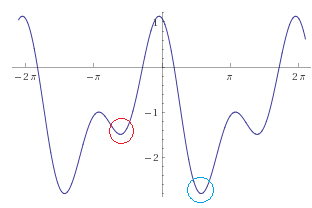 I’ve circled two areas of interest, one in red, one in blue. The red circle surrounds a local minimum. When I’m confined to a small area, this looks like it’s as low as I can get. However, the blue circle surrounds a (non-unique) global minimum. If I look at the entire global space, I will never find any place lower than this one. Now, that’s pretty easy to do with well-behaved functions like this. But when your function is “height of the tide” and your global space is “planet earth for the next 100 years”, it can be impossible to know if you’re in a local minimum or a global minimum. The space is too hard to search. A local minimum might masquerade as a global one.
But in many ways, it’s much easier to predict global effects than local ones. This is because local effects are subject to randomness in often alarming ways that global effects are not. This is why the weather is hard to predict, but we’re all pretty sure it’ll be warmer in July than February. In general, simulations are good at predicting broad global trends. They’re not as good at predicting local effects, and they’re not good at distinguishing local phenomena from global phenomena.
So, in my models, the “global” effects I’m looking to predict are things like, “How much can I reduce average inpatient boarding censuses by reorganizing the types of surgeries performed on various days of the week?” In climate science, a global effect is along the lines of, “How will monsoon weather patterns shift given a 40% reduction in summer time Arctic sea-ice?” And we’re decent at that kind of thing (Though I just made that climate question up, and have no idea if anyone is looking at such a thing, or what the answer might be.). In my world, a “local” effect would be, “How crowded is the emergency department going to be on Tuesday, August 3rd?” In climate, it might be, “What will the rain gauge look like in Florida in July of 2015?” We can’t answer these kind of questions, and we will never be able to. They’re too dependent on too many factors that are influenced by randomness.
It is really tempting to try to predict local phenomena. That’s what the media wants. That’s what politicians want. People ask if tornadoes are the result of global warming. Or if a particular bond issue led to revitalization in a midwestern city. But we can never truly know those things. It’s easy to look at situations in hindsight and see causes and effects. But for local phenomena, small-scale events in a large system, the truth is, causality is obscure. Generally, the best we can do is say that local phenomena are made more or less likely by global trends.
So when the media and politicians make sensational claims about complex systems, feel free to ignore them. The actual papers done by competent scientists are always carefully qualified with detailed lists of assumptions and alternative scenarios. Predictions are tempered with confidence intervals and probabilities. Those things rarely get reported. But, when good, well-validated models are used to predict broad trends? Pay attention. Because we know how to do that pretty well, these days. And the results can be enlightening.
A Visit from the Old Guard.
This weekend, Lawnboy is bringing the Lawnwife and Lawnspawn to visit me in ECC. This will be the second time that someone from my old home in St. Louis has come to visit me. Readers may recall that my St. Louis-based sponsor visited a couple of months ago, in early April. Lawnboy is one of my oldest friends, and I sometimes refer to him as Infactorium’s resident atheist. I don’t really take a position on god here. I reject faith-based labels for myself and like to simply say that I’m hopeful about god. I would love for there to be a god.
Lawnboy is the example of a person active in the atheist/skeptical movement who is a credit to the movement. I think it’s sad, really, the direction most of the skeptic/atheist movement has gone. So many adherents, even those who support basic social justice (a qualifier sadly necessary when discussing the skeptical movement), do so viciously and indignantly, vituperative toward all who take any position slightly off orthodoxy. But Lawnboy is that rare combination of steadfast in his ideals while magnanimous in his demeanor that could make the movement much stronger and more pleasant if more would follow his lead.
And Lawnboy is a natural leader too. Right now he is focusing his skeptical pursuits on a non-theistic alternative to the scouts for the Lawnspawn, among other things. I’m not involved, of course, but from afar, the efforts look impressive, exciting, and above all positive. I think the relentless negativity is one of the main reasons I haven’t engaged more with the skeptical movement: the skeptical blogosphere is all about insulting either each other, or believers.
I bet there are many thousands who are quietly working to make the world a better place. I wish they weren’t so quiet. There’s so much about the skeptical movement that is and can be positive: good medicine; charity free from proselytizing; evidence-based approaches to social problems. Things that many, many people could get behind if the visible leaders of the movement weren’t so busy sneering contemptuously at everyone and each other.
As I said before, I’m not really a member of the movement, so I don’t really have standing to critique. But I believe I’d be up for participating in some things (I have before!) if the online environment weren’t so toxic.
Anyway, the Lawncrew is coming, and we’re going to a baseball game, my first in ECC. And I’ll show them around the basic sites that I know. Which still aren’t many. But ECC is a major, historic city. And I’m excited to show what I know of it to my friends. Plus, the precocious Lawnspawn are awesome. Stay tuned: we’re all going to be marveling at their scholarship in about ten years.
Excitement and Apprehension.
Proving that there is nothing that can be so good that I can’t worry about it immediately, I now have a new raft of problems. My grant was funded! This is really just excellently, purely wonderful. As I wrote before, this is a small grant ($10K), internal funding from Very Fancy University. Now, MECMC isn’t, technically, affiliated with VFU. But all our physicians and surgeons are employed there, and our residents are trained there, and their med students rotate through our departments, etc.. Our research faculty have joint appointments there, and of course, I’d love for that to happen for me. I could partner with schools of medicine, business, or engineering to work on improving health care, with just a slightly different framing of my endeavors.
The grant falls under the large umbrella of “Implementation Science” which is essentially a topic of meta-study of how to get people in real world systems to adopt changes suggested by research or other analysis. It goes by various names, including “Translational Research” or may be described as “Bench-to-Bedside” work. I’ll be using (what else?) computer simulation to examine the space needs for one of MECMC’s cutting edge surgical services. Here’s the trick when you’re on hard money: write grants for stuff you were going to do anyway, that allow you to do it your way.
I’ll be using the grant in part to dump some money into my department’s coffers and make them happy. But also, I get to hire 200 hours of undergraduate student intern time, at $15/hr (well above the going rate for student interns of $0.). I will get to teach them how to simulate, and direct them on a project that will hopefully help them develop their careers as business/engineering students. And then, when we publish, they will be authors. Everybody wins. University, students, MECMC, me.
It’s exciting work, really. A cool project, an academic environment, I get to be all professory.
And of course, I am immediately nervous. My bosses have never, ever, had a funded investigator in the department before. They don’t know how it works. I don’t know what they’re expecting. Do they think they’ll be in charge of the money? Are they going to try to micromanage my grant? I doubt it, but I don’t know. And neither do they, because they’ve never been in the situation before. I need to be a team player, but I also need to assert myself if they try to railroad my grant expenditures.
But mostly that’s just worry. Every single boss-employee interaction I’ve had has been pleasant. They’re interested and dedicated to my development. I’ve had almost no push-back on my agenda. All in all, It’s been a 100% good experience. I have no reason to think it’ll change. And I have no reason to worry about tomorrow. I just do. So I need to remember to work my program in these circumstances too. I can’t control my bosses. I like my job. I like my job even if I never have funding at all. So I just need to relax. Take it day by day, and move forward. Life is good.
I will have had my new job for three months, tomorrow. Three months. And I am now a funded investigator at one of the finest medical centers in the country. How the hell did this happen?


