On Pseudonymity.
I have very little to add to the already comprehensive discussion. The story of a vindictive and powerful male editor at Nature exposing the name of a popular-but-occasionally-polarizing junior female scientist and blogger because he was insulted and offended by the way she spoke and wrote about his publication has been well recounted by people with far bigger megaphones that I have here. It was wrong, it was inexcusable, and it deserves reprimand.
I have a different relationship with pseudonymity from many of the other bloggers around. While we share the desire to be able to write without incurring the wrath of our employers, I am, I think, in a far safer position than many of the nameless bloggers out there. I’m not going to be accused of being unfocused on my academic tasks for keeping a blog. I don’t have negative things to say about my employers, and I don’t pretend to speak for them. And in general, I sit in a position of privilege compared to an enormous number of bloggers out there. I don’t fear insulting powerful editors, reviewers, agencies because my livelihood is not dependent on being accepted by them. I’m a white, straight male. And because I don’t make attempts, in this space, to change the culture of science. That’s not what Infactorium is for. I’m not a warrior here.
I stay pseudonymous because I’m an alcoholic, and I believe the traditions of AA suggest that I remain so in this space. I choose to follow them (No one is bound by any “AA rules”; they don’t exist.) because they protect me from having my mental illness disclosed to my employer. I’m sensitive about that, I think reasonably. But I’m not truly concerned about it. I am rapidly approaching six years of sobriety. If my alcoholism were disclosed, I can sit down and discuss it with my employer. I have plenty of character references who will attest to my continuous sobriety if I need.
The real reason I keep a pseudonym is to protect others. By broadcasting my name and my alcoholism, I might frighten off those who would come to me for help. When we are considering becoming sober, we are terrified of being exposed as alcoholics. That our humiliation will be made public. I stay pseudonymous so that those people will see that it is possible to recover and to keep privacy during the recovery process. When we are newly sober, it is often impossible to imagine how we will feel at a month of sobriety, much less multiple years. We can be fearful, paranoid. We don’t want anyone to know our secrets.
Outing someone, in any context, is an act of violence. It is seizing control of their identity and shaking it bright light. It is an act of bituminous revenge. Each person has the right to determine how they express their own identity. It’s a human right. People with unpopular opinions or perplexing or confrontational identities nevertheless have the right to express them. If we don’t like how someone expresses their identity, the only right we have is to disengage from them. We cannot change them. We must not do violence to them. Doing so disgraces our own humanity.
My reticence about my identity is not so much (though it is some) because I fear being exposed. It’s mostly about protecting those who would come to me for help.
Co-Authoring with Undergrads.
One of my current research pieces is getting ready for Phase: Manuscript. We actually still have a little bit of time before we have the results we’ll need to publish anything, but the simulation development is done and we’re ready to go about conducting simulated investigations. So I’m having my undergrads (Two incredibly talented young women studying engineering at local universities VFU and UHR.) write the paper. I’ll have them co-first author it, and I’ll be senior author. One of them is planning on going to medical school, and the other on being a practicing engineer. The former may benefit more than the latter from being published, but both are enthusiastic.
So I’m teaching them how to write a scientific paper. The first thing that goes into writing a scientific paper is reading a bunch of scientific papers. In general, but also focusing on papers on similar topics to the one we’ll be writing. I’m going to confess something: I don’t like reading medical papers. I find they’re often not terribly useful to me. Usually, I need to read medical papers to do a background on a phenotype for a paper or grant about a simulation I’m proposing. But the simulation itself isn’t designed to address the condition, so the medical details are often irrelevant. Similarly, I’m not trying to advance the theory of simulation from a computer science perspective, so those papers aren’t useful either.
The papers that are really useful to me are the (generally case studies of) deployments of simulations in health systems. And sadly, much of the literature on that topic is absolutely fuckin’ gash (and Mark Renton would say). Engineering done half-assedly by physicians who don’t know what they’re doing and trying to prove a point they selected ahead of time. If it weren’t a total dick move, I could easily write a review called “Your Simulation Sucks; Bad Uses of Discrete Event Simulation in Medicine”.
But more productive is to contribute good work to the field, so that physicians can see what it looks like, and hopefully decide that partnering with, you know, people trained to do the work will be useful. But. I’ve been sidetracked by my own self-aggrandizement. Again. Back to the topic at hand.
So, to teach my interns (My well-paid interns. Eschew free labor.) how to write papers, I’m essentially going through my own process, and giving them access to it. I wrote an outline of the paper to be written: Introduction, Background, Methods, Results, Discussion, and Conclusions. Under each I wrote a couple of topic sentences about the material to be covered. Where relevant, I put needed references in parentheses: “Simulation in clinical care delivery (5-8 references)”. I have particular references in mind for a lot of these, but I want to see what papers the students find to inform the manuscript as well.
And then I’ll have them write drafts of each section, and take them through improving them, expanding them, correcting them. Introducing them to scientific candor and revision. It’s a cool project and a good topic. I think we’ll have something informative and productive to contribute. And even though I almost never get a response when I directly ask for input, I’ll ask anyway: What lessons have you learned from either mentoring undergrad authors, or being an undergrad writing a paper? What should I impart? What didn’t you know you wish you had? What did you, or your students, do well?
I want this internship to be as valuable as possible for these very promising students. That starts with paying them. With allowing them to contribute to the intellectual development, not just the grunt work. I’ve done that. Now I want to let them contribute to the reportage and dissemination. And provide them with what I hope will be career-developing and educational experience.
Repost: My Open Letter to the Allegro Coffee Company.
This was originally posted, in a slightly modified form, 25 February, 2011.
To whom it may concern,
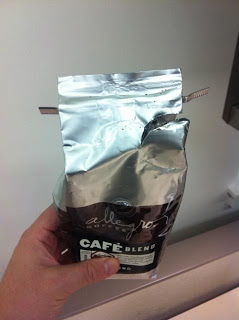
I love your coffee. It’s really good coffee. I’m not complaining about the coffee. I’m including a photo of the problem. The adhesive you use to seal your packages is so strong that the packages cannot be infiltrated from the top. This would be the preferable way, as it would also render your built-in resealing apparatus useful. So instead, in order to gain access to the ground roast coffee berries (And let’s face facts here: coffee is made from berries, not beans. They just look like beans. They’re an arboreal fruit. Interestingly, avocados are berries, and raspberries are not. Weird, eh?) I am forced to cut a small hole in the side of the bag, which, in this case, as can be seen in the photo, I then had to inveigle a finger into in order to enlarge the aperture sufficiently to form a rudimentary spout.
The key word there is ‘rudimentary’. The result of this crude manipulation is a ragged edged egress for the coffee. In this case, my primary objective has been achieved: I am now capable of liberating your excellent coffee into a coffee-brewing device (a machine which has its own set of enthralling deficiencies, but which is, frankly, none of your business.). However, several secondary purposes remain thwarted. I am not, for example, possessed of the ability to satisfactorily reseal the bag, which results in only three options:
1) Consume the entire contents of the bag immediately, resulting in a deplorable condition I’ve come to call the ‘tremulous vigilance’, or
2) Resort to drinking stale coffee later on (which substantially diminishes the satisfaction derived.).
3) Toss the bag and buy a new one, which is, in this economy, a sub-optimal use of scarce resources and probably has a large carbon-footprint enhancing effect.
Another secondary purpose which I am unable to achieve is the preservation of my office workspace in a condition unsullied by the presence of large amounts of granulated roast coffee berries. The bag thus rendered, it is nearly impossible (I’m not a surgeon for God’s sake!) to confine the spillage of the grounds strictly to the filter thereby (a) retaining as much of the coffee as possible for consumption and (b) not making a mess. But you know, spilling the coffee does result in a wonderful roast-coffee potpourri scent emanating from my desk, and I’m not made of stone; let’s call this one a wash.
All of these travails could be satisfied by using a lower quality adhesive for sealing the upper opening of your coffee-bags. In bulk, I’d imagine this could even save you, say, $0.01/100 bags. I’m guessing that a fine roast-beverage concern like Allegro sells a lot of small metallic bags of coffee. So, for every million bags, you’ll save (according to my wild guess about a made up number, assuming that a cheaper adhesive will actually solve my problem – which I don’t actually know to be the case.) $100. Tell you what, for $50 in coupons the idea is yours!
Thanks and love your coffee!
Dr24hours
p.s., I don’t actually need any coupons.
It’s Done.
In September of 2009 while taking a computer modeling short-course I had an idea. It was one of those suddenly blinding ideas that I knew immediately would have interesting implications if I could make it work. I spent about a year fleshing it out. Then, I wrote a grant. It was funded on the first application. I developed the idea. I took data. I modeled a test system. I wrote two papers. The first paper was essentially a concept piece that allowed me to get 3000 words published that allowed me to make the second paper of manageable length.
The second paper fills out the meat of the idea. I’m a methodologist at heart. I see different phenotypes as essentially interchangeable from the perspective of how we model the systems of care-delivery. But we use these models to make inferences about the effects of delivery policy on public health. I think this paper is actually something valuable. It’s useful. Other people can take the method, and do interesting things with it in many different fields of health care.
I did science. I’m so happy and so tired. This paper went three rounds of review at PNAS before being rejected there. I thought it might go baby-glam. In the end, it’s in a smaller-but-thoroughly-respectable journal that caters to people who work with computer modeling in the world of medicine. I’m going to make a career out of small papers in small journals and I’m totally ok with that. Eventually, in the end, I think I’ll have made a tiny difference.
This is good news. Today is a good day. And hopefully, this means demonstrated productivity for my next submission this June. Today, I’m a scientist. Today, I’m an engineer. And that doesn’t suck.
Academic Whackoffery.
Sometimes, you read something so spectacularly stupid that only an academic could have come up with it. The kind of idiocy that is only the product of a fertile mind. Someone who has thought long and hard about something, and done a great deal of analysis, decided they see a connection between to distinct concepts, and then run that into the ground without any apparent understanding of the second concept. We tend to see this a lot when academics try to do interdisciplinary work.
I am personally susceptible, because I’ve worked with medical scientists for so long that sometimes I start to think I have medical insights. I don’t. I’ve just talked a lot with people who do, and read a lot of literature. I don’t have any medical training. But that doesn’t stop me from sometimes talking as if I do.
But this weekend, Dave Shiffman alerted me to one of the most howlingly funny and absurdly idiotic examples of academic whackoffery I’ve read in a long time. Helen Fisher, PhD, is a research professor at Rutgers University, in the department of anthropology. A quick look at her CV and website suggests that Dr. Fisher is an erudite scholar on the topic of love, romance, sexuality, divorce, and evolution. I have no reason to doubt that she knows a great deal about those topics. What is glaringly absent from her CV is any history of research of substance abuse.
But Dr. Fisher doesn’t let that stop her from opining, in The Guardian, that the concept of addiction itself needs to be retired from the scientific lexicon. The reason she gives is a garbled mishmash of claims that romantic attraction – what I would call limerence – represents an addiction, and a positive one. Dr. Fisher’s point appears to be that because there are some vernacular correlates (and perhaps some neurological correlates) between how people talk and think about love and how people talk and think about substance abuse that… well, it gets unclear at that point.
She says that romantic love is a “positive addiction”. And that this addiction evolved 4,400,000 years ago in order to focus hominids on pair bonding in order to form nuclear families. I’m going to guess that that’s as much a political statement as a scientific one, but I’ll leave it up to anthropologists to argue.
She says that because we have nostalgia about our former partners, that’s like relapsing on a drug! That our obsessive thoughts about a new partner represent craving and withdrawal! Here’s the relevant passage from The Guardian:
In fact, besotted lovers express all four of the basic traits of addiction: craving; tolerance; withdrawal; and relapse. They feel a “rush” of exhilaration when with their beloved (intoxication). As their tolerance builds, the lover seeks to interact with the beloved more and more (intensification). If the love object breaks off the relationship, the lover experiences signs of drug withdrawal, including protest, crying spells, lethargy, anxiety, insomnia or hypersomnia, loss of appetite or binge eating, irritability and loneliness. Lovers, like addicts, also often go to extremes, sometimes doing degrading or physically dangerous things to win back the beloved. And lovers relapse the way drug addicts do: long after the relationship is over, events, people, places, songs or other external cues associated with their abandoning sweetheart can trigger memories and renewed craving.
This is distilled academic whackoffery at its absolute best. Some things are like some other things! I’m familiar with jargon! She goes on to say that she has unpublished data suggesting that some brain-scan results are similar as well. Now, I’m not super familiar with how fMRI works, but I know a lot of my readers are. If anyone can comment on this:
In fact, our group has found activity in the nucleus accumbens – the core brain factory associated with all addictions – in our rejected lovers. Moreover, some of our newest (unpublished) results suggest correlations between activities of the nucleus accumbens and feelings of romantic passion among lovers who were wildly, happily in love.
I’d love it. To me, it sounds like: “This thing in the brain does things when love or addiction!” Which does not surprise me at all, and does not at all sound like evidence that love is an addiction.
Here’s an absolutely crucial difference: progression. Addictions to substances are characterized by progression and tolerance. While Dr. Fisher mentions tolerance in the quote above, that’s not at all the same concept. Now, I don’t dispute that people can become obsessed with a partner/romantic object (that word “object” being key… a person seen as a substance rather than as a person), and feel like time with them is not enough.
Tolerance of a substance means that intake of a volume of a substance delivers diminished effects, resulting in increased intake. There are physical reasons for it. Progression means that despite advancing damages to the body and mind, we continue to consume more and more until, inevitably, we die without some intervention. Whereas the “tolerance” and “progression” that Dr. Fisher would have us see in love are naturally resolving! Who feels the same obsessive need, affection, and desire for their mate after 5 years as they did in the first months of interaction?
Sure, many still feel powerfully attracted, very much in love, and deeply satisfied. And that’s wonderful. Some feel hateful and resentful. Some feel indifferent. But if a mate were a drug, and love were an addiction, the feelings of obsession and desire and need would be monotonically increasing. This by itself substantially falsifies Dr. Fisher’s ridiculous assertion.
But the deeper reason it’s all so absurd is hard – for me, at least – to lay out in any kind of scientific way. And that’s to say this: they don’t feel the same. The desire for a drink, and the desire for a mate feel nothing alike. The withdrawals are nothing alike. The “use” of the “drugs” are nothing alike. I’ve been in the throes of terminal alcoholism. And I’ve been in the midst of joyous, blinding, brilliant, waste-laying limerence. They’re nothing alike.
She may be a renowned scholar on love, I don’t know. But Dr. Fisher knows, apparently, very little about substance abuse. She doesn’t betray any understanding of how it feels to be addicted to a substance. She’s an academic (and a famous one, apparently) who has an idea that a thing is like another thing. And she’s perfectly happy to say ridiculous things in support of her ill-conceived hypothesis.
As academics, many of us like to think that because we’re experts in a particular field, we must also be experts in related (or seemingly – to us – related) fields. We’re not. And it’s nothing but jargon-laced masturbation to convince ourselves otherwise.
My Long Game is Public Health.
I’ve written a little about my career plans recently. Setting up my own lab at MECMC, so that I can be a director instead of an advisor. Currently, I live in a strange no-man’s-land where I’m doing quality improvement work – some my own and some part of other people’s projects – and also PI of a grant-funded research project. And the research would be happening even if I didn’t get the grant. It’s just that now I get to have student interns and a small slush fund.
I’ve also written about how my desire is to get systems engineering (specifically computer simulation of healthcare delivery) published in the medical literature. I want to do this because my belief is that without physician and surgeon buy-in to the concepts of engineering in care delivery, we won’t be able to make the kind of impact on hospital care that is possible with the kind of work I do. Which I believe is significant in both the sustainability and quality arenas.
But all of that is short-term to mid-term in the sense of how long it takes to accomplish. I think I’ll have my own directorship within two years. I know I can publish in the medical literature, I’ve done it several times now. And the effects I’m hoping for – systems engineers being brought in to improve health systems – had begun before I got here. I like to think I’m making a positive impact on that, but the truth is, I’m a very small voice. I’m hopeful that it’s growing. I’m just conceited enough and just insecure enough to want my voice to matter.
But I was thinking this morning about the long game. I look around at other disciplines, and I see a lot of long games and big dreams. Oncologists who work so that one day, most cancers will either be curable, or rendered chronic, mild conditions. Robotics engineers and computer scientists who aim to build intelligent transportation systems that minimize consumption and eliminate catastrophes. Science writers driving public engagement to inform and inspire, and bolster support for research and discovery. Ecologists who seek to preserve and restore crucial natural systems. Physicists who look to unify field theory and understand the origins of the universe. Energy engineers building new ways to end our reliance on carbon-producing energy.
Thanks to twitter, I know and interact with people who are doing these things, writing about these things. People in the trenches solving proximate problems, leading to broad questions and bold solutions and eventually to improved lives. It’s exciting. And I wondered: what’s my long game?
My long game is public health. Health care is utterly unsustainable right now. Not just here. Everywhere that values human life, and believes that access to health should be a basic right has to make grueling decisions about how much care to provide and for whom. Because innovation is expensive. Every time a brilliant cardiologist invents a new intervention to treat a heart condition, it results in patients who used to die suddenly being offered a chance: someone pays enormously for the procedure, or they die.
We’ve decided, it seems, that the default answer is that regardless of cost, people should have the right to treatment of treatable conditions. There are exceptions, of course, but in general, the refrain is: “No one should go bankrupt paying for health care.” And that’s a laudable and supportable goal, and as a theoretical principle, I endorse it. The problem is, new innovations are abundant. And new treatments and medicines are always very expensive. They have to be to justify the investments made in their discovery. But even single-payer systems face the same dilemma. How much can the system bear in expense to justify providing exorbitant treatments?
And so we will always, always, be faced with that same dilemma. How much can we justify paying to save lives? To improve lives? Because there will always be new and expensive treatments. Because no one is giving up, and deciding that healthcare innovation is done. And no one should.
So my long game is public health. By doing the work at MECMC, I hope that I am improving our delivery model and our sustainability. By publishing in the medical literature, I hope that I am providing basis and justification for these models to be adopted elsewhere. And when they are, I hope that leaner, more efficient, improved delivery systems are able to treat people less expensively and with greater success. With shorter delays.
I see a system where the basic level of care is accessible to everyone. Where “basic” means “excellent”. Where intelligent performance measures and evidence-based quality improvement yield sustainable policy.
We will always have to make trade-offs for care in terms of affordability. My goal is that those trade-offs occur in the context of excellent care for all. That the difficult decisions are made on the margin, the blinding edge of innovation. And that basic, excellent care is widely available and affordable, whomever is paying – patient or insurance company or government.
What’s your long game?
Making Amends.
Making amends is one of the things that terrifies newcomers to AA. I was fortunate. I didn’t have a great many amends to make. I didn’t need to go to jail (sometimes making amends involves confessing to crimes). I didn’t need to pay huge sums of money. I didn’t need to talk to the parents of anyone I’d killed. I know people who’ve done all these things. It’s difficult.
My amends fell into a few basic categories. Acknowledgement of wrongdoing. Acceptance of consequences. And leaving people alone. There’s a reason making amends is step 9. We’re not ready right when we get sober. And people are not ready for us. Frequently, when we first get sober, we want to run right out and fix all our relationships, and rectify all our wrongdoing. But we can’t.
By waiting until step 9, we prepare ourselves, but we also let time pass. The passage of time is hugely important in making amends. We can show up the next day and say: “I’m sober now, for a whole day, and I promise I’ll never do anything like that again!” It’s bullshit and everyone but us knows it. Letting time go by, and showing up after six months or a year and saying: “I’ve had a lot of time to consider how I harmed you. I haven’t had a drink in half a year,” will be far more meaningful.
When we’re ready, and when enough time has passed for those we’ve harmed to be ready to hear it, then we can start to address how we’ve done wrong in the lives of others. I think that amends and apology get conflated in ways that are not useful. An apology, by itself, is very rarely an amends. And though most will, not every amends needs an apology. Sometimes, you just have to write a check.
Because, at its heart, the amends is about the person who did the wrong, not the person who had the wrong done to them. We make amends so that we can go on with our lives, free from debt and regret and resentment, able to move forward and respect ourselves. As long as our goal is forgiveness, we’re not ready to make amends. If our goal is to retain or regain something from our past, we’re not ready to make amends. We’re ready when we’re ready to accept the consequences of what we did, make what restitution is possible, and change our behavior. Nothing else is within our control.
Circumstances are also often such that we were harmed by a person whom we have also done harm to. In this situation, we still need to make amends to them. And when we do, we can’t be expecting them to also make amends to us. We can’t offer our amends conditionally upon their acceptance of some blame. We make amends for how we’ve harmed them, and do not mention or discuss how they’ve harmed us. That may come another time. It may not.
When we make amends, we explain how we harmed the person. We accept the consequences of that harm. We lay out how we’ll make it right, if we can. We describe how our future behavior will change, so as to ensure that this sort of harm will not happen again. We apologize. Usually, this results in forgiveness. Sometimes not. But the amends do not hinge on forgiveness. Some people are not interested in forgiving us. Some people will never want anything to do with us again. Some people will want revenge. We can’t control their reactions.
Nor are we hostage to them. If we’ve honestly and forthrightly attempted to rectify a situation, without excuse or condition, and our amends is not accepted, so be it. Everyone has the right to say: “I do not forgive you.” Or the right to say: “I will not rehire you.” Some wounds are too deep. And some people are not forgiving. We accept that. Sometimes, the harm we’ve done causes irrevocable rifts. We go on to live separate lives. But we do not need to grovel or complete trials trying to earn forgiveness. If our amends are sincere and not accepted, we can move forward in our lives without regret.
The key for me, the internal litmus which tells me if I am ready, is resentment. If a person has harmed me, and I also owe them amends, am I resentful about having to make mine while they still also owe amends to me? Then I’m not ready. Am I angry about what I’ve lost, and blame someone other than myself for it? Then I’m not ready. Will I be offended or insulted if my amends are not accepted and forgiveness granted? Then I’m not ready.
But when I see my own fault, and when my own culpability in harm is objectionable to me beyond any resentment, I am ready to address my wrongdoing. When my knowledge of my own error interferes with my serenity, my peace of mind, I am ready. When the harm I’ve done others pains me not because of how it affects me, but because of how it affect them, then I am ready. Sometimes this is immediate. Sometimes, it takes a long time. But it happens.
Making amends is about setting right my wrongs. I do it so that I can live with myself. I do it so that I can stand in this world and feel that I am a positive for others. So that my resentments don’t intoxicate me. So that my debts, karmic or financial, are clear. I accept my consequences so that I may transcend my own bad behavior. So that I can move forward and live soberly, and be of value to others. Not so that I may be forgiven. Not so that I may regain status or position or material. Only so that my hands are free from debt. So that my heart is free from shame.
Because shame and debt and resentment lead me directly to despair, and depression, and inevitably to alcohol.
2014 Starts with a Bang!
Such an exciting year ahead of me. I’ll turn 40 this year. There’s a very reasonable chance I’ve lived more than half my life. The first half didn’t suck, but it sure had a lot of challenges. I’m sure the second half will present its own new ones. But I feel confident and ready for them. I’m doing well. I’m sober and reasonably sane and happy and productive. And I’m in the best physical condition of my life. These are good things. You couldn’t pay me a million dollars to be 30 again.
And 2014 is looking to be a good year. I’m excited to move into my new home. To explore my deepening relationship. To pursue my professional life. So many things to anticipate.
And 2014 has begun in about the best way possible. My first major research paper for MECMC was accepted by a very respectable medical journal. Well, technically, they still want minor revisions, but the review to which I need to respond has no particular demands. Just a few general statements that I can square in the discussion and future work. The journal is second-tier specialty, which is about where most of my papers end up. And I’m very pleased with that.
I am publishing engineering in the medical literature. It’s a very small niche. My goal is to get more people like me doing hypothesis-driven engineering in medical centers to improve quality and performance in the delivery of health care. There are other journals where I would be more likely to get people like me to read my work. But I’m less interested in that. I believe that to get people like me doing the kind of work I do hired by hospitals – which could, I believe, dramatically improve care-delivery – we need to get physicians on board with systems engineering.
And the only way to do that, is to publish on pages that will pass before the physician’s eyes. If I can do that, then, when administrators are looking for evidence-based policy solutions using engineering methods, tech-savvy physicians will be supportive, because they’ll have been exposed to the concepts. I’m never going to publish glam. I’m never going to be a famous researcher. But if I can get articles into sub-specialty journals that physicians read, then I believe I’ll be an academic success. And today, I think I made a big step on that journey.
Happy New Year. To all of us.
Resumption.
Let’s make one thing perfectly clear right up front: I have no specific goals. OK that’s a lie. I have one specific goal. But it has no ancillary goal-hangers-on. My one goal stands solitary in its monolithic representation of the platonic ideal of “aspiration”. Like most good goals, I cannot achieve this goal tomorrow. But I do have a deadline. And I will do what is required to reach my goal when the deadline arrives.
I haven’t run much in the past four months. I started slacking off in September. I didn’t really run at all in November. And in December, I didn’t run at all. Until yesterday. Yesterday, Christmas Day, I dragged my sorry ass out in 25 degree weather (Farenheit!) and ran for 31 straight minutes. Five kilometers. Pace per mile: 9:59. Which is just fine. It’s especially fine considering the amount of time I took off. What it tells me is that my roughly 20 miles-a-week walking keeps me halfway decently fit.
But it’s not the same as running. I can tell because today I’m sore. Like, sore. And today, I ran another 5K. Slower. 34 minutes. Sore, and tired, I ran. Well, I jogged. Tomorrow, and for the next few days, I’ll do other kinds of things. Mostly the sort of physical labor associated with moving and packing. But through the winter, and into the spring, I’ll run. I’m running to Pittsburgh.
OK, I’m flying to Pittsburgh. But once I’m there, I’m running the Pittsburgh half-marathon, on May 4th. Yes, this alcoholic formerly obese pack-a-day-smoker is signed up to run 13.1 miles. In a row. Several friends are joining, including my new girlfriend BB (who has run actual marathons and is going to leave me in the dust at mile one). It’s going to be magnificent. And my only goal is to finish. That’s the goal. No time. No placement. Just finishing. I’m so excited. I’m gonna Run Like Hell.
The Year in Review.
Well, dear reader, this has been one hell of a year. I had some of the biggest changes of my adult life, and almost all for the better. The year started, (well, last Dec 21st), with me being offered my dream job at a prestigious medical center. I accepted it, and that plunged a huge number of things into motion. First, I had to quit the job I had then. Then I had to move to the East Coast. Start a new job. I got a swanky apartment right in the middle of downtown East Coast City, and took a month off between jobs to learn the city, and discover what it had in store.
Answer: lots. ECC is a fabulous town. Easy access to the entire Eastern Seaboard. Great culture. Fascinating institutions. A lively intellectual community. Lots of twitterers. A good AA community. One of the things I had to do when I moved here was get a new sponsor. I did. He’s pretty cool. He also works at Major East Coast Medical Center, but in a different department, different building. I’ve never seen him at work.
I started my job and had some success right away. I petitioned for and was granted Principal Investigator status. To get that – because I’m not faculty – I had to submit my CV to the IRB, and request formal permission to conduct research at MECMC. They approved me to conduct non-clinical research (i.e., no live human subjects). Which is exactly right because clinical research is not my interest or capacity. I won a small grant – the first external funding in my department’s history. I submitted two papers, one of which has now been published. The other remains in review.
The paper I got published is my first ever senior-author paper. In general, my work is such that I should be both senior and first author. My idea, my writing, my grant. I don’t have any post-docs who do the research or writing or programming for me, and thus would be appropriate first authors. But for this paper, one of my colleagues, an up-and-coming administrator, was perfect to take the first author role. And since the paper was my concept, I was senior. We wrote it, revised it, and got it published in a very respectable niche journal appropriate to our discipline. I’m hopeful it will be read. I completed one simulation and have two more that are essentially done. Professionally, it was a good year.
Personally it was a better year. I fell in love. Just, stupidly, madly in love. She’s not in ECC, which sucks, but we’ve managed to see each other about every two weeks for the past eight months. We’ve been on two short vacations, one to Maine and one to Bermuda. We’re going to Japan and Korea in March for two weeks. It’s dazzling. I mean that literally. I look at her, and I’m dazzled as if staring into the sun. Teared and blinking in the brilliance of it all. Staggered and liquified.
And now I’ve bought a house. That I will be moving into in about 2-3 weeks. I have to furnish it and put appliances in it and just, guh, so much. It’s daunting. Moving again for the second time in less than a year. But then I’ll be settled. And I am happy. My life is blossoming. I’ve come so far from being an unhappily married drunk. Light and freedom prevail in my life right now. That’s a blessing. And I know it might not last. But I know that I can face whatever might come next.
I owe it all to the practice of the very, very simple principles of the program of Alcoholics Anonymous. It’s often difficult. But never complicated. And what amazing promises come true when I work the program. I calculated recently that I have probably drunk 250+ gallons of pure ethanol in my life. But none in the past nearly-six years. And what heights I’ve risen to without it.

 Infactorium