Homeownership!
It all got done. For a long moment on Wednesday, I was pretty sure it wouldn’t. But it did. The seller got their shit together, got the paperwork handled, and now I own 20% of a lovely row home in a nice, burgeoning neighborhood of ECC. I don’t yet know precisely when I’m going to move. I have some time left on my lease, so I can do it in a leisurely way if I need to. Right now I’m wishing I had a car. I need to make various plans, etc., and then go get them done.
One of my coworkers is leaving and needs to get rid of a desk and a bed. I think I’ll take them. I have a lot of space to fill in my new home. It’s not a huge place, about 1500 sqft, of which at least 200 is not really usable living space (a third-floor hallway and 1.5th and 2.5th stairwell landing). The only really large area is the enormous kitchen/dining room area which probably measures 12.5″x16″. It’s not quite a real square, but it’s open and comfortable. I’m not going to have a real dining room, of course. There’s a perfectly-sized alcove for the piano, and I’ll put a couple of small chairs or a bench, and it’ll be a nice sitting area.
The really important part is that it has miraculous bathrooms. That’s what I really wanted. A place for the piano, and good bathrooms. Now I just need to move. Again. I can do this. And now, with vast debt hanging over me, I guess I’d better get to work.
Peak Stress Level.
As I’ve written many times recently, I have good problems today. But they’re still problems. My ex-wife was trained as a therapist, and she often talked about Maslow’s Hierarchy of Needs. Now, I know next to nothing about this field. But what I remember of her discussion of MHN was that no matter where you are on the triangle, your problems feel like real problems to you. So, someone who is struggling deeply with say, confidence and achievement might feel as though their problems are just as impactful as someone struggling with health and property. I’m going to round back on that point in a minute.
Until yesterday two major stressors: finishing a bunch of major projects at work, and buying a house. While these are listed at a fairly low-level on the pyramid, they’re still kind of luxury problems. I have a good employer that, while (reasonably) demanding, appreciates my work and values me. Buying a home is a luxury problem for anyone, really. Especially considering I already have a perfectly good place I can afford. So while these don’t really represent serious problems, they feel as though they are urgently mortal.
Yesterday, a third stressor was added. My preceptor at work is getting a promotion. He’ll be leaving my project. I don’t know who is going to replace him. It might be me. I don’t want to replace him. I’m not confident I can do his job, especially while doing my own. If my projects founder because I don’t have the right person driving them, that could end up putting this job I love at risk. That does start to strike at the base of the pyramid. That maybe starts to fall into problems that are real problems, not luxury problems.
So I’m operating in a very high-stress mode right now. Some of it will drop off in two days when, one way or another, the house is either purchased or walked-away-from. Some of it will drop off in a couple of days when I finish the simulation I’m currently writing, which is almost done. But some of it is just the general stress of living. Which feels real to me. It feels incredibly big and stressful and problematic.
So, now let’s round back to the point above. I don’t have any problems. I have a back-up plan if I lose my job. I have a home if I can’t buy this house. And I don’t have any of the things that cause people to have other serious stresses in their lives, like health problems or children. Or children with health problems.
Maintaining perspective is crucial for me. And I think generally for alcoholics. If I start to live in a world of stress, it becomes easy for me to pity myself. If I feel self-pity, I start to think I deserve to have it addressed. I start to think the world owes me something. I can fall into toxic entitlement pretty easily if I let myself. So I need to regularly look back at that pyramid and examine how well all of those things are addressed at every level. I have to remember the places I’ve been and the people I’ve met, and know, who can’t say that.
And I have to remember my gratitude. I’m an alcoholic. Every day I don’t get up in a puddle of vomit with a splitting hangover is a good day. Every day I don’t look at myself in the mirror, hateful, resentful, and down a shot of vodka is a good day. Every night I go to bed sober is a good night. So, while my problems may feel vexing to me, those are just feelings. I need to separate myself from how things feel and look objectively at how I’m progressing in my sobriety and in my life.
For all the discussion of spirituality in AA, the program also emphasizes being strongly rational about our problems, and our solution. Do the things today that will improve your life today. Do them every today. And your life will improve. Focus on the reality of your situation and address that. Don’t cower under the weight of your difficulty. Find people who have good lives, and who have been through what you’re going through, and do what they did to get where they are. A program of action and accountability.
And let go of the rest. Because the house will happen or not. My employer will like what I do or not. Most things in life are beyond my control. I’m doing reasonably well (but not perfectly) at the things that are within my control. And when it comes to stress, yes, I get to own my stress and it’s alright that I feel it. I’m allowed to feel my feelings. I don’t have to denigrate them because objectively, many others have it far, far harder. But it’s worth recognizing, and internalizing, that my problems are, objectively, not lethal.
Social Compassion for Alcoholics.
AA is a little bit different in different places. And a lot the same everywhere. I have been to AA meetings in four countries and seven states. Hardly a huge sample. And except for Missouri, California, and my current home state, I haven’t been to enough meetings anywhere to really judge what AA is like in those places. The meeting I went to in Bermuda was small and cozy, and felt just like home. The meetings in New Zealand and Norway were somewhat depressing. A lot of people who had fallen very far down on the scale, and very few who seemed to have made strides into the core bedrock of sobriety.
In St. Louis, there are meetings of both types. And the same is true here in ECC. Of all types. Meetings composed mostly of people with longer-term sobriety, living comfortable lives. Others composed mostly of recent drunks and felons, struggling to find a way forward. And meetings where these groups mix fluidly. My one-meeting-each experience in other countries isn’t enough to provide me with any evidence about the actual state of sobriety, from an epidemiological perspective, in any of them.
But I do wonder anyway. In both Norway and New Zealand, I was told that AA hasn’t really taken hold. Compare that with the UK, where, though I don’t know the meetings personally, many people (including the writer of the excellent “Guitars and Life” blog, Furtheron) tell me AA is said to be more universally accepted. Is it the language? Lots of ideas just don’t come across as well in translation. Is the program of AA one of them? I have no idea.
But one thing that was said to me in Norway was interesting. I no longer remember the phrasing, so file this under “things I think a drunk once told me…”. And that was that in Norway, drunks don’t think they need AA. They don’t think they need recovery at all. Because society protects them far, far better than America protects our drunks. In Norway, I was told, in the cities, anyway, being a drunk is really easy. There’s excellent and inexpensive public transportation (and the penalties for drunk driving are incredibly severe). So drunks tend to get in fewer traffic accidents. Health care is free, and emergency rooms will dry you out, perk you up, and send you home.
Suffice to say, the impression that was conveyed to me was that it’s harder to hit bottom in Norway. The social contract provides for addicts in ways that we do not here in the US. The result is that probably fewer people die from acute effects of addiction. But I was also told that it takes much longer for the average person to decide they need to find sobriety. This was supported (again, n=1), by the fact that there were no young people in the meeting I went to. I, 37 at the time, was the youngest in the room by a decade. In New Zealand there were younger people in the room. But they were largely heroin addicts. The strict alcoholics in the meeting were, again, mostly older and with only a few years of sobriety.
I’m forced to wonder if all this social investment in the addict actually helps us. The answer, surely, is complicated. I’ve written many times about the problem in addiction treatment with the chasm between statistical and clinical significance. A drug that increases mean relapse time from 3 days to 9, p<0.0001, is almost useless. Because 9 days of abstinence avails me nothing. Some will say, “It gives the addict time to ‘get it’!”. Maybe. But clearly, not many are ‘getting it’ if they’re relapsing so rapidly.
When I went to rehab, I took medicines. I think they helped me feel better through my withdrawal. We all know benzodiazepines save lives, when an alcoholic is in acute detoxification. I’m not anti-medicine. And I’m not anti-rehab. But these things are not necessarily required for recovery. Incredible efforts and funds are spent investigating and treating alcoholism. I fear often for the worse. For alcoholics like me, I think certain things are true:
– I think that a large proportion of alcoholics will always die of alcoholism. I think that that proportion is depressingly high. And short of sequestering the alcoholic away from drink, there is very little that can be done about this.
– I think that addressing alcoholism in one’s life requires a complete sea-change in how one approaches the world. It is not enough to try to avoid alcohol and use mnemonics and slogans. It is not enough to dry out and try really hard to stay clean. It can never be enough.
– I think the social contract that cares for and provides comfort for alcoholics prolongs a lot of lives, but it doesn’t save them. I think it makes our alcoholic deaths slower, sadder, and more perplexing. We had all the help in the world, and couldn’t stop drinking! I think some of us need less help. Until we’re ready for the kind of help that works.
– I think we make the choice as a society to try to help people with addictions through methods that don’t actually help us. They relieve us of the burden of recovery. They transfer the responsibility for our addictive behaviors from the addict to the physician. To the institution.
– I think that alcoholism is a terminal illness with a very poor remission rate. Frequently, our medical interventions seem designed to keep the alcoholic alive, drinking, and dying slowly and miserably.
We say in AA that we recover when faced with jails, institutions, or deaths. But there are no institutions, really, that do what they did when those words were written. That lock up the alcoholic permanently for alcoholic insanity. And so today, the choice is really between jail, death, and recovery. But we have a medical apparatus that makes the “death” option much slower, and perversely attractive. We can keep drinking. And in places where the medical system is more robust, my own experience is that it does not usher alcoholics into recovery. But my experience is far from evidence.
What is the solution? I think more alcoholics would probably recover if more alcoholics are dying in the snow. But of course, I don’t and can’t advocate that. I think more alcoholics would recover if HIPAA didn’t prevent AA members from working with hospitals. But I don’t think I can advocate that either.
I don’t know that I have a solution. Except to say, there is no bleaker image for me than the one in which alcoholics are repeatedly brought back from the brink of desolation only to drag themselves back to the edge. To die slowly, surrounded by exasperated and impersonal medics, vacillating from withdrawal to indulgence. In my experience, alcoholics like me recover when we reach a point where, emotionally, even if not in actuality, we have no more options. And when the social structure provides endless options, we just find a way to use them to ever more lugubrious ends.
No House Yet.
Purchasing real estate is absurdly complicated and nobody is on your side. Whether you’re the buyer or the seller, your agent is working for the other side. Because their interest is in selling the house. If the house doesn’t sell, they don’t get paid. There is a whole team of professionals who only get paid if the sale goes through. So they all want it to happen. That’s great, if you like the house and there are no problems. It’s bad if there is an issue.
In my case there is an issue. The title showed a break in the chain of ownership from the previous owner to the seller. Now, I believe that it was simply a clerical error (my agent keeps calling it a typo). But it was severe enough that my title company would not issue a buyer’s policy on the property. So they, and my agent, were trying to tell me to just switch to a title company that wasn’t so persnickety. Ummm.
Not a chance in hell. There is a break in the chain of ownership. I’m not buying the house. If it’s simply a clerical issue, then fix it. If it’s more serious than that, then that means that there is no sale. Period. My agent kept telling me that my earnest money would be at risk, and that I would likely lose it if I walked away from the deal over this issue. So I called a lawyer. In fact, I spoke to three lawyers. They all agreed that I had a strong case for the return of my earnest money if I walked when the time expired on the contract. So I told that to my agent, and made my position very, very clear: unless this issue is fixed, I don’t buy the house. No further discussion.
Today is the we were supposed to close. We can’t because the issue isn’t fixed yet, though I’m informed that there is significant movement, and that the previous bank (who seemed, clerically, to still have a lien on the house) is involved and cooperating. So today I am going to offer an extension to the sellers, to get their shit together. I’m putting language in the extension that states that the reason for it is that they haven’t yet produced marketable title. If they don’t accept that, I’ll walk.
It could be an expensive gamble. In two ways really, because that language won’t override the original contract, and so might not protect me even if they do sign it (but surely couldn’t hurt me). And because they might not accept such language.
But last night at my men’s meeting, someone said, “A problem that can be solved with money isn’t a real problem.” I don’t accept that entirely, of course. Lots of problems are real problems that could be solved with money but that money isn’t available, and as a result, people die. But his point in this case, is that I’m not risking my health here. I’m not risking my employment. I’m not risking my sobriety. I’m not risking my life. My worst case scenario is that I lose my deposit and end up living in my current too-expensive apartment another year. That’s not really that bad.
This is a stressful and frustrating problem. But it’s a luxury problem. I used to worry about choking to death on 60 proof vomit. Now, it’s that the house I want might not come through. What a change. What a warmly rising path I’ve trod these past nearly six years.
Making it about Me.
In AA, we’re taught to talk about our own experience. We find that when people go to active alcoholics, and talk to them about their drinking, the defensiveness immediately erupts and chances at honest and effective communication are rare. I’m not a big fan of interventions, as a concept. I’ve known lots of people who had them done. I don’t recall an alcoholic in recovery telling me that that had an impact on them except to harden them. I’m not saying they can’t work; I’ve just never heard of it.
Instead of approaching an active alcoholic and telling them what they need to do, we’re taught in AA to talk about our own experience. We tell them about how we drank. Why we drank. How we felt and then how we changed. What it was like, what happened, and what it’s like now. What we’re like now. But telling our own stories, we don’t lay judgement on the alcoholic. In fact, we relieve it. Our own stories are usually as full of crime and bad acts and shame and humiliation and disease and degradation as the life they’re living today. In this way, we connect. Then, sometimes, the active alcoholic decides that they want what we have, and seeks change in their own life. And embarks upon the journey.
I’ve found this approach to be useful in communicating with people on all sorts of topics. I try not to tell people what to do, or how they feel, or how I think things should be done. I generally try to listen to them, and then think of an experience in my own life that is somewhat similar, or applicable, so that I can relate to what they’re sharing. Now, for a lot of topics, I don’t have anything. But most of the time, I think the human experience is broad and generalizable. I think that when we try, we can find things in our own lives that apply to another person’s experience.
But I’ve also found a problem with this approach. I take the approach so that I don’t step on a person’s experience or agency by telling them how they need to behave or feel. But when I try to relate by sharing my own experience, it risks them feeling that I am making the topic of conversation me instead of them. This is especially problematical in discussions where there are different levels of privilege.
Since I have about the highest level of privilege there is, sharing my own experience can be seen as entitled assumption. But the other way, talking about the other person’s perspective can be seen as dictating their experience. The simple answer is this: sometimes, I just have to shut up. Whether I’m talking about you or talking about me, I’m talking. Sometimes – and this is hard to fathom – a person isn’t interested in what I have to say on a topic, whether I frame it about me or about them. And that is their inviolable right.
However, I’m also allowed to have thoughts and opinions and motivations of my own. Once I’ve listened to someone, and accepted their perspective and their experience, it’s usually reasonable to offer my own experience as a way to connect to their understanding. After all, shared (or similar) experiences are one of the basic foundations of human connection. Then, if they ask for it, it might even be reasonable for me to offer advice or thoughts about how they can proceed, if I have anything relevant.
But many people have no interest in that. For many reasons. Sometimes, a person wants to share with no input at all, solely for their own sake. Sometimes, people are hostile, and will not accept any possibility of shared or similar experience. All of that’s fine. Everyone has the right to choose how they interact, or don’t interact, with other people. Active alcoholics especially tend to be very hostile towards advice. They are more receptive to shared experiences, usually, but not always. “You can’t understand me!” is a common and depressing phrase I’ve heard from a lot of people who have no desire to change their drinking.
But it’s generally none of my business who drinks and who doesn’t. My goal is not to drink. To understand the principles of sobriety. To apply them to my life. I hope to be understood. Most of us do. So when I listen, and then share about myself, I’m doing it as an attempt to find common ground so that I can understand the other party’s position and perspective, their life, better. Because I know it’s not about me; but finding connection matters to me. And a connection has two people in it.
I Am Not Ashamed.
I’m embarrassed. Yesterday I did something stupid and foolish. I have a Picassa-album-type-thing for photos from my various travels that I share with my meatspace family and friends. I don’t share it here or on twitter because, well, I dunno exactly. I just don’t. Let’s call it non-overlapping magisteria, or something. But I shared my Bermuda pictures with my colleagues at work. Including my boss, who is a friendly, affable, pleasant man and an effective leader. And that album included this picture:
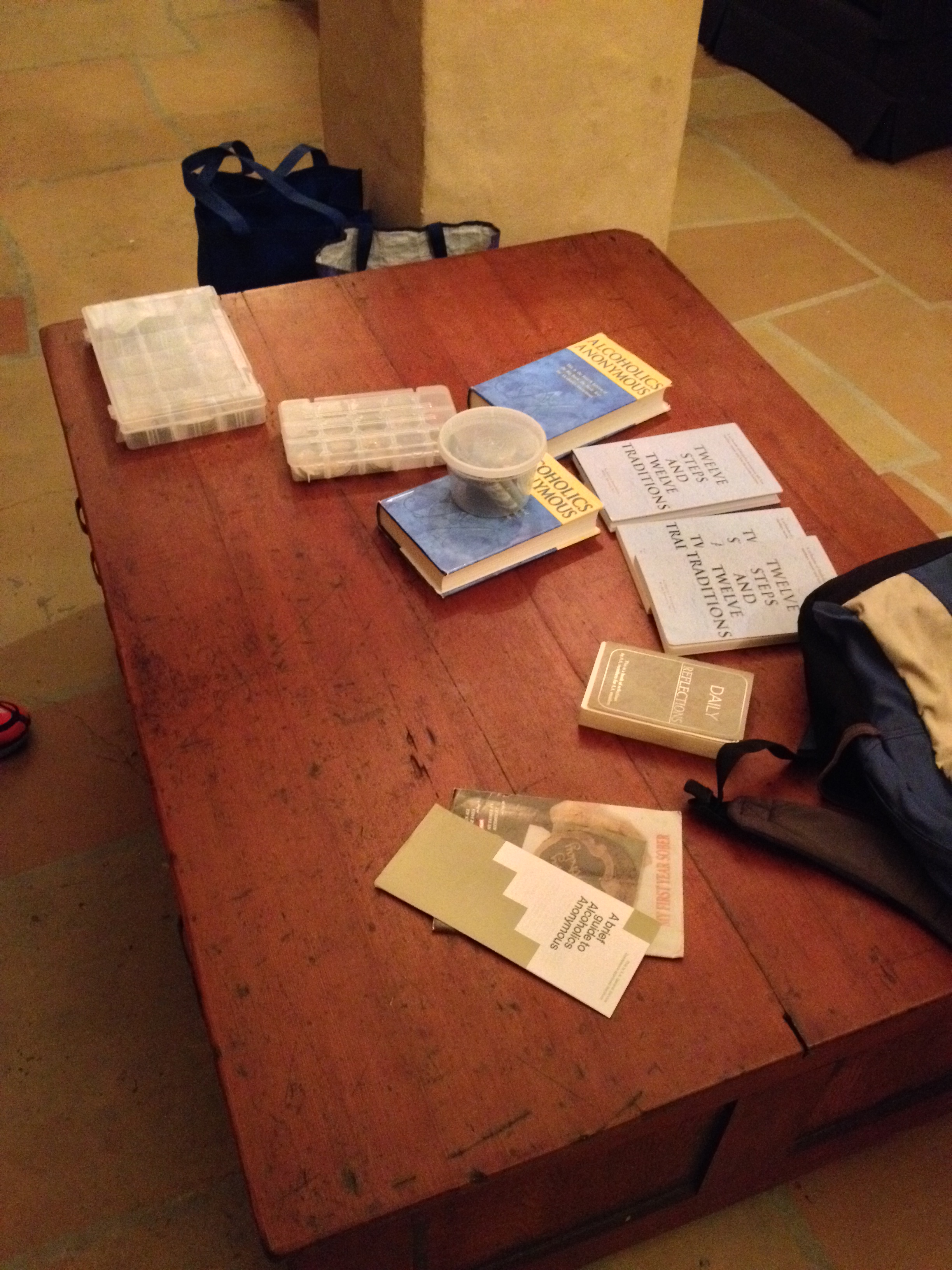
Well. that pretty clearly identifies that I went to an AA meeting while in Bermuda. If anyone took more than a second to look at the picture, they’ll know I’m an alcoholic. What they won’t know is how long I’ve been in recovery, or what my history with alcohol is. Or why. People have their own biases and impressions of AA. I’ve had people tell me that it’s a cult, that it’s a Christian Church, that it’s the best thing that’s ever happened to addiction, that it’s the worst. I’ve had people tell me that it works/doesn’t work/should work/shouldn’t work/can’t work. I’ve had people tell me I’m lying to myself because I think AA works. I’ve had people tell me that if I have stopped drinking it means I was never an alcoholic in the first place.
Unless you’re a member, chances are, you don’t know what AA is or how it works. And that’s fine. If you don’t have a desire to stop drinking, AA isn’t for you. You don’t need to know. Feel free to go on about your business. We’ll handle ourselves. I’ll keep my side of the street clean, and your side is your side, and not my business.
But now I’m suddenly worried that any time I’m not perfect at work, my boss (who looked at the pictures and commented on them, though not on that one specifically) will be suspicious that it means that I’m drinking. I don’t know how to address that. So I did what every alcoholic-in-recovery should do when they feel panicked and confused and upset. I called my sponsor. He told me that I should drop it. Just don’t say anything, and if people ask, address it honestly and straightforwardly. And essentially to say, “I’m in recovery. What’s your point? How does that affect my job in any way?” But not as aggressively as that seems in print.
Because here’s the deal: I’m not ashamed. I’m an alcoholic. I’m an alcoholic for many reasons. Mental illness, probably genetic. I’m an alcoholic because I like to treat discomfiture with alcohol. I like to anesthetize myself against things that make me unhappy. I like to drink, because I like the effects produced by alcohol. Left to my own devices I will drink, rather than do any other thing. And I’m not ashamed of any of that. It’s just who I am. It’s an irremediable defect of my brain and my genes.
I am not ashamed, because I don’t drink anymore. I have made, or offered, amends to everyone I’ve harmed in my life to my knowledge. And I continue to do so as I continue to harm. I have examined the faults that I have and take daily steps to ameliorate them. I go to bed each night sober, and I wake up the same way. I have done this without fail for 2,118 days in a row. I am not ashamed, because I tend to my responsibilities and I care for the people who matter to me. I acknowledge the contributions that others make to my life, and I endeavor to repay those efforts.
Sometimes I am fearful. Sometimes I am stupid. Sometimes I am thoughtless. Sometimes I am regretful. Sometimes I am resentful. I have done many things in my life I am not proud of, and some people have been hurt in ways that I cannot repair. I have harmed people – even in sobriety – through bad decision-making, selfishness, and anger. I have attempted to amend those harms. I have not always succeeded. Sometimes I am lazy, and slipshod. Sometimes I am dishonest. But I work daily to say what I mean, and do what I say.
I am a work in progress. I have never claimed, nor will I ever claim, perfection. I do not do these things alone. I am not sober by my own strength or efforts. I am sober because I follow a program of moral accountability and spiritual seeking, guided by the wisdom of the many millions before me who succeeded at this task. My best efforts lead me to despair, desolation, inebriation, and moral destitution. The efforts of something much larger than me, this massive network of sober people who form the net into which I fell, which caught me, are responsible for my sobriety. I have done only what I was told by those who went before. I cannot claim authorship of my recovery.
I cannot control what others think, or do, or say. I have only the power to manage my own reaction, and my own feelings, and my own behavior. Because of AA, I have dignity and personhood. Because of AA, I understand my place as a man in the world. I am not ashamed of my alcoholism. But alcoholism has consequences. Part of my recovery means accepting all of the consequences associated with my disease, fair or not. Because it does me no good to rail against the world. I am no crusader. I have stopped fighting.
I doubt that there will be any consequences in this case. Hell, I doubt anyone noticed before I took the photo down. What happens will happen. I’m angry with myself. I’m fearful of becoming the subject of gossip. I am an alcoholic. But I am a sober member of Alcoholics Anonymous. And I am not ashamed.
Bermuda!
The past four days and nights I have been in Bermuda. I suppose I could tell you I was soaking up the beautiful sun resting languidly on a beach, but those of you who’ve read about my previous travels will know that that isn’t really how I roll. I need to keep moving, seeing things. And luckily, that appeals to my new girlfriend as well. It was exciting to discover that we traveled well together, and enjoyed doing a lot of the same things. And that we also agreed on the things we didn’t need to do, like stay out late or push ourselves to see every last thing on the island in four days.
Bermuda is a great destination because there are easy, quick flights from ECC and just about every other major city on the Eastern Seaboard. We stayed in a charming little bed and breakfast run by a cute couple who provided nice continental-style breakfasts (granola, fruit, fresh roasted coffee, scones, yogurt, etc.). Harry was loquacious and affable, and sailed for Bermuda in the 1976 Olympics. We rented a scooter and tooled around the island trying not to die. It was more precarious than it might’ve been because the Bermudians were playing this joke where they all drive on the wrong side of the road. The refrain for the trip became, “Left turns are easy. Right turns are hard!” I only killed us once.
The city of Hamilton, which is the capitol, is a surprisingly bustling small city. Considering the island’s entire population is somewhere between 50,000-65,000 full-time inhabitants, Hamilton feels like a city for a much larger constituency. The city was decked-out for Christmas, which is a little disorienting for me considering I’m used to associating it with snow and misery. But they did a nice job of it, and everything was elegantly done, which is inspiring considering the ludicrous vapidity we’ve achieved here in the States.
Bermuda is quite wealthy, and free from the slums that are found in other tropical destinations once you venture out past the heavily-protected ring around the resort communities. Bermuda has beautiful architecture, everything white-roofed and stuccoed in colors that ride the line between pastel and primary. Because there’s no source of fresh water on the island it all comes from rain, and so the roofs are fascinatingly-designed water entrapment devices, and every home has a cistern.
Our first trip on the scooter was to a nature preserve called “Spittal Pond”, so named because you’re supposed to.. no just kidding. I’m not sure why it’s named that because it isn’t really out on a spit, or anything. But there’s a beautiful nature trail and a bunch of rocks to climb on. The rocks, volcanic limestone slowly deteriorating under the ruthless assault of the sea, was covered in little limpet-like things, inspiring BB to point and exclaim: “There are CREATURES!!”

The next day we visited the village of St. George, which has a fabulous abandoned church. The great part is, it was abandoned before it was done. Only politics can achieve such a result. The bones of this would-have-been-stunning cathedral remain exposed to the elements after, more than 100 years ago, everybody just said, “Fuck it, we quit.”

From there we scooted past Tobacco Bay and visited the amazingly preserved and picturesquely located Fort St. Catharine, which defended Bermuda from invaders from the north. It’s a squat, imposing, serious military outcropping looking out onto the world’s bluest water.
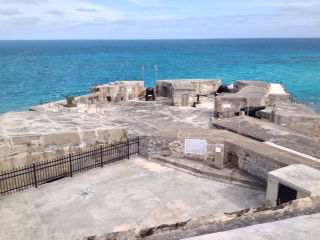
Which reminds me: you know how they say that the water is that color because of the sky? Well that’s bullshit because the water is that color even when it’s entirely overcast. It’s uncanny. Strange and beautiful and alarming and amazing. Right next to Fort. St. Catharine there’s a little beach where we went swimming. Because it was only 70 degrees and late November, we had the beach to ourselves. It was fabulous.
Saturday morning we went to the Botanical Gardens, so that I could go to an AA meeting. They’re beautiful, and like everything else in Bermuda, tiny. There’s a little aviary with a few parrots and peacocks, and a bunch of fiery-looking tropical foliage. Because we were there early, it was almost abandoned, and we were able to walk around the perhaps-10-acre grounds undisturbed, and uncrowded.

Then we went along the South Road, seeing a number of beaches and realizing why they call it pink sand. It’s because it is! You can’t see it in the photos, but the sand has little pink flecks of shell in it, about the same size as the sand-grains. We visited Warwick Long Beach and Horseshoe Bay, before having a lovely little lunch at a restaurant opposite The Reefs timeshare community.

And that, basically, was our trip. Add in a few nice dinners (Eating in Bermuda is not cheap. To eat on anything like a budget, you will need to go grocery shopping and even then, plan on it costing as much as eating out at home.). There were a lot of overcast skies, but that’s ok. We actually had the best weather of the trip in our last few hours before leaving.

But this wasn’t ever really intended to be a beach vacation. It was to explore a new place, with the new love in my life. And that was quite thoroughly accomplished.
On the Institutional Review Board.
Did you know, dear reader, that your humble narrator has had an official finding of research misconduct levied against him? I was guilty too. Let me go back and describe it:
I was a newly hired engineer at my previous institution, prior to my promotion to PI. I was working directly for the Chief of Staff, who is kind of a “Big Science Deal”. More than twenty years of uninterrupted funding, hundreds of papers in very good journals. Contributions to both medicine and engineering. Full professor in both a medical school and a school of engineering. That sort of thing. He hired me to be his concierge engineer solving problems for his medical center. I worked on quality improvement. In fact, I had essentially the same job I have now.
One of my first projects, which was only very peripherally related to the patient experience at all, ended up with a neat little result. At this time in my career, I had published only one paper, and though I was first author, I didn’t write it, or submit it. The senior author did all that. I just did the work. So I really had no idea whatsoever how publishing worked. And, since I was trained as an engineer – even though I had been working in health care a long time – I had no understanding of human subjects research. I was always strictly on the quality side of things. I’d had HIPAA training, but no research training.
When we came up with the neat little result, my boss told me we should publish it. It was exciting. I’d never been interested in publishing, really. I had no designs, at that time, on being an academic at all. So I wrote a paper about what I did, and submitted it. Well this set off klaxons of alarm. Publishing is research! Manuscript preparation is research! The Institutional Review Board (IRB) sent me a grim memo. I went to my boss. He took responsibility for it. It was his fault I hadn’t been oriented to research; if he wanted me to publish, he had a responsibility to ensure I knew the rules.
The project and the paper involved only retrospective, deidentified, aggregated data. Those reading this familiar with human subjects research will immediately recognize what that means: it’s exempt from IRB review. There was no harm, actual or potential, to patients or to their protected health information. But because I had prepared and submitted a manuscript prior to securing a decree of exemption, I had technically engaged in research misconduct. The official finding was that the misconduct was neither serious nor continuing, and a memo was placed in my file. And I believe it has since been expunged.
I tell that story because I want to emphasize that I understand that IRBs are imperfect instruments. However, they are the fundamental structure we use to ensure that research is conducted ethically and safely. So that research subjects are informed about the risks and benefits of the research. So that research is carried out only on subjects who consent to be researched. It’s not a small thing.
I’m not a lawyer, and I’ve never served on an IRB. But I have had multiple protocols reviewed and approved, and multiple protocols reviewed and exempted. Most of my research is exempt from review, because it is quality improvement work based on retrospective, aggregated, deidentified data. But even then: only the IRB can determine if the IRB needs to review the protocol. That means that your protocol must be reviewed in order to determine if it must be reviewed.
Yes it sounds circular and silly. But this is how we do human subjects research. Scientists have biases and blinders. If you’re a scientist, you have them. Hell, if you’re a person, you have them. We all like to believe we would only conduct safe and ethical research. But when we think we have great ideas, we all – every one of us – will rationalize a little bit about it. I do it. You do it. That’s why we have systems for independent oversight.
The IRB is intended to safeguard patients’ persons, and their information. The basic document regarding ethical research, sort of like a constitution and bill of rights for researchers and subjects, is The Belmont Report. IRBs use this document and the principles found therein to guide them when reviewing proposed research. IRB oversight of research is required for all federally funded studies in the United States, and nearly every institution requires IRB oversight whether they receive federal funds or not.
I had a long conversation on twitter yesterday in which it was asserted that “IRBs are only for publication.” This is not only wrong, it is dangerously and disturbingly wrong. Yes, in order to publish the results of research respectable academic journals will require a statement of appropriate IRB oversight. No, that is not what IRBs are for. IRBs are to protect patients so that Tuskegee doesn’t happen again.
My opponent in last night’s debate laments that this essentially prevents private citizens from conducting and publishing research. Well, sort of. As a researcher at a medical center, I have access to a large and streamlined IRB which reviews all of my work so that I can do my work as research and publish the results. Private citizens don’t have that. There are, however, IRBs-for-hire. They may be expensive, or they may be free of charge, but they exist.
But I am unmoved by restrictions upon private citizen-science when it comes to human subjects (or animal subjects, for which the equivalent body to the IRB is the IACUC). Human subjects research has a deplorable history of subjects ending up as victims. Doing ethical research requires oversight, standards, ethics, and accountability. All of those things cost money. And if you can’t afford appropriate oversight and accountability for your research, then you can’t afford to do research. And that’s a good thing, not a bad thing.
The idea that IRB oversight is simply a regulatory hoop that a scientist must jump through in order to publish their results in a peer-reviewed journal is, frankly, vile. It was asserted in the argument that if a citizen (or corporation!) wanted to conduct their own human subjects research and publish it on a blog, that that would be fine, ethically. That is absolutely, categorically untrue. That is exactly how excrescent lapses in ethical behavior result in serious harm to research subjects.
When safety, ethics, and oversight are seen as regulatory impediments to science, instead of part of the core principles of scientific research involving human or animal subjects, humans and animals suffer. Those who see regulatory oversight as bureaucratic box-ticking reveal themselves bereft of the concern for respect, beneficence, and justice which must be at the core of medical and scientific exploration.
What do We Owe in Return?
AA has saved my life. And when I say that, I don’t just mean that people in AA threw me a life-preserver when I was drowning. They did. But that wasn’t all. AA took me, a 33-year-old man-child – incapable of operating in the world, utterly baffled and perplexed by the nature of society, by what it means to be a man, by employment and responsibility – and slapped me around, straightened me up, dusted me off, and set me right. Because of AA and the program that I work in sobriety, I am a capable and effective human being today. In the first place, the opportunity that AA gave me was to live, instead of not existing. As I matured in the program, it gave me the opportunity to live, instead of merely existing.
What do I owe to AA in return? What debt have I incurred to this organization that has saved my life, redeemed me, and put me back into a state of manageability? There is a plaque on the wall at many AA meetings that says:
Whenever anyone, anywhere, reaches out, I want the hand of AA to be there for them. For that, I am responsible.
I believe that. And I believe that I live that. If you, out there, cannot control your drinking and cannot manage your life, reach out to me. If you can’t go on living like you’re living, but you don’t know how to stop, reach out to me. If you want to find some other way, some other path, anything but this blistering misery of alcoholism, reach out to me. I know how to help. Wherever you are, whatever your condition, there’s a path for you out of where you are. And I can either help you find it, or I can put you in contact with local resources who can.
But AA isn’t perfect. And any organization will drift from time to time. I oppose, for example, the signing of court slips and the sentencing of drug/alcohol offenders to AA. I think it violates the spirit of our laws (in the USA), and I think it violates the traditions of AA. And here’s what I intend to do about it:
Nothing.
Nothing about the program of Alcoholics Anonymous requires me to be involved in AA policy. Nothing obligates me to participate in organization. In management. As I’ve written many times, there’s precious little organization or management, and I generally think there’s too much as it is. A troll who happened across my blog recently took me to task, calling me “startlingly self-centered” for not being interested in guiding policy in AA.
In fact, I think it’s quite the opposite. Self-centered would be to believe that my ideas are so important that all of AA must be made beholden to them. Self-centered would be to insist that other people work the program of AA the way I believe they should. Self-centered would be to demand that everyone agree with my opinions about court-ordering alcohol offenders and signing court slips.
I have an opinion. It’s not particularly well-informed. I don’t have any data about whether signing court slips is good for people. I don’t understand constitutional law. I haven’t really studied the traditions of AA. I just have opinions. And the height of arrogance is to form an opinion based on precious little information and then assert it as if it is the best or only way to approach an issue. My gut reaction is that AA and the courts should not have any official relationship. And that’s where it’s going to stay.
My obligation to AA is to be there, and be available to other drunks. People who need help ascending from the cellar of misery we carve for ourselves in the midst of our addictions. My responsibility is to the AA members in the groups I attend. To my sponsor, to any sponsees I might have. I have no obligation to AA World Services. Nor to my local Intergroup. I think it’s probably a good thing that people volunteer for those things, and take up roles that sustain the minimal level of organization that we have. But even there, I’m not sure.
I don’t know that AA and alcoholics in general wouldn’t be better off if AA World Services went bankrupt. And I personally won’t give a shit if they do. Because that’s not where the program lives. My AA meetings would keep going right on if AA World Services vanished tomorrow. AA doesn’t need a structure. All it needs is the book, and people who intend to congregate to recover. And the rest of it could all burn to the ground, and it wouldn’t make a bit of difference to the program of Alcoholics Anonymous.
We don’t recover because we have a carefully manicured institutional policy. We recover because one drunk talks to another. And leads them through the steps. Quit fighting. Acknowledge something bigger than you. Clean your house. Help others recover. If you let someone lead you through the twelve steps of Alcoholics Anonymous – someone who’s done them themselves – with honesty, openness, and willingness, you can recover from alcoholism. I know because I did.
And in general: no one, anywhere, is morally obligated to adopt and promote anyone else’s political agenda. Vilifying or castigating anyone for failing to endorse a particular orthodoxy reveals a lamentable poverty of spirit. We cannot control how others think. We should not demand that others work toward our own goals. It is precisely that thought which offends, which dissents, that needs and deserves defense. There is no need to defend the right to inoffensive opinion. But each of us will find at some time that our own opinion offends someone with more power than ourselves.
Brain Fatigue.
Yesterday I gave a 20 minute talk to the bigwigs at MECMC. The talk went very well, and my boss was quite pleased. And our chief bigwig was saying that I need to be cloned so that we can get more work done for the hospital using the tools I employ (I’m essentially the only person doing what I do here.). So it was nice to be told I’m useful and hopefully there will be senior support for me to hire some post-docs, data/stats folks, and implementation specialists and set about doing a lot of good work here. That would put me at sort of an associate-professor-level position, with a lab and hard money and grant submitting and publication privileges. And if I get there, I’ll have exactly what I’ve always wanted career-wise. I think.
I was talking with BB last night about it. It does seem that every time I achieve a new goalpost in my career, one that I’ve said: “When I have that, I’ll have what I want!”, I’ve been wrong, and wanted more. Is that dissatisfaction? Or is that ambition? Is not wanting more just complacency? Where is equilibrium? Where is the point where I say: “I am satisfied rising no higher. I have my life’s work to do here.”? I am not sure. But I truly do feel that I’m close right now. I am doing what I trained to do. People are pleased with my work and want more. I feel good.
But I have been working hard for a long time without a break, and I am really looking forward to my tiny vacation next week. BB and I are winging away to a foreign land for four nights over the holiday. (Email me an address if you want a postcard!) It will be good to check out, and relax, and not think for a while. I also booked our spring trip. To celebrate my whole first year on the job here at MECMC, I’m taking two weeks off and going very, very far away indeed. Close to as far as it is possible to go. At least while staying in the northern hemisphere.
My mind is checked out already, and I have three-and-a-half more days of work before I get to leave. But soon I will be far away, with my new love, recharging. I am enchanted by the prospect and having difficulty thinking of any other things. Luckily, I don’t have too much else to do until after the holiday. Work has slowed a trifle, and I’ll be ready to go when I get back. In the meantime, life is good and I’m happy, and I think that in about three weeks I’ll own a new house. Probably.


