Just Like Riding a Bike.
When I was 13, I went on a month long trip riding a bike across France and Spain. That’s a bit of a grandiose description. We rode 10 days out of 30, and covered a total of about 250 miles. We started in Paris, and then took the train to Orleans, from which we rode about every third day through French countryside. I saw Chartres, and Chenonceau, Ambois. It was beautiful. Then we loaded the bikes up for an overnight train across the Pyrenees and rode again through little towns in northeast Spain. Santiago de Compostela, and Sanxenxo are the ones I remember now.
I had a terrible time. I was not quite pubescent, and I was the youngest kid on the trip by almost a year. I didn’t fit in. I still don’t fit in, of course. But I really didn’t fit in. I wasn’t in good enough physical condition. I rode only once – for ten miles – prior to leaving. On the trip, we averaged a 25 mile day while hauling all our luggage on pannier racks. I was in pretty decent shape at the end. I made an ass of myself regularly just by being too immature for the group. I ran out of spending money. I called my mom, to ask for more. She said, “They won’t let you starve to death,” and hung up on me.
And I found other ways to humiliate myself. At the age of 13, still not quite pubescent, I had never worn deodorant. I didn’t know it existed. And I was lazy about washing my clothes on the trip. One day in Spain, everyone was joking about “smelling something”. But no one would tell me it was me. I, of course, didn’t smell it. But I wanted to fit in. So I pretended I did. And I pretended that I didn’t know where it was coming from, just like they were. Only, I wasn’t in on the joke. Later, one of the leaders took me aside.
“Dude, can I tell you something?” He said. He was in college. I admired him. “You peef, dude.”
I’m still humiliated. I wish I could find them. Let them know how different I am now. Am I different? I’m still immature. I’m still socially clueless. I still struggle to be popular, to fit in. And as a drunk, when I didn’t care about myself, I even went without deodorant again, often. Alcoholism traps us in adolescence. I’m still emerging.
But I discovered, on that trip, that I loved to travel. And I loved to ride a bike. Riding a bike is a lot like flying. I rode a lot throughout high school, and some in college. But after about age 22, I stopped. I owned a couple of bikes thereafter, and rode very, very occasionally. But I bet I haven’t ridden 20 miles in the past 15 years, total.
Until yesterday. This weekend, BB worked all weekend getting her two bikes into working order. She’s handy and know how to do things like that. I’m not, and I don’t. And frankly, I’m not that interested in learning. But luckily, in this modern day, one can hire other professionals to do things like fix bikes. So I don’t need to learn if I don’t want.
I bought a bike. It’s a halfway-decent, point-and-shoot bicycle. Push-button shifting, etc.. Nothing fancy, nothing special. Just two wheels and a derailleur. And yesterday I took it out for a ride. I rode home from the shop, of course, and then on the path where I usually run. I rode 7.8 miles in 45 minutes. And I just kind of sailed the whole way. I can’t even begin to describe how wonderful it was. I felt myself nearing tears several times.
I have a complicated history with bicycles. They evoke shame and humiliation. Adolescence. I broke my arm while riding a bike when I was 16. But they are also about growth and freedom and exhilaration and joy. And I have a different relationship with myself than I did the last time I rode.
My fitness is in an entirely different place now. I hadn’t ridden a bike for more than a mile in a decade. Probably more. And yet I got on this bike, my new bike, yesterday, and rode joyfully for 45 minutes without being tired or suffering in the heat. Without much in the way of effort. It was easy and fun and liberating. I felt like a 40 year old boy. It’s exciting to be able to do that kind of thing. For my body to work the way I want it to, instead of me being subject to its inadequacies.
Things stay with me. Old pain. Old fear. And bicycles.
Unwelcome Respite.
I’m not running today. I’m not running today. I’m not running today. I want to, because it’s been two days since I’ve run. But my calf isn’t getting any better and I need to let it recuperate. I can’t go in to a three month marathon training season with a sore, tight calf that bugs me for months. Last year, my lower abs strain took months to heal, and left me with a lot of anxiety and fear about hernias. I don’t want to repeat that with my leg. So I’m resting it another day.
That doesn’t mean I’m doing nothing, of course. Wednesday was 30 minutes of 40/20 sec intervals on the recumbant stationary bike. Yesterday was my day with my personal trainer, and he absolutely ruined me. Lots of lifting, and conditioning type work. I’m a little sore now, but I’m going to be a lot sore in about 12 hours. I jumped rope for the first time since high school. Holy monkey powder, Batman. Three 1-minute sessions were absolutely brutal. I’ll have to do more. But the major thing that’s going to really hurt are my forearms. Lots of carrying 45# kettle bells yesterday.
BB is often telling me that if I’m not getting sore, it means I’m not doing the right kind of work. I’ve come to agree. While it’s nice that I can run a long time without getting sore, what that also says is that I’m not challenging my muscles to improve. When I work out with my trainer and feel deeply sore for a couple of days, that means I’m building real strength. I think.
The really hard part is controlling food intake. I just ate a doughnut and several doughnut holes. Of course, part of the reason I exercise so much is to be able to eat without quite so much fear of metabolic collapse, or whatever. But I’d be doing better if I could be happy eating nothing but healthy fresh foods. Wouldn’t we all.
But the truth is that I’m doing pretty objectively well. And I’ll rest this week and get back to the running on Tuesday, or so. Meantime, I have some beautiful data and I’m going to write it up for a publication. I think this will be nice and easy to get out there. And I’m excited by it because I get to make my co-worker the first author, for her first publication. And this is one that should really help her move her career forward. I like being able to help people accomplish those things.
Training Forward.
This weekend I went on my first stateside trail run. It was 9.8 miles, and really only about half of it was on trails. paved bike paths comprised the rest. But I enjoyed it. I hurdled a fallen tree! I climbed difficult dirt paths, steep enough that stairs were cut into the path! It was a fun run on a well-traveled path. I can see immediately the appeal of trail running: it’s more technical. It requires care and attention to decide where to plant your feet; you have to think about two steps ahead. And it works all kinds of little muscles that straight-ahead road running doesn’t.
We ran with a guy from BB’s Monday running group. He’s in his early 50s, and has a similar fitness history to my own: in midlife he decided he was tired of being obese and started running, biking, and swimming. He lost a bunch of weight, and looks fabulous. He does short and medium distance triathlons regularly. On our nearly 10-mile run, he literally didn’t even break a sweat. That gives me hope. Not that I’ll stop sweating, of course, that’s probably a genetic thing. But that I will be able to be fit and vigorous throughout the next decade and beyond.
I really am tired of not having the body I want. I am just constantly surprised at how much work it is to get to where I want to be. A little more than a year ago, when I was training for my first half-marathon, I had these visions in my head of what a half-marathoner looked like. What I imagined I’d look like. But the truth is, you don’t have to be lean or especially fit to complete a half-marathon. It’s a race within reach of nearly anyone, I think, who is willing to work consistently at it for about four months. It does make huge changes in you. But it’s not a challenge that requires excellent or athletic fitness.
Now that I’m training for a marathon, I find myself entertaining the same thoughts about how I’ll look, what a marathoner looks like, feels. But I’ve seen people running marathons, faster than I’ll ever run a marathon, who don’t look like my narrow imagination once thought marathoners had to look. Everything is harder than I thought it would be. The body I want, the fitness I want, it demands more effort than I thought it would.
That’s ok. Part of the program of Alcoholics Anonymous is “taking life on life’s terms.” I can do that. The fact is, I need to do a better job of food and of exercise if I am going to get where I want to be. I have to find another way to work a little harder. Go a little further. I am very fond of saying I’m willing to put in B+ effort for B+ results. Well, I put in what I thought was B+ effort, and I got B- results. So I have to work a little harder.
I don’t have much talent. Not physically. I’m bad at sports, and always have been. I tried to ski and failed. I tried to play baseball and failed. I’m just not an athlete capable of the fine-motor type movements required to be really good at sporting activities. But I can run. Not fast. But for a long time.
I like to do things that not many people will. I don’t say “can”. I think most people can do what I do. I’m not special. But I like to do things that not many will. I don’t have talent, but I think that I have the right kind of hard-headedness for distance running. I’ll never be fast. I’ll never be great. But I can finish things I start. And I’ve discovered I like starting races. My next one, at the moment, is the Marine Corps Marathon in October. I’ll start that race. And I think I’ll be able to finish it. And then from there, we’ll see.
I find myself feeling like I am supposed to apologize for what I want out of running. Like I should ask forgiveness for being proud of what I can do, and what I’ve achieved. Survivor’s guilt. Maybe I’m vain. Maybe I’m egotistical. Maybe I don’t care. My running is about me. About my sense of self. About my relationship. About my health. About my fitness. My body. My time. My strength. My drive. I’m not sorry about it. I don’t feel ashamed. I worked to get where I am. I’m not yet where I want to be. I’ll work harder.
Finding Who I Am.
At my men’s meeting last night, the chair mentioned “returning to the man [he] was.” It struck a deep chord with me. I talked about how I didn’t really start drinking until I was about 21. I had some time as a young man before I was a drunk. And so I thought I knew something about who I was and what I stood for and against. What I wanted in life. Now, like just about every early 20-something, I was wrong about must, perhaps most, of that. But I had a self I had developed.
Then came the drunk years. I lost myself in some really complete ways. My ambition. My confidence (such as it ever was). My eagerness to learn. The education I’d cultivated. All went down the memory hole.
But when, at the age of 33, I gained my sobriety, I felt that I was returning. Returning to the life and vigor that I had once had. I was startled and dismayed by what I had become: obese; smoking; sedentary. It took me a year and a half to quit smoking. I gained more weight. I sat.
But I worked. The first thing I did was get a job. It was a post-doc like position working as a concierge engineer for the chief of staff of a local hospital. It was a good job. It didn’t pay much, but it was enough to give me direction. As a sober man, doing something I was trained to do, I excelled. I was rapidly promoted. I felt like I was getting my life on track. I’d just wasted about 5 years worth of time. I should have been starting my career at 29, not 34.
My wife decided she didn’t like me. That was ok. She had married and entirely different man than I became as a sober person. I won’t speculate as to why she didn’t like me sober. She didn’t. That’s enough. We divorced when I had been sober a little more than two years. I haven’t heard from her now in about four years. I hope she’s well.
But despite the fact that I felt I was returning to being someone I had been before my alcoholism hijacked me, I don’t know that that’s really true. Because I am that alcoholic. Just as much as I am an engineer. A scientist. A runner. A piano player. A romantic partner. A traveler. All these things are me. I don’t get to exclude alcoholism just because I don’t like who I am when I indulge it. I am a drunk, just as I am a sober man.
I am a drunk. But I don’t do drunk anymore. I have new paths forward. In AA, we talk about “trudging the road of happy destiny.” There’s a lot of discussion of that word, “trudge”. I don’t think it’s a depressing word. I don’t think it’s a difficult word. It’s about moving forward through whatever terrain we find, slowly and surely. I have trudged a long way. And I trudge on in many venues in my life, discovering who and what I am.
And somewhere along the way, I discovered I can run.
Like anything worth doing, getting and staying in shape is a major pain in the ass. Every time I see significant progress, I tend to backslide. I think, “Oh! I’m losing weight! That means I’m operating caloric deficits. I can up my intake!” And then I over compensate and gain. Or I add miles, and then kick up the carbs because I’m famished, and then I don’t make any real progress on my fitness. It’s disappointing. I wish it were easier. In the past month, all my key indicators went the wrong direction.
I say that. I say I wish it were easier. But you know, the truth is I’m kind of glad it’s hard. I’m glad it takes effort and sweat and dedication and time and willingness to endure. I’m glad for a good reason and an ugly reason.
The good reason is, I feel good about myself when I do difficult things. I gain a sense of accomplishment, and perseverance. I feel healthy when I do things for my body that require extraordinary effort. Accomplishing easy things isn’t as satisfying. There’s personal satisfaction in knowing that I’ve trained my body to do difficult things. I feel more confident when I feel like I’m fitter and better looking. I feel more secure in the future of my health.
The ugly reason is, I like being able to do things that not many people can do. According to Running USA, there were about 2 million half-marathon finishers in 2013. But it’s not clear if that means unique individuals, or total race finishes. I think the latter. So, if someone ran three races, they’re counted three times. Realistically, many fewer than 2 million people finished a half-marathon. I like being in a group of achievers that includes a very small percentage of the population. As ugly as it is, I like having a pedestal from which to look down on people.
I’m not proud of that. I work at not being like that. And I hope that I am very positive about supporting people who are striving for fitness too. Much like sobriety, I believe that fitness is there for nearly anyone who decides to reach for it. Not Olympic-athlete-level fitness. I’ll never have visible abs or finish a marathon in under three hours or be 9% body fat. But I think that general fitness is within the reach of almost all of us.
I guess my spirit of kindness and generosity needs as much work as my body. I’m taking steps to improve that. Finding that the way I was interacting on twitter was leading me to be nasty, and cynical, I’ve stepped away from my dr24hours twitter account. I’m going to try to contribute to different communities and be positive. I’ve instituted some measures which will help me improve the way I contribute, and keep me sequestered from people who I think are disruptive to me being the person I want to be.
Much like I cannot drink alcohol and still be a normal, kind, positive, contributing member of society, I am discovering that I cannot engage with cynical, sarcastic, angry people and still be the positive and peaceful person I seek to be. And to be sure, not all of academic twitter is that way: in fact only a small percentage is. But the cynics and agitators are interstitial to the matrix. There’s no way to exclude them from my community, because I don’t get to decide who is in the community. I only get to decide if I am or not.
So I’ve made changes to my online presence. Changes that I hope will change my surroundings, and therefore the way I behave. People, places, and things. I have to say goodbye to some people in order to build the environment I want to live in. That’s sad, maybe, but it’s just the way the world is. I set the parameters of my own interactions. I cannot expect others to change to make me more comfortable. In fact, the relentless externalizing of expectations – the demands placed by the academic twitter community upon everyone to adhere to community orthodoxy – is the main reason that I can’t be there anymore. I am uninterested in enforced, monolithic, echo chambers.
So I find a new way. I move forward on a tangential path. I don’t know where I’m going, right now. Maybe I’ll go back to that place. But only if I can find a way to do so that preserves my sense of positivity, and my ability to contribute elevating things.
Providence Completed.
We had a good race in Providence. It was a lot smaller than the last, well, all of my half-marathons. Probably 2500 people running it. A lot of times, only one lane of the road we were running on was closed for us. Our intention for this race was to take it easy and enjoy it running with my friend Goldlust, who was running his first race. My calf has been barking at me for a few weeks now, and BB’s leg has been bugging her too. So we were planning on a straightforward run of 13.1 miles, and then omelets and massages.
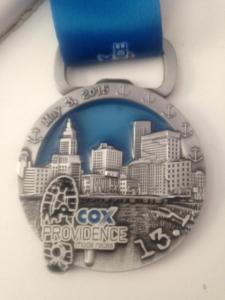
And that’s exactly what we did. The course had a lot of long rolling hills, including some challenging ups for me; hills that, while not steep, felt like they lasted a LONG time. I’m glad I did some hill training. We finished in 2:25:36, and I am very pleased with that. It was a gorgeous day to be running. And they handed out a really snazzy medal.
Fitting in.
When people make pointed effort to remind you that you don’t fit in, it’s ok to be gracious and agree with them. I don’t need to fit in to every place. I don’t need to be a member of every group. I don’t need to wedge myself into places I’m not welcome, or that are just generally unwelcoming.
When we first get sober we are often told that we need to change all the people, places, and things that associated with our drinking, our desires to drink, and our generally toxic behavior. Trying to fit in where I’m not welcome is one of my toxic behaviors. It’s vain. It’s self-centered.
I find myself changing my behaviors and modifying my nature to try to achieve stature in groups that are manifestly hostile. I don’t know why I do it, other than to feed my ego. I like to be seen as an important member of the community. I often don’t focus on whether that community is a positive place for me. I often don’t consider if the person I have to be to fit in is a person I admire and respect.
Being sober is so much more than not drinking. It’s recognizing what things represent intoxicants in my life. What do I do to pursue them? What does that cost me? And when I recognize that I’m participating in a toxic environment, what am I willing to do to stop? What am I willing to do for serenity?
Providence!
I’m feeling a bit more centered and relaxed after a great men’s meeting and talk with my sponsor last night. More and more I’m beginning to feel like the end is near for my primary interaction with the online world, my Dr. 24hours twitter account. I may return to this being my main space, and I may take time off here too. I’m thinking of trying to do a different kind of writing for a while. A kind that’s not directly posted for the world to see immediately. I don’t know. Things are vague. But the way I’m interacting with the online world needs to change somehow.
This weekend I’m heading to Providence, RI to run in the half-marathon. I’m excited to run with my friend and with my partner. It will be the smallest race I’ve run: fewer than 5000 people between the half-marathon and the marathon put together, and those two races are mostly on different courses. I suspect it may be a fairly sparsely populated affair, once we get out on the roads. It’ll be interesting to see if I prefer the different vibe.
This race is not about speed. Not about trying to put up a big time. It’s just about running. I want to run from one end to the other with my friend and my partner and cross the finish line and then get brunch. That’s the whole goal. I want another medal to photograph and display on my wall. I want to check off another goal and feel confident going in to the fall running season with another half-marathon and a full marathon on my docket.
It’s a crazy travel schedule, and far worse for BB than for me. But we’ll do it. We stretch to do difficult things. I expect the Providence half to be more difficult because I think it’s kind of hilly. I’ve done a little running on hills, but ECC doesn’t have many, and that makes it tough to do serious training. I think I’m going to start running the stairs in front of our big institutional museum building. If I’m going to dispense of this flab I need to kick my efforts up another gear.
I don’t know what my goals will take to reach. But I know I’m striving. Striving is good. And failing is ok. I work hard to achieve things, and I’m eager to succeed. But I learn from making it, and from falling short. And my real goal is to try, daringly. When my goal is to try, I almost always find myself achieving.
Scientific Paternalism.
This isn’t about GMOs. My opinion on GMO crops is that they are safe, and should be widely adopted for the many, many benefits they bring. Humans have been adapting crops and animals to their needs for millennia, and now we have some new ways to do it. I have come to this opinion based on talking to many fine biologists and biochemists, who do this work. Who understand it thoroughly and have oversight. GMOs are safe, and valuable. They are a solution to food security in a world that desperately needs food security. This isn’t about GMOs. But I’m going to discuss labeling of GMO containing products in order to talk about the culture of paternalism in science.
I don’t have a problem with the idea of labeling GMO products. I think it’s a little silly. I think there’s a risk that labeling them will make people think they’re risky. I don’t know where the public stands on the labeling issue, but I know that there is a significant portion (perhaps a majority?) of the public who would like to see these products labeled. If that interested group is successful in lobbying lawmakers to label GMOs as GMO, I won’t lament it, even though I don’t see that it’s a necessary label from a health or safety perspective.
The argument against labeling GMO products is essentially that the labels do harm, because they make a product seem to be risky when it isn’t. And that that injects mistrust into the relationship between food scientists, and by extension all scientists, and the public. Therefore, many (perhaps most) scientists oppose the labeling of GMO products because they believe that it is both bad for public perception of science, and maybe for the public health if GMO products are unnecessarily rejected.
I don’t really accept that argument. Or rather, I’m not sure that that argument is being made entirely in good faith. Scientists today remind me of physicians not too long ago: highly educated, and often indignant that people will not take their word unquestioningly. Just as physicians used to conceal patients’ diagnoses, just as they used to prescribe treatments in secrecy, many scientists today seem to feel that the public should just take their word for it when it comes to science, and accept that because scientists have extraordinarily advanced training, they understand what’s good for the public. Explaining everything is complex, and may be fruitless. Some things simply cannot be communicated in detail to people without specific education.
Scientists are deeply concerned with the erosion of public trust in science. We worry that if people don’t accept what we say, there will be terrible consequences with regard to things like food security. Climate change. Vaccination. And on that there is some truth: we are facing terrible consequences on those fronts.
But I see the battles we fight on the issues, vaccination, GMOs, climate science, as somewhat distracting. The core problem is not that the public doesn’t trust us on these issues. It’s that the public doesn’t trust us. And that gets assigned to anything that the scientific community starts to be concerned about. And the reason the public doesn’t trust us, I think, is that we as a group have a record of being untrustworthy.
Science has grown by leaps and bounds in the past half century with regard to ethics. Part of the reason for that is that a lot of horrifying things were done in the name of science. Whole ethical apparatuses had to be constructed to protect people from scientists, and physicians, who I think usually truly believed they were acting in the public interest. The perpetrators of the Tuskegee atrocity probably thought they were advancing the cause of relieving human suffering. But scientists, like any other group, are capable of rationalizing vile things when they believe that the ends justify the means. And because we’re smart and educated, we tend to tell the public, “Trust us.”
Scientists, in addition to the rare moments of true horrific evil, like Tuskegee, have a nice long record of just being wrong. Arguably, science is simply a long, evolutionary process of being less and less wrong. Many times, things that we believed to be harmless have turned out to be harmful. Especially in chronic exposure to low, acutely non-toxic substances. Medicines that help one thing but cause slow, stealthy harm in another arena, only discovered by longitudinal analysis years later.
The way GMO research is conducted, and the way foods are produced using genetic modification, I think that this risk is incredibly low. And there is already an oversight process in place. But it isn’t zero. The risk of any human endeavor is not zero. And even if there are risks, the benefits of GMO, I think, clearly outweigh any potential harms, which are likely to be vanishingly rare. But I don’t think that this means that we should reflexively oppose labeling GMO foods as GMO.
I think one reason for the core distrust of scientists among the public is our paternalism. Or insistence that we know everything. Our condescension to them to not worry their pretty little heads about it. No need for a label. We promise it’s all ok. We reject this attitude in medicine now. Patients have the right to share decision-making with their physicians. Why should consumers not have the right to share decision-making with scientists?
That’s where we need to start the discussion. There needs to be an incredibly compelling argument to conceal information from the public. We despise it in politics. We despise it in medicine. Scientists despise it in each other, with the increasing movement towards open data, methodological transparency. If you’re not sharing all the information, it’s reasonable to distrust your methods and your motives; so say the open science advocates.
And yet we turn around and tell the public: we’re not going to divulge which food products have been genetically engineered in a laboratory. Just trust us. It’s totally fine. The FDA looked at it and everything.
For once, I’d like to see the scientific community embrace openness and transparency before the public. I’d like to see us drop the reflexive defensiveness we have that the public might dare to question our skills, our motives, and our assertions. I’d like to see us say: “These labels are unnecessary. But maybe it’s not really about us.” Maybe it’s about the public’s right to have information it wants, even if that information isn’t really all that informative.
The scientific and academic community is rightly dismantling paternal and patriarchal systems throughout the conduct and development of science and knowledge. And yet we are fiercely paternal when it comes to non-scientists accepting what we tell them. It’s unbecoming. I fall on the side of letting the public decide what information it wants. I don’t support the labeling of GMOs. I don’t think it’s necessary. But I don’t oppose it. Because it’s not really about the science. It’s about the right to empower the public to make its own decisions.
Maybe relenting on our paternalism will help the public decide that we’re partners in societal progress, rather than self-styled philosopher kings.
It Never Ends.
Today I am having my Air Conditioner replaced. Another $3,500. I am now past the $20,000 mark on repairs to this house that was sold as if in livable condition. I count myself incredibly fortunate that I have had the resources necessary (with a little help from my insurance company and my mom) to make the needed repairs. I don’t know when they’ll be done. It’s not yet. I still have to fix the floors and sheet rock from the roof leak. That will probably be a couple more grand.
It’s frustrating, and it never seems to end. But this is where I am in my life. The big middle. I work. I maintain. I improve. Wealth is created through labor. This is true of personal financial wealth. It is true of spiritual wealth. It is true of the wealth of body we enjoy when we are fit and healthy. Obviously, labor is not the only source, but it is a significant one, and it is the only one that is under my own ability to control.
By doing all these repairs on my home, it will be worth more when I sell it in a few years. By working and establishing my name and my expertise, I will make myself more valuable in my career. But continuing to improve my diet and my physical condition, I will be preserving my health into my later years. My practicing my program in Alcoholics Anonymous, I am able to maintain my remission and spiritual fitness so that my perspective stays appropriately reasonable and my spirit remains serene. Such as I can.
I have a tattoo that says “Strength and Courage”. And I have a tattoo that says “Serenity and Wisdom”. I need another that says “Acceptance”. Resentment, lamentation, and rage do me no good. I am angry about my house. I was mislead, and I believe defrauded. But I can get no recompense. The sellers have plausible deniability on everything, and so I settled with them for a pittance rather than waste everyone’s money on lawyers. I accept that and I’m going to be ok.
Friday, when I learned I needed a new air conditioner, I just laughed. I’m putting in a Lennox. Compressor and coils. Replacing the piece of garbage that the place came with. A brand that apparently everyone knows is garbage but my inspector never saw fit to mention. The furnace is the same brand, and I will probably have to replace it soon enough. For now, it works. And if I have to replace it, I’ll have it done right and then I’ll have a house with a high quality HVAC system to sell when I sell it.
It never ends. And that’s a good thing. I am in a constant battle with my own entropy. I labor to improve myself and my surroundings. It costs time and it costs effort and it costs money. I’m fortunate that I have the ability to muster those things. And my ability to muster those things is in part a result of the labor I did earlier in my life (along with many other factors, including many privileges I was born with).
I’ve heard many times that if we’re not moving forward, we’re moving backwards. I think that’s nonsense. Standing still can require enormous efforts. Discipline. And labor, to defeat entropy and maintain a stillness of space worth inhabiting. Standing still can be revolutionary act in world determined to race from conclusion to conclusion. I will stand and contemplate. I will build a small place where I can breathe slowly.
In this moment, I am here. I have worked hard for here. So I will stand still in this place.

 Infactorium