Secrets and Lies.
I’ve recently hurt some people I care about. I try to console myself by telling myself that I wasn’t trying to be malicious. But I have to admit to myself that withholding information that other people would use to (maybe) make different decisions is not honest. I’m not going to describe the actual circumstances here. Suffice to say, I conducted myself badly. And as a result, people were wounded.
In the midst of this occurring, I got an email from a new reader of this blog. A woman with 5 days of sobriety, asking me for advice about whom to confide in about her sobriety. She didn’t want to be keeping secrets, but she also didn’t want to risk repercussions associated with being discovered as a person suffering from alcoholism. I told her that keeping secrets and not telling people things that are not their business are not the same thing. I further advised her to find a women’s meeting immediately, and listen to what they told her.
So, I need to apply my advice to myself. And pay close attention. The truth is, I can be very selective about what I think is “none of their business” when I fear that someone may act on the information in a way that doesn’t align with my desires. That’s selfish. It’s dishonest. I spoke to my sponsor about the situation. He agrees that I had an obligation to be upfront in ways that I wasn’t. The situation can probably not be set right, in any meaningful way. I simply have to accept that I hurt some people and learn from that. And go forward and be better.
I try to progress in life. I feel like I took a step backward recently, and I’m not proud of myself. What I know is that I rarely make the same mistake twice. And I owe it to everyone, including myself, to behave better.
International Meeting for Simulation in Healthcare
I’m in Florida for IMSH 2013. I forgot my laptop cord. So I’m blogging from my phone, which sucks. I’ll be brief.
I just had a great sit down with a brilliant young woman who does what I do: discrete event simulation of medical systems. She’s doing a short post-doc with a friend of mine. We’re going to sit down and do some model analysis later. It’s exciting to see the next generation, and humbling to think that at 38, and really just starting the middle part of my career, I’m already and old guy.
But I’m excited for the conference and eager to learn. She suggested we propose a DES panel next year, and present the concept with our current results. I’m totally on board.
Further updates as events warrant! Dr. 24hours.. Out.
Sadness about Missing a Milestone.
I made a decision yesterday. One that makes me a bit sad. I chose my moving date. On 12 February, a truck is going to come and pack up all my things and take them away. They’re going to disassemble my piano and store it in chunks. Wrap up all my furniture and put it on a truck and then keep it for 3-10 days. Finally delivering it to ECC on 48 hours notice. And charging me enormous sums of money if I can’t arrange for it to be delivered when they say. Which is reasonable. If I wanted a specific delivery date, I could rent a whole truck. For like, $35,000.
Things are coming together, but it’s very frustrating. I feel like everything is looming and piled up in precarious towers. Like the junk in the Room of Requirement. I pull on the wrong thing, and it all comes crashing down. I do much, much better when I’m coasting in a steady routine. This is about as big a disruption of my routine as is imaginable. Well, barring catastrophe.
But objectively, things are coming together in a neat bow. My house is rented for a year. And LawnBoy and his LawnWife are going to manage the property for I have an apartment in a great place, close to work. I have figured out how to sell my car. I’ll get less for it than I might if I were willing to invest more effort in it, but more than I expected when it first occurred to me to sell it. So I consider that a fair split. And it’ll finance a nice vacation for me. The major things I have left to handle are utilities, and actually getting my ass to ECC.
I’m still thinking about my budget. It’ll be roughly the same, all things considered, I think. My rent is going to be vastly more. But my car expenses will go from about $400/mo average to about $0/mo. My utilities should be going from about $250/mo to about $100/mo. I’m not sure about TV and internet. Currently, I have U-verse internet bundled with my iPhone. I’ll have to separate those to determine the cost. And I have DirecTV at home, which is about $85/mo. TV and internet have to be bundled where I’m going, because of the building rules. I’ll have rental income coming in from my house. And I’m getting a raise. Taxes will be different, and probably higher. I’m not sure how it’ll all work out.
But I am sure it’ll all work out. I do the things. The fact that I’ve started packing already is helping me stay sane. And I’m going to a conference in Florida for the next few days, which will be very cool. I’m seeing a friend there who is also a collaborator. It’s very exciting, even though it’s an insanely bad time to be doing it. Welcome to being a grownup, Dr. 24hours.
And seriously, just the change of address notifications alone drive me mad with anxiety.
But the big sadness is that this means that I will not be in St. Louis for my 5th sober birthday. I’ll be alone in ECC, probably in an empty apartment. I’ll go to meetings, of course. My sponsor will mail me a coin, I think. We’ll figure it out. But I’m going to miss my friends. I’ll miss my homegroups on Wednesday and Sunday. Passing my coin around among friends who are like family. Instead, I’ll be in a strange new city, knowing no one. It sounds lonely. But I know you’ll be here for me, dear reader. I’m not ashamed to admit that I think I’ll need you.
This post is so meta. So, peer review is one of the core concepts in science upon which the apparatus of scientific pursuit and dissemination is hung. Peer review means that science is not done in a vacuum. When I do some science and then write it up to share with the world, other scientists, ideally those highly likely to be able to understand what I did and how well I did it, read my paper, and make corrections, assessments, recommendations, criticisms, etc.. Then, an editor, who is also a scientist, will decide whether to publish the paper or not based on that critique and how I respond to it. Peer review is also conducted of grants. Before a grant is funded, it will be scored by scientists in the field who assess the likelihood that the grant will be successful based on the merit of the science and the track record of the investigative team.
There are lots of problems with the peer review process. It’s long. Reviewers are volunteers, so may not put their best efforts into the process. Finding appropriate reviewers can be difficult for cutting-edge science or interdisciplinary science. Reviewers are not machines, and may have unknown biases and personal grudges. And the entire process can feed into the glamor-magazine disaster that science has been beholden to for decades now, where the quality of a j0urnal is used as a proxy for the quality of a paper, when in reality there are myriad reasons that an excellent paper might be published in a smaller, less prestigious journal. Some argue that the only true review of a paper is the post-publication review in the arena of ideas. That all science should just be published openly, and then the good papers will rise to the top of the field. I don’t buy that entirely, but I’m intrigued by it.
So, today on Infactorium, I will do a post-publication peer review of a paper (which has successfully navigated the peer review process) about using agent-based modeling to study the peer review process! It’s a review of a reviewed paper about review! Charlie Kaufman and Spike Jonze could make another bad movie about it.
This paper(*) uses agent-based modeling to examine how peer review functions. Agent-based modeling is a system of using computer generated autonomous entities called “agents” to perform tasks and interact with each other. Agents may be endowed with attributes – variables representing their unique characteristics – and rules of behavior governing how they interact with each other and their environment. Other examples of agent based models include cells in a tumor, birds in a flock, etc.. Agent-based models are especially good at modeling large numbers of individuals that together make up a population which may exhibit emergent behavior. Think ants forming a community and building an anthill.
Allesina develops a model of the peer review system in an agent-based simulation. He does this in two basic scenarios: the way we have it now, where authors pick a journal, hope to be published, and repeat this process if they are unsuccessful (including a minor variation which allows pre-review rejection, or desk rejects, to make the scenario more realistic); and a second scenario where journals bid on papers (!).
Allesina’s model treats each author as a ‘source’ for papers, and each paper is given three attributes, which are distributed according to a probability distribution, on which the paper is scored by each journal: {Topic, Quality, Novelty}. Then, a paper is represented as a sample of those distributions: (t,q,n). Under the traditional model, the one we have now, the author then submits to the journal with the highest impact based on the expected values of the (t,q,n)-tuple, and the probability of acceptance at the journal.
A pool of reviewers then make their own estimate of (t,q,n) for the paper, with the accuracy of their estimate being biased by the familiarity of the reviewer with the topic (interestingly, this allows reviewers in this model to give inaccurate reviews!). The paper is then revised, which increases q and n (but not t), yielding the revised manuscript I’ll call (t,q’,n’). Finally, the paper is accepted based on a random number call defined by the paper’s final quality and the journal’s selectivity threshold. Rejected papers are resubmitted to different journals up to five times, and then abandoned. This process is described in the paper’s figure 1.
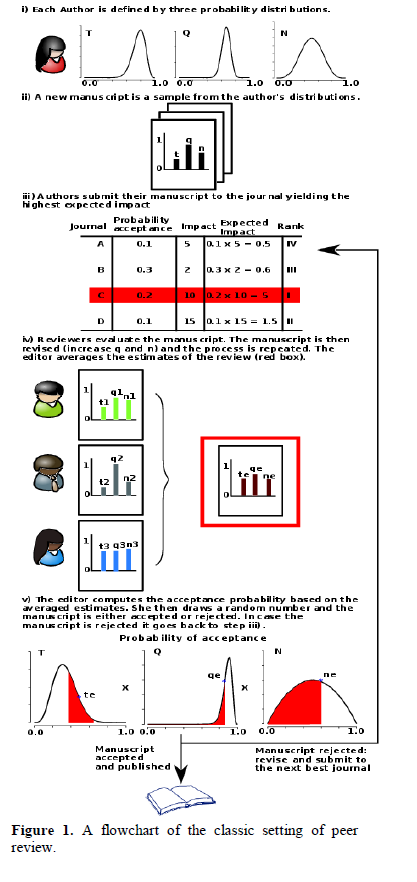 The first variant allows the editor to reject (but not accept) a paper prior to review according to an analogous process to the peer-review, but in very little time.
The alternative method of peer review that the paper uses would represent a radical departure from the current way of doing things. It creates a pre-review archive of papers, like arXiv. However, to submit a paper to the simulated preprint archive, the author must review three papers already in the archive (let’s ignore for the moment how the first three papers get submitted to the archive…). Authors select their “favorite” papers (i.e., the one they are most suited to review), and review them. Once a paper receives 3 reviews, it is revised by its author, and resubmitted to the archive for re-evaluation. The paper is not explicit in its methods in describing whether the revision is seen by the same three reviewers, or must undergo the random-chance revision process again. I assume the former.
Once the twice-reviewed manuscript is done, it is sent to a pool of aptly named “Ripe Manuscripts”. Journal editors then review all manuscripts and “bid on” (offer to publish) any manuscript that satisfies their publication thresholds and survives a roll of the dice. Authors then accept the bid of the journal that has the highest impact for them, based on their own peculiar desires. It’s a really interesting model. I have strong doubts that a real-world version could be implemented, but it’s a fascinating proposal to study in simulation.
The results were very interesting as well. The same 500 authors and 50 journals were simulated for 10 years in each of the three scenarios. In the classic setting without editorial rejection (A), 67.6% of papers were eventually published somewhere. In the setting with editorial rejection (B), only 41.5% of papers were eventually published. However, in the bidding scenario (C), 97.6% of manuscripts were eventually published. Another really interesting bit is in the amount of work for reviewers. Under (A), 9.64 reviews per manuscript had to be performed. Under (B), 4.71. In (C), each manuscript received exactly three reviews (bearing in mind that re-review after revision counts as the ‘same review’.).
Authors had more publications and higher average impact of their work in the bidding setting. Average time to publication of a manuscript went from (A) 22 months to (B) 16.8 months to (C) 8.7 months. As expected, mean quality of a paper was lowest in the bidding group, because nearly everything ended up published regardless of quality.
Allesina notes how idealized this simulation is. Authors know precisely the quality of their own work and the probability of being accepted by a particular journal. Reviews are all useful. However, the simulation shows just how responsive these systems are to both minor and major perturbations. The introduction of editorial rejection drastically reduces the number of papers and time-to-publication or abandonment. The wholesale change scenario (C) makes an even larger difference, with vastly more science published with dramatically reduced review effort and time-to-publication.
Allesina’s big takeaway here is not about a particular method of peer review (a far more complex model would be needed to make real-world conclusions about the effective consequences of changes to the system and to have predictive validity, and Allesina notes that.). It is that modeling these complex systems can provide useful insights, and make quantitative evaluations of proposed changes.
If I may briefly editorialize, this paper is an excellent illustration of my reticence to wholly endorse the Open Access publishing model. I agree with the ideals behind it: more people should have more access to more science, and it should cost less and be more efficient. But the system is huge, complex, and has many semi-independent subsystems. Small changes to funding models, review process, access, etc., will likely have far-reaching consequences that we cannot know without careful study. So I endorse the open access goals of widespread dissemination of science. But one has only to look at the fiasco created by the public funding of science (another good ideal) to see that the unintended results of systemic change are not always good. I prescribe study. Funded study. By people like me. Or me.
_________________________________
(*) Allesina S, (2012) “Modeling peer review: an agent-based approach”, Ideas in Ecology and Evolution 5(2): 27-35
Science is a Hideous Bitch Goddess.
With all due respect to Tennessee Williams, Or William James, or George Burns, or whoever actually said that first about show business (Bart Simpson?), I think the sentiment applies quite well to pursuing the scientific arts. I am, of course, not in the strict realm of academic science. Some will tell you I have no claim to the mantle of “scientist”. My degree is in engineering. I work for a hospital, not a university. My academic appointment is a courtesy, and only adjunct. I’m not a real scientist like those real scientists who teach and have fancy labs (I have a lab, but boy is it ever not fancy… or even all located in one place, or used to anything like its capacity.).
And I myself often don’t really claim the title. As an engineer, I prefer to do work that is designed to be applied to and improve real world health care delivery systems, not test hypotheses and incrementally advance generalizable knowledge. However, I then like to try to publish these ideas so that other clinics, other hospitals, can adopt the solutions we come up with in ours. Because many, many clinical systems in diverse environments face the same struggles. Each is idiosyncratic, but each bears many basic similarities to others as well. And the process of developing ideas, testing them in a pilot clinic (experiment) and then distributing them in the literature (dissemination), is a scientific process.
What I like about engineering – direct, applied engineering – is that I get to engage with and improve my local environment. As such, success or failure is generally on the basis of my own merits, and those of the people I work directly with. This stands in basic opposition to most university based scientific pursuits, where success vs. failure is often, in the first place, predicated upon the successful writing and funding of a grant by an outside agency, which is a prospect that is these days as likely to hinge on luck as talent. Everyone applying for grants is absurdly talented. And there’s not enough money to go around. Reviewers far away with limited time and energy will decide your fate.
Success in engineering is also measured by simple metrics. Does my clinic perform better after my intervention than it did before? According to basic metrics that have been laid out ahead of time. Scientific success is also measured along these lines (Did the experiment produce the results the hypothesis predicted?), but it is also measured by the quality of the journal you publish in, the number of papers you produce annually, etc.. These things are also based somewhat on luck. You might have a brilliantly conceived and flawlessly executed experiment. Editors far away will decide your fate.
In science, there’s a lot of rejection. Papers, grants, applications for incredibly rare faculty positions. Even excellent, brilliant work will get rejected a lot. In the case of grants, the NIH and NSF and VAORD are rejecting hundreds of grants a year, probably thousands, that would produce fine results if funded. I’m not going to get in to my opinions on the state of federal funding right here. I’m just noting that a lot of good, hard work goes unrewarded when you’re in science. In the case of papers, if your topic isn’t what some associate editor thinks is most relevant for the journal right now, unless you’ve decided to submit to PLOSone, your excellent work won’t be published.
Science has many incredible intermittent rewards. Yesterday a paper of mine that had been languishing un-cited in a minor journal got its first citation! I was thrilled! Someone read my work! Sure, the citation was essentially just to note: “Humans have done work in this area.” But still. Someone at least read the abstract! Now that it’s been cited once, it’s much more likely to be cited again. Maybe someone will actually pay attention to my result. Maybe I’ll have made an impact somewhere, a little bit.
I have a couple of papers that have been rejected several times each out there right now. I’m trying like hell to get them published. One, the one I’m most eager to see in print, somewhere, somehow, passed its first hurdle. It was sent out for review by the journal I submitted it to. No desk reject! That’s exciting! At a pretty good journal!
When a paper is accepted, or a grant is funded, or a student is accepted into medical school or graduate school, the rewards of science are blisteringly hot and glorious-resplendant. Even when things are not going superbly, being a scientist and a researcher carries prestige. People are impressed. Even my own essentially meaningless title of “adjunct assistant professor” sounds really good when it falls off of my tongue. Even though I realize that I don’t think I would want to be a full-time, tenure-track professor, I’m envious of people with that title. It’s a prestigious title.
Science is a grueling profession. Dizzying rewards. Catastrophic rejections. Good people, fine scientists, routinely leave the field for no reason other than bad luck and a bad system. Over the avarice of administrators, the poverty of funding agencies, and the short-sightedness of editors. I’m glad to have carved myself a niche in the scientific world, the engineering world, where, while I may not wear the cloak and scepter they give to tenured professors, I can be happy, productive, useful.
Because I think we shouldn’t forget the purpose of science. While frantic scientists scramble to maintain their livelihoods in an era of vanishing support and upheaval in the publishing industry, I hope we don’t lose sight of the ideal of science. The search for new knowledge. The unbroken chain of innovation that recedes to antiquitous revelations of spark and blade; that stretches in front of us to the clockwork of the mind, to the riverbeds of Mars, to the preservation of this teeming, mad, unutterably beautiful world.
This is the seduction of science. It is worth all the pain we suffer for it.
Things Done. Things to Do.
I have accomplished an enormous amount with regard to my upcoming move. Most of my home, not including the kitchen, is packed, and I have gotten rid of hundreds of pounds of things I no longer want/need. I would bet that between books and clothes, I’ve donated more than 300 lbs of perfectly good stuff to the goodwill and a local nursing home. I was surprised to learn that the library was not interested in a box of perfectly good books. But they turned me on to the local Catholic nursing home system, who happily accepted a box of books so heavy I thought I would crumple beneath it. My generation, when we’re seniors, will be happily accepting old Call of Duty XLVII games for Playstation 10011101.
I’ve given away much furniture and other equipment, including a lovely pair of Magnepan SMGcs. I still have a bit of stuff to get rid of. Craigslist was a total bust for me. Not one inquiry for my sofa. One scam offer for my entertainment center. One legitimate inquiry – I think – for my small wardrobe, but which fell through. Luckily, my tenant will accept the place with a few furnishings. And since I don’t really care about them, I’m not particularly fussed if her cats rip them apart.
I’ve made an arrangement to get an estimate on the move. I’m terrified at the expense. The piano alone is going to be absurdly expensive. But the truth is, I have no idea what to expect. I won’t be shocked to hear anything from $2K to $10K. Thank god moving expenses are tax-deductible if you go more than like 100 miles (I’ve been told. Right? Right?!). I’ve rented an apartment. I’ve done all of the tasks I’m required to do for starting my job at PECMC, though I still have to deliver the original copies of the fingerprint report. I’ll do that after I move there.
There are a number of things I have left to do:
1) Talk to my insurance company about the issues associated with renting out my home.
2) Arrange for the actual move to be planned.
3) Create and sign the lease with my tenant.
4) Deal with utilities (ending the ones at my home, establishing the ones in ECC).
5) Figure out how to sell my car (this is harder than it sounds, if you want a decent price).
6) Decide if I’m keeping my parrot.
7) Figure out what to do with my parrot if the answer is “not”.
8) Move.
9) Everything I’ve forgotten.
Seriously. This is amazingly complex. The last time I moved I was still a drunk. Doing this sober affords me the ability to do things well and correctly and on time and without incurring extra expense. But it also forces me to handle it without chemical relief from the stress. Obviously, I have no desire to drink. I know what happens when I drink. But I am at least occasionally envious of those who can work hard at something for a long time, and then relax with a drink that makes them feel happy and helps them unwind.
But of course, drinking doesn’t do that to me. If I have one drink, I don’t feel relaxed and unwound. I feel utterly obsessed with having a second drink. Then I obsess about a third. I wonder if normal people can understand what it’s like to be thinking about how you’re going to get your next drink while you still have a full glass in your hand. The entire day’s drinking consumes my thoughts from the moment I have the first one. From before I have the first one. When I am a drinker, nothing but drinking can matter. Everything else is just the stuff that I have to do to get back to the bottle.
So, yes, I fantasize occasionally about being able to have a beer and relax from the stress of moving and changing jobs. But as I’ve written many times, what I fantasize about it not how it was. It’s a gilded version that was never real. I was a drunk from the beginning. And it’s important to understand the difference between a fantasy and a craving. I don’t have cravings anymore, thank god. I can’t say I’ll never have another one, but it’s been nearly five years since my last one. And thank god. Cravings suck.
I also fantasize about being able to fly, being an object of adoration by underwear models, and winning the National Medal for Science. Fantasies are fun! But I have no need for them to be grounded in reality. Alcohol is part of my past. I have left it behind, gratefully. Now, I confront my life on the terms that it has for me. And all things considered, those terms have been pretty good for me.
Legal Matters.
Today I have the day off of work for Martin Luther King Jr. Day. I’m using it to, among other things (like watching Obama’s second inaugural address), go through my important legal documents and make sure that I have everything I need for the move in one safe place. This means the deed to my house. My divorce. The title to my car. My passport.
Going through my file cabinet is odd. It was half-populated during my drunk days. Half by my ex-wife. Half during sobriety. But I never actually went through and cleaned it out. Even in sobriety, official paperwork frightens and confuses me. I’m not good at administrative things. But some things simply have to be handled correctly. I have a deed and associated quit-claim to my house. I need to have those things, so that when I sell the house, I can do so legally and correctly. I have to have those things. There’s no other option. If I want to travel abroad, I have to have my passport. If I want to sell my car, I have to have its title.
The gift of sobriety is that I have is that I can look dead-on into the face of my fears and discover that they have only the power that I give them.
A Visit to the Past.
Today I am going to visit my old psychotherapist for a single session. I’m going for nostalgia, more than anything else. I spent a long time in psychoanalysis. I know there are a lot of people who consider that pseudoscientific babble, but I don’t have a dog in that fight. In my case, it helped in some areas, not in others, and in general led me to a far greater understanding of myself in ways that helped me be liberated from shame about my past and my desires. But it didn’t lead me to changes in behavior. AA did that. So, I consider psychoanalysis to have helped me, but it would not have been sufficient to bring about the substantive changes in my life that I needed to achieve independence from my past, and from alcohol.
I stopped seeing my shrink almost four years ago. I was a year sober, and my wife and I were going to try to have a baby. I had a great new job and was feeling invincible. I felt like I had a deep understanding of who I was, where I was going, and what I was doing with my life. I was happy. It was time to move on. And of course, over the next year and a half, all that fell apart (except the job). But even as it did, I didn’t fall apart along with it. I felt confident and capable even in the midst of all that confusion and misery. In part, that was because of the strength of my psyche that I had built while working with my shrink. In part, it was because as a sober man with the support of a strong community, I was able to confront difficult things.
Lots of drunks engage with psychotherapists, and for various reasons. Oftentimes, we do it in order to get people off of our backs. If we say we’re seeing a shrink, then we’re “addressing the problem” and then the fact that we keep drinking can be framed as someone else’s failure, not ours. Or we can simply use it to browbeat people who want us to quit: “I’m seeing a doctor about it! What more do you want from me?” Alcoholics are very good at presenting our failures and continued drinking as other people’s faults, and blaming our victims for our drinking. “If you weren’t such a horrible person, I wouldn’t have to drink so much.”
Most of us in AA have found, it seems, that psychologists never helped us much. As I wrote above, while I feel that I have gained an enormous self-understanding, and developed excellent tools for introspection, from psychotherapy, I don’t believe that psychotherapy would ever have led me to quit drinking. Maybe it can for others. The people who drink like I drank have not, in my experience, been led to sobriety through engagement with mental health practitioners alone. I think that alcoholism is recalcitrant to treatment imposed by others. It is best treated in a community of recoverers who all have a stake in the outcome.
But I am looking forward to seeing my shrink. I had a huge crush on her. She’s brilliant and beautiful, and of course the analytic relationship is enormously intimate. It’s a cliché to be attracted to your shrink, but it’s a cliché because it’s so natural. I want to go to tell her about the successes I’ve had, and the failures. I want to share my excitement and fear. I want to refresh the way of looking at myself that she helped me cultivate. And it feels like a bookend. I spent a great deal of time in her office, hacking my way through a jungle of terror and humiliation and rage. Now I get to go tell her about the clearing she helped me carve, the fire I built. The tree houses I’ve constructed and the wells I’ve dug.
Because what I’ve learned about myself is: I was born in that jungle. I was probably born an alcoholic. I was probably born a depressive. Challenges I was born with, and challenges that landed on me early in life, have shaped me, the way they shape all of us. My experience is mine, but it is not unique. And in hand with many challenges, I have been given many gifts. I am grateful, today, for all of them.
New Podcast!
Things That Will Change.
Aside from Everything, that is. So, yes, I’ll be changing cities and changing jobs. But many other things are changing too. I have probably permanently removed myself from tenure-track professorial consideration, supposing that was ever something I truly wanted, of which I’m not sure. I certainly had no interest in it upon graduation with my PhD. And I certainly didn’t see it as my path when I entered grad school. In fact, it popped up on my horizon only recently, after I was transferred to a research position about three years ago, and expected, suddenly, to be a PI when I’d never written a grant, and had only three papers to my name. But I liked the challenge of research, in a way that I did not as a graduate student. My interactions with grad students and post-docs and professors on twitter led me to want to try to compete on their field.
I wrote about 7 more grants after my first one was funded. Only one was triaged, but none were funded either, and my scores ranged from about the 30th to the 70th percentile. I have two currently in review (well, one as PI and one as CI), and I don’t expect either of them to be funded either. I have still not had my papers from my funded grant accepted, though I’m presenting a poster at a good conference later this month.
But my position at PECMC is a hard-money position performing Quality Improvement using simulation techniques. I will be allowed to publish, but I will almost certainly not be submitting grants. At least, not for a good long time. A few years of QI work will be needed, at minimum, before anyone is going to be interested in me branching out on my own. And I’m scared of writing grants, because as soon as you do, people expect you to get funding, and then they expect you to keep covering that portion of your salary and then you’re back on soft money.
But, as I said, when I planned my career as a student, professorship wasn’t the plan. It became my alternative career. But now, I’m back on track to do what I set out to do: improve quality and efficiency in medical systems. With the added bonus of continuing to disseminate results through publication. Which means that if I do go on to seek a professorship later, as an established researching engineer, I’ll have a track record of publication to demonstrate continuing productivity. Presumably. I know that publication is more important to me than to them. But I will be a powerful advocate for what it can add to my new department.
Other things, silly things, are going to change. I won’t have a car. The task of acquiring groceries without a car seems.. insurmountable. But there’s a grocery store across the street from my new building. And an awesome market – a lot like the Pike Place Market in Seattle – less than a mile away. Walk there, take the bus home. There’s a bus that goes directly from the market to my doorstep. I’ll walk to work too, and there’s also public transport that goes door-to-door home-to-work for those days when the weather is too awful to walk.
And I’ll need to change how I dress for work. Now, I’m in khakis and a button up shirt or a polo. I’ll need to be in business dress most of the time. I think that slacks, oxford, and tie is acceptable. But I’m not 100% certain. I like dressing up, so that’s not a problem. But it’s a change. I’ll probably have to make sure my hair is cut monthly. I’ll have to shave more often. I’m going to have to use an Atul Gawande trick and put up a laminated check list so that I can do all the things on a schedule.
And I’ll have to spend more hours in the office, and take shorter lunches and bring my lunch more. In fact, I’ll probably have to bring my lunch almost every day. I haven’t brown-bagged since highschool. But I’ve also recently calculated what I spend on lunch, and it’s ungodly. I can cut it by two-thirds, easily, by bringing my lunch to work. And that brings me to the other big change: financial responsibility.
Right now, I’ve been in a really nice situation with respect to benefits and salary and rent. I make pretty good money, and have been saving aggressively to make up for the fact that I got crucified in the 2008 crash. My current job matches 5% in my retirement account. My new job will match only 2%, and not until I’ve been there for a whole year. They have some sort of pension system, but I don’t understand it. The documentation I’ve been given is not clear in the slightest. But it’s a standard package for all employees, and was not subject to negotiation.
I’ll be making more money at PECMC than I am here, but I’m also going to be paying a lot higher for housing (like, astonishingly higher), and for other basic living expenses. In terms of my disposable income, it will actually drop some. Though my electric and water bill will be lower. And I’m renting out my house, so there’ll be some income from that. And there may be expenses, I’m just discovering, with grocery delivery. Large items like paper towels, toilet paper, and heavy items like milk and canned goods might be best to have delivered. As usual, twitter, in the form of @modernscientist and @doc_becca, has proven very informative and helpful. Apparently, something called PeaPod can help.
So many things will change. Many will stay the same. I’m me, after all. I will still be me there. But I am looking forward to being me in a new place.


