Marine Corps Marathon Recap.
We woke up at 0415 and had coffee and granola. Strapped on our gear and headed out to the metro at 0500. Just missed the first train and caught the second. Rode to the Pentagon and got in the porta potty line. 40 minutes later, we got in the security line.
The security line was an uncontrolled scrum. We stood without moving for 40 minutes. Rumors of needing to go one way or another flickered through the crowd and I became genuinely concerned, then frightened, that there could be a crush or stampede. It was not a safe situation. Finally there was a break in the lines and some people jumped the fences rather than go through the metal detectors. We hurried to the start, well late.
We missed the howitzer and the national anthem. We didn’t even get to the start until 0813, 18 minutes after the gun, and after about two hours of standing in lines. I was disappointed to miss the pageantry, but we did see the parachuters and the Osprey flyover. And realistically, we’d only have gotten out a few minutes earlier if we had been at the start on time.
We began running in a thick crowd that only barely let up ever throughout the race. BB wasn’t feeling great at the start and it took several miles before the anxiety of the security fiasco wore off. Finally we fell into a rhythm around the 6 mile mark and started feeling better.
We paced really well. Perhaps a bit slower than we could go, but very steady at about 11:25. We kept that up without much variation through the whole race. But it got harder and harder. By mile 12 my feet hurt in a way they hadn’t in a long, long time. Standing around is hard. And we’d walked about 2 miles before the race start.
I just decided that it was going to hurt for a long time. It did, and I kept running. We slowed to a walk through all the water stations but nowhere else. And we took a couple of potty breaks and shoe tying pauses. Other than that, we ran and ran and ran. Great crowds. Great marines.
Mile 13, I think, is called the “blue mile” and is lined with pictures of marines killed in action. Then, you run under a tent of American and marine corps flags. It’s haunting and beautiful.
By mile 16 both of us were in a lot of pain. Much more than in our training runs. My quads were burning and my feet were absolutely wrecked. And we had ten miles to go. The bridge at mile 21 is a crucial landmark. If you don’t get there by 1315, you don’t finish. It reopens to traffic, and it’s an interstate. We got there with plenty of time to spare. And began running further than I’d ever run before.
By this point, I was out of gas, in a lot of pain, and ready to walk. BB said, “We can do five miles in our sleep.” She was running a gutsy race. Neither of us felt at top form. But we kept running because we had to keep running.
At mile 25, there were doughnut holes. One of the marines handing them out, a young African American Seargent, looked at me as I slowed to a walk to take the emergency energy. He looked at the picture of Phillip on my shirt, looked up at me and said, “You better be running, boy.” I got it. It’s about honor. If I’m honoring a fallen marine, I’d better run like a marine. I ran.
Right at mile 26, I heard my mom shout at me. I looked and pointed and saw mom and Aunt Julie beaming with pride.
The last few yards of the Marine Corps Marathon are called “taking Iwo Jima”. You turn the corner and run straight up a steep hill to the base of the marine corps memorial, a statue from the famous picture of the flag raising. It hurts. It’s hard. It’s cruel. We ran. We crossed the finish hand in hand and raised our fists. And finally stopped running.
Four hours, fifty-nine minutes, and twenty-three seconds. Those thirty-seven seconds mean the world to me. I did it, and I did it in less than five hours.
I am many things. I am a doctor of systems engineering. I am a researcher. I am a son and a brother and a partner. I am a sober member of Alcoholics Anonymous.
And now I am a marathoner. 
I Am a Marathoner.
Pictures and recap tomorrow or Tuesday. BB and I finished the Marine Corps Marathon just a few seconds under five hours. So from here on, for the rest of my life, I am a person who has run a sub-5 marathon. We crossed the line together after allllllmost 5 grueling hours of running. It’s done. We’re done. We did it.
Two Days Left.
Well, the marathon is Sunday. All the training is done. All the time has slipped by. From the disappointment of missing the lottery to the excitement of my Aunt Julie getting me a Race Director’s exemption. The miles and miles and miles of runs. I wrote a training plan based on things I’d seen online. It’s my own plan, written just for BB and me. With the sole goal of getting us to the point where we can finish this run. Twenty-six miles, three hundred and eighty-five yards.
I didn’t run the plan perfectly, but I got in all my miles – 475.3 of them – one day after another. In addition, I averaged a day-and-a-half each week at the gym, and rode my bike some 299 miles during the same period. And I managed to put on seven pounds. Because of all the rationalization of food splurges. In fact just now I had a huge piece of cake.
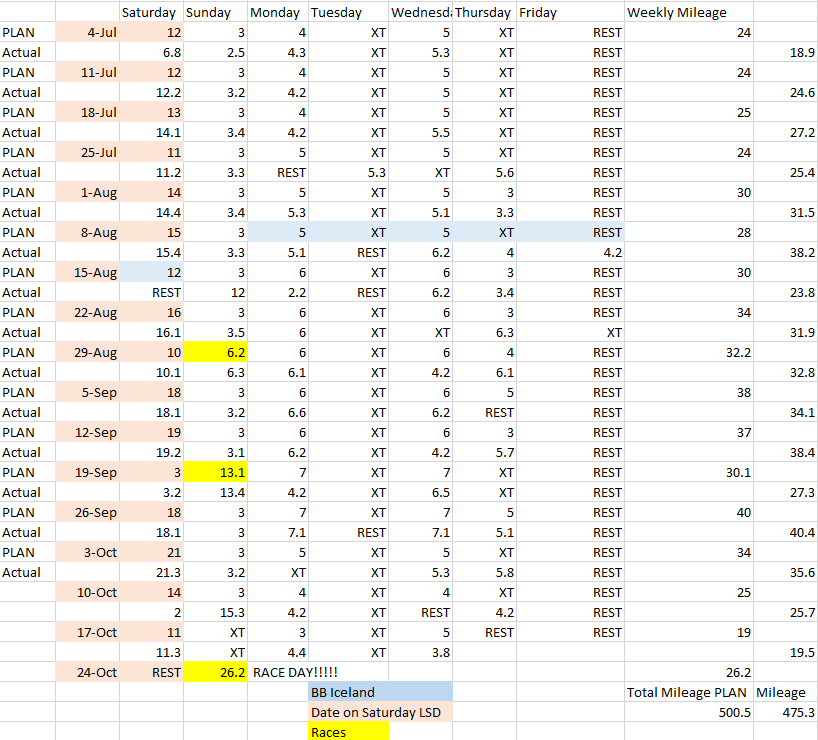
My last workout before the race was a 12.6 mile bike ride yesterday, at a good clip. I finished it in 53 minutes. About as much work as a five mile run. I’ve made my weekend plans. I know my tasks. I know what my race plan is. I’m ready to go. I’m nervous, but not scared. I’m excited. I want to finish. I want to finish strong. This matters to me. I want to be its equal.
Dictating the Terms of your Sobriety.
Yesterday at my Men’s Meeting a new guy shared about being angry. There are lots of emotions that bull-in-a-china-shop their way through you when you’re in early sobriety, and this guy has his share. He’s been sober a little more than three months, and he’s probably my age or maybe a little older, chronologically, but he’s about 14 emotionally. That’s true of a lot of us too. We often say in AA that emotionally, you stop maturing when you become a habitual drunk. When you sober up, you start aging from there.
New Guy was angry because his ideas for making meetings better aren’t being honored and listened to. This is fairly common. Everybody, when they first join AA, thinks they know how to make it better. This typically manifests in a few stereotypical ways, either about God or about gender (The book Alcoholics Anonymous makes a few assumptions about gender typical of the 1930s, despite the fact that it’s a wildly progressive document for its time.), or about tweaks to the steps.
Generally after a year or so, people settle down and realize that there’s no need to be fractious about things. We all live and let live, in AA, and the book is what it is and says what it says, and if you don’t want to take stock in something about it, well, feel free not to. Whatever works for you. Nobody’s changing the book. Nobody’s splitting up the fellowship over arguments about language. You just do what you do and take what works for you, and let others do the same. In this way, for some 80 years, millions of us have been recovering.
New Guy was angry today that when he had chaired another meeting (And, for the record, that’s a shit idea. No one should chair a meeting until they’ve got at least six months sober and done a few steps. New Guy hasn’t.) he had decided to change up how the meeting was opened, because he felt it was a little repetitive. So, without consulting anyone, he just did it. Because he doesn’t get that it’s not about him. Then, when his sponsor called him out, he got pissed off.
This is the same guy who, a few weeks ago, came into the Men’s Meeting about 5 minutes late, started talking over the speaker saying hello to everyone, and then announced, “Don’t wait for me, I’m just going to go to the bathroom.” I looked him square in the eye and said, “Yeah, we weren’t gonna.”
I’m hopeful for New Guy. I think he’s got a shot at this. But he needs to shut up and listen to other people. The people who come in to AA and start trying to change the program before they’ve worked it usually end up going out. I’m not talking about what happens to all of us, thinking we can see improvements. Some people come in and really fight the program. They make themselves crusaders about this topic or that, and get angry when people don’t immediately adopt their newer, “better” way. Why can’t we see how smart they are?
These people are trying to dictate the terms of their sobriety. One crucial aspect of the program, one thing that is required for people who drink like we drink to recover, is the surrender. We have to be willing to take direction. To do it someone else’s way. To recognize the possibility that we may not have the answers, and that we may be wrong when we feel 100% right. A lot of people come in with riders attached to their sobriety contract: “I’ll sober up if the world treats me right.”
Yeah, good luck with that. Generally, those people just need to do a little more research, as we say. When it’s time to embrace recovery and sobriety, we must come to it from a place of brokenness, contrition, and willingness. If the sentence, “I’m willing to do whatever it takes,” is followed by an “if” or a “when” or a “provided”, then you’re not ready. Go try something else, or go drink. AA probably isn’t for you.
We say that a lot in AA to newcomers who are disruptive or fancy themselves crusaders for a new way before they’ve tried the old. Or those who think they can learn to drink normally. Go ahead. Give it a shot. AA will be here when you’re ready. Sometimes they do, and they disappear or die. Sometimes they do, and they return ready to recover. Sometimes they don’t, they get it, and they recover. Sometimes they don’t, they keep up their weird crusade, and end up miserable but abstinent. Or they end up going in and out for decades.
All of those are ok. I will fight like hell to help someone who wants what I’ve got. But if you don’t, let’s make one thing perfectly clear: I’m in AA to save my ass, not yours. If I have the kind of life you want, and you’re willing to go to any length to get it, I can walk you through the door, up the path, and all the way to the promised land. If you don’t, or if you’re not willing to do what it takes, then I never had any chance of helping you in the first place.
The program is the program. Its worth is proven millions of times over. If you think you have an easier, softer way, I will be thrilled for you when you find it. Maybe you can help others. But I have found my way. It is the only way I know, or am interested in. Having discovered the way to peace, I do not need to fight any new battles.
Inching Closer.
Five days now. I’m looking forward to seeing my mom and Aunt Julie, but truth be told I’d be as happy to be running it with just BB and no one at the finish line. Sharing with too many people feels like dividing myself up and being spread too thin, emotionally. I don’t know how I’m going to feel at the end. I’d be happy to share that with just my partner. But life is what life is, and this run isn’t just about me.
It’s about my cousin Phillip, and his sacrifice. It’s about Aunt Julie, her grief, and her assistance in getting me a bib to race this race. And it’s about my mom, and her pride in her child aiming to accomplish something difficult. Those are all worthy things, and I am proud to take a part in putting them all forward. I’ll be proud of myself, when I finish. But then and there, it won’t be the time to say so.
I get to make it about me later. And here, on Infactorium. I’m the one who gets the medal. And I’m the one who gets to run side by side with my partner for the five-ish hours it will take to run the race. We get to be together. We get to accomplish this marathon jointly.
And you know what? Even if something goes wrong, and I get hurt or can’t finish or I just give up from cowardice and sloth, I’ve still run 471.5 miles in the training for this, in less than four months. I have 5 more to go this week. I’ve run a 21 mile run. I’ve accomplished so much just preparing to attempt a marathon, that I already feel like a victor. I’m 41 and in the best shape of my life.
I am, however, looking forward to switching things up for a while and not running all the damn time. A month after the marathon, I’m running a half marathon. And then I have nothing on the docket until March.
Nine Days to the Marathon.
I’d by lying if I said I weren’t a little nervous. The taper is a strange thing. I feel like I should be running more. I’ve had a couple of good four mile runs this week, including a fast one (for me) Monday. Tomorrow we run 11 miles, which feels, these days, like a nice short run. For a long run, I mean. We should finish that in well under two hours and be ready for brunch by 9:30. I have to be careful about not respecting the distance, any time you’re running double-digit miles, it’s a long run. But we’ve gotten to the point that less than a half-marathon feels eminently manageable.
Then, only 8 miles on the schedule next week. That kind of feels insane. But I will ride my bike some (I’ve ridden about 400 miles during the marathon training, and run a little more than 455.). And I will go to the gym a little. But mostly, next week is all about making sure I’m rested. I won’t lose any fitness in the week “off”. I don’t need to run 25 miles before Sunday to prep for the 26.2 mile run. I just need to trust the work I’ve put in and go take the big test.
I feel at the verge of a big accomplishment, and that’s great. But part of me wonders if there will be a bit of a let down. My body didn’t change the way I wanted it to. I never doubted I’d get to the point I could do it if I trained right and didn’t injure myself. But I don’t know what I’m going to feel when I’m done. I’ll just have to let it happen and see how it feels when it does.
I’m proud of the fact that when I set my mind to something I can generally accomplish it. I work pretty hard (but not as hard as I can) and more forward slowly until I get where I’ve decided I want to go. That means moving through pain and effort and doubt and fear, sometimes. So it does. I experience those feelings and accept them and move forward.
Life is pretty good right now. Sobriety, work, relationship, health, fitness, all are proceeding apace. I’m happy.
Approaching Sexual Harassment as a Manager.
As I enter the world of management in a formal way, I find myself thinking about things I would really rather not have to confront. In the science world over the last week, there’s been another of the all-too-common discoveries that a big name and prominent scientist was a serial sexual harasser. He’s been publicly admonished, and given a “zero-tolerance” policy for future crimes. But no formal censure. I won’t comment directly on that case, because I haven’t read about the details. But I’d like to comment a bit on the culture.
I asked, over on twitter, why there seem to be so many “open secrets” about who is a predator, and yet so few formal investigations. The primary reason I’ve been given in response, and it coincides with my own suppositions, is that the general rule is: the accused suffers at most a verbal warning, while the victim routinely has her career destroyed*. Often there is explicit retribution. Even if there is not, other institutions often decide not to hire a “troublemaker”. As if it were the victim who caused the trouble, and not the perpetrator.
I believe firmly in the assumption of “innocent until proven guilty” and that every accused person, regardless of the accusation, is entitled to a vigorous defense, and to confront their accuser. These are bedrock principles of any free society. The fact that an accusation is sexual in nature does not relieve the accused of these rights.
However, fanatical devotion to these rights leads far too many to abuse victims in attempts to silence, discourage, and discredit them. And this is done in a spectacularly egregious fashion with regard to sexual offenses in the workplace. We build systems, like Title IX (a well-intentioned disaster), that silence and bewilder victims in bureaucratic labyrinths designed to protect institutions at the expense of individuals.
I admit freely that I don’t know how to resolve the tension between these two poles. Justice is not only the righting of wrongs, but the assurance that a process is fair. It needs to be fair to both accused and victim. I don’t know what the right balancing of these issues looks like. But I know that where we are now, with respect to institutional investigations of sexually predatory behavior, seems unfairly tilted in favor of protecting institutions themselves, which generally believe that their interests are best served by pretending that “that doesn’t happen here”.
When the investigating party has a vested interest in finding that no wrong occurred, it is no wonder that victims are discredited and disavowed. And that leads me to what I believe my own position must be, as a manager**.
I, personally, have to start by believing the victim. The barriers against reporting sexual harassment can be so severe that it would be madness to file a false complaint. I say that knowing that false complaints exist. But they are vanishingly rare. And the existence of such things does not bear relevance on any case that’s in front of me. After all, I know people have been framed for murder. But I don’t automatically assume that every accused murderer is probably being framed. It’s absurdly uncommon.
That means being an advocate for them, and standing by them as they negotiate a difficult and bureaucratic process. That means supporting them and calling out any retaliatory behavior against them. That means coming forward with any appropriate evidence which I might possess.
It does not mean retaliating against the accused. It does not necessarily mean agreeing with the victim about what the perpetrator’s punishment should be. It does not mean substituting my own judgement or insight for anyone else’s.
We have a culture where institutions are rewarded for protecting powerful men who have decided to use their power and position to exploit women. We need the culture to change. My role as a manager must include, as a bedrock principle of free and equal society, that institutions be rewarded for fostering an environment where predation is not tolerated and all employees can work safe, equal, and respected.
I recognize I have a small role. But I think it’s crucial that the people with small roles unite behind the idea that protecting individuals is more important than protecting institutional silence.
____________________
*For the purposes of this post, I’m going to assume sexual predators are male and victims are female. This is not always the case, but it is the vastly most common case, and I’m not going to torture my pronouns to account for other, far rarer situations. They happen. They are also unacceptable. But talking about the issue from a male-perpetrator, female-victim perspective applies to the whole issue without loss of generality.
**For the record: I know of no complaints with how my own institution, MECMC, handles such issues. We have a strong policy, which everyone is trained in. We have an institutional culture against retaliation. I’m proud to work here.
Surprise Progress.
Yesterday my director hauled me into her office. Ok, that’s not quite right. I showed up at a prearranged time. We were due to talk about my plans for the year, and what I can expect to accomplish with my new hire. I’m nervous and excited about my new hire. He’s a talented young engineer, and we’re going to be able to accomplish some exciting things. It’s going to take a lot of effort and I’m scared I won’t have enough for him to do, but I will find ways to make it work.
So, expecting to talk about those plans, I sat down with my boss. She had a different agenda for the meeting. She promoted me. I went from being part of the quality improvement team to being a program manager for my own sub-department for health systems engineering. I hadn’t asked for it specifically, though everyone knows that that’s what I want. She told me my title will change, I’ll get a small raise, and I’ll be responsible for more departmental strategy. Because I have this new hire, I’ll be able to do the same amount of systems engineering, and add in the managerial aspects.
I’m super thrilled. It’s exactly what I’ve wanted, and a year or two sooner than I thought it would happen. I think there’s a chance I’ll be able to make VP by the time I’m 50. Assuming that that’s what I want. Right now, I’m really just excited to be where I am, doing something I love, with job security and a comfortable living. I’m in a good place, and it keeps getting better.
Alcoholic Courage.
A very good piece, written by Bill Littlefield, came out yesterday or the day before. It is about CC Sabathia, and the courage it takes to ask for help. It touches on some of the same points I made a few days ago. Don’t wait. Ask for help when you need it. Drop everything and start recovery. Fuck the playoffs. All that is good, and right, and true. But there’s something in this whole discussion that doesn’t sit right with me. And that’s “the courage to ask for help.”
When I was at the bottom, when life felt no better than death and the only thing worse than drinking was not drinking, I didn’t feel courageous. When I went to see Wes, the counselor who had run my DUI-penance a couple of years prior, and told him I thought I was in trouble with alcohol, I didn’t feel courageous. When I told my then-wife, “It’s every day,” I didn’t feel courageous. When I googled “alcohol rehab” and called the first number I saw, I didn’t feel courageous.
I didn’t feel courageous when I got on the plane. I didn’t feel courageous when I checked in to rehab. I didn’t feel courageous when I took 4 mg of Ativan to keep from seizing during withdrawal. I didn’t feel courageous as I spent the next week in pajamas wondering what the hell my life had come to, wondering if I was going to get sober just to lose everything anyway. I didn’t feel courageous as I looked into my future and could not for the life of me fathom how I was going to live another week, much less the rest of my life, without a drink.
I felt lost. And desolate. And alone. I felt like apologizing to everyone I’d ever known. Not for the things I’d done wrong, when I was drunk. That would come later. I felt like apologizing for who I was. For what I’d let myself become. My entire identity had shrunk to fit in a bottle. How could I be so weak? So useless? My whole life people had told me I was brilliant and destined for great things. Instead, I was weeping on the floor in an inpatient rehab. I had become completely worthless. I could see that I had been that way for a long time.
I don’t tell people it takes courage to ask for help. Maybe I don’t really know what courage is and how it feels. But when I talk to alcoholics still active in their disease, I tell them that it’s ok to fall apart. We have to fall apart at the end. Because we’re broken, and we need to be put back together. It’s ok to surrender. It’s ok to give up. It’s ok to let go. Other people can take it from where you are. There’s a way out. You can’t see it. But I can. I’ve been over it. Many times. First for myself, then with others. Close your eyes. Take my hand. We’ll walk when you’re ready. It’s not as far as you think.
There is courage in recovery. But for me, and for the people who I know who drank the way I drank, it didn’t come at the beginning. You know when I started to feel like I had some courage? When I started to do the things that brought me back to life. When I sat down to write my fourth step. When I sat down with my sponsor and did my fifth step. When I got my first real job. When I started to say, “I can do things. I’m willing to try.”
The courage of recovery, the courage I feel, is the courage to be ordinary. To do the things that so many normal people take for granted: work a job; be in a relationship; move from one city to another. It is a small kind of courage. It’s not exceptional or uncommon. But it feels kind of momentous to me. Because I spent so many years a coward. Hiding from life by obliterating my feelings and my ambition and my integrity.
Today, I have the courage to be ordinary. To try things I might fail at. To run further than I thought possible. To take on challenges that terrified me. One of the Promises, in AA, is that we will intuitively know how to manage situations that used to baffle us. That’s come true for me. And so I have the courage today to take on baffling things. Because my intuition has returned, and leads me right more than it leads me wrong.
In the beginning, the day before the day your life changes, you don’t have to be courageous. We are the net that catches you, when everything else has failed. Let go. Fall.
The Taper.
Well we did it. We made it through to the taper. The taper is the period before the marathon where you ease up. From here on out, it’s hard to gain any fitness that will be relevant to the race. I’m as fit as I’m going to be. So now we relax and take to foot off the throttle so that we don’t get injured in the last couple of weeks leading up to the event. It’d be terrible to push hard all the way to the end and get a stress fracture and not be able to compete. We want to be ready and rested and on the way to our goal in 18 days.
So this week I have 10 more miles to run and then a 14 mile long run on Saturday. Our last long run was 21.3 miles last Saturday. That was a lot of work. At one point, going up a steep hill and talking at the same time, right at the 13 mile mark, I got dizzy and lightheaded and let myself tumble to the grass. I made a controlled-crash landing rather than try to stay upright and risk passing out and falling hard. BB gave me some salt, and I had some water and some calories and I felt better in 30 seconds, and finished the run. Eight more miles without a hitch.
Our pace, with several stops and road-crossings, etc., was down to 11:28. I expect we’ll be faster come the race day. But even if we aren’t, we’ll have done it, and I’ll be happy. I’m not afraid or ashamed to be slow. I just want to make it. And I think I can make it. I’m eager to pit myself against the road for 26.2 miles and see how I fare. I ran for more than four hours on Saturday. I’ll run for almost five in a couple weeks. I’m a little scared but very excited.
I’m hoping to feel something transformative. Drunk, smoker, obese. And now soon, none of those things. And a marathoner. How will that feel? I don’t know. Probably anticlimactic. My half marathon was a little. I’ll just wait and see. The beauty of recovery is that I get to allow myself to feel things in the moment, however they feel, rather than obliterating them with ethanol. I’m excited to see how this feels. This is my next big thing.

 Infactorium