The First Real Brick.
Today I am doing my first real brick. I’ve done a lot of strength workouts followed by biking or running, and I have to ride my bike to the pool, so when I swim I have a 2 mile bike ride immediately after. But today I’m doing a real brick workout.
When I get home from work, I’m going to ride my bike 12.6 miles (from my house to the bridge and back) and then I’m going to hope off the bike, change shoes, and run for 3.1 miles. This is the distance of a sprint triathlon, minus the 500 meter swim. I’m hoping to finish it all in around 90-100 minutes.
Each exercise alone is pretty straightforward and easy. a 12.6 mile bike ride takes me about 50 minutes. A 3.1 mile run takes me about 30 minutes. Throw in a 5 minute transition and add a few minutes for fatigue, and 90 minutes sounds totally reasonable. If it takes me 100, then I’ll probably have had to walk some, which will tell me something about how hard I need to train in the next two months.
If I double those times and add about 45 minutes for the swim, I’m looking at about a four hour Olympic triathlon. That’s a long day, and hard, especially in late July on the Eastern Seaboard. But I think I’ll be able to finish. That’s my goal. Finish, collect a medal, and then start getting ready for a full marathon in November.
Back Home from St. Louis.
I had as good a time in St. Louis as is possible given the enormous amount of crap I had to get done. I wish I’d had my mom with me. Mom knows how to just start working and not stop until it’s done. I can’t figure all that out and then I end up hiring people to do work I could do myself. But oh well. This is going to cost me several thousand dollars, and I’m not doing everything that my agent wants me to do. I won’t get out of the house as much as I want, but in the long run, life is going to work out fine.
I went to a baseball game with Jimmy Legs, and breakfast with Lawnboy and Lawnwife and the Lawnchildren. And I went to two AA meetings Sunday morning that I needed like a transfusion. I saw Mike S and Frenchie, and Pam, and Annie and Deb, and even MBK. Seeing MBK was the real crux of the second meeting for me.
For those who don’t remember, I used to work with MBK. Not directly, but in the same hospital. She was a supervising nurse and I was an operations guy. When I showed up to that Sunday morning meeting the first time, six months sober and newly hired, I was terrified to see her there because I was afraid she’d expose my alcoholism to the bosses. It didn’t occur to me that I was a much greater threat to her than she to me.
When I got my new job at MECMC, which is a big-name, prestigious organization, I said some crass things about my old institution in that meeting that she heard. I felt like a shithead for a long time. I even wrote her a letter apologizing, but I never heard back from her. At the time, she just rather sternly said: “You don’t want to be the guy who’s bashing his last job at your new one.”
She was right. And I took that advice. So yesterday when I saw her, I told her, “I still feel like a shithead for what I said when I left.” And rather sternly she said, “It’s ok to let that go.” So I will. Amends and forgiveness are incredibly powerful. We hang on to things, they writhe into our flesh and our brains and feed on us. And then someone says, “let it go.” And it rolls away. And like sunlight on mold, the things die.
The house is the house. I’ll make it through it. There’s physical stuff and legal stuff and I’ll manage it all. The house is what it is and it will sell eventually. While my real estate agent is insisting on many repairs and upgrades, the fact of the matter is, people know what they’re getting when they buy a 100 year old home. It’s a good house. It served me well and it will serve someone else well. I’ll miss it.
Frustrations
The house in St. Louis is a total clusterfuck. It “needs” a great deal just to be worth 75% of what I hoped. Yesterday I did a lot of work and today I had the garage knocked down so it wouldn’t fall down. Tomorrow I need to bleach some mold and figure about drylock for the basement. And there may be a title issue.
The greatest thing:
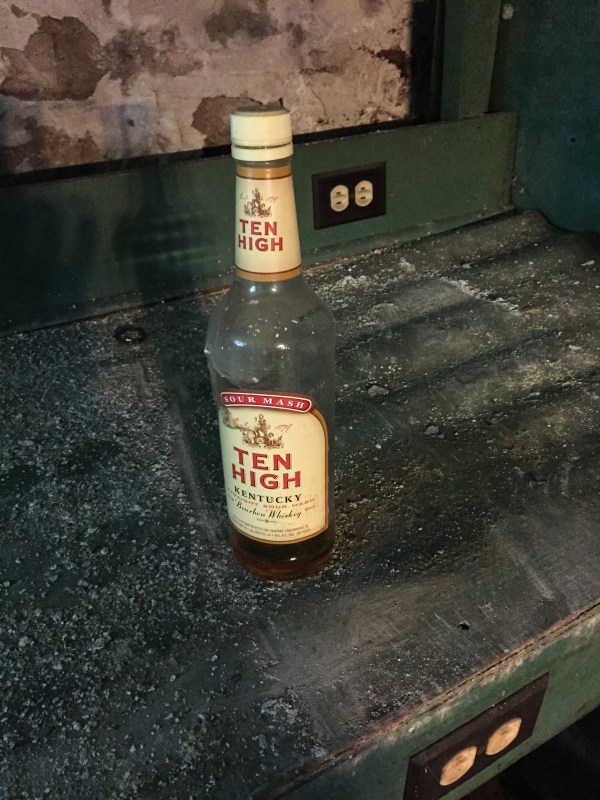 I found a bottle! I hid booze all the time as a drunk. This was in the basement, hidden in a crawl space. There was about 3 oz left. I’m sure I was furious wanting a shot many times not knowing this was hidden down there.
It it tells me where I’ve come from. I’m out. I’ve escaped myself and I’m not going back. Soon I will be relieved of this house too. It’ll be done soon enough. And I’ll look forward.
The Shoes.
I have a peculiar and irreversible injury in my foot: a Morton’s Neuroma. It’s a nerve problem in the foot that causes several annoying sensations not unlike hitting your funny bone. Pain isn’t the right word, but there isn’t really a right word. It’s definitely unpleasant. Luckily, I have found a solution for my problem.
The HOKA ONE ONE shoe “Bondi 4” works for me. It’s heavily cushioned and very wide. That’s the real key. I run with my shoes wide and loose, so that they don’t put pressure on the nerve. This is good enough to keep it from zapping at me. Sometimes I try to run in other shoes, and in a mile or two my foot is rebelling. It’s really awful.
I live in fear of HOKA changing their design for the Bondi 4. I will buy 10 pairs of the old stock f they do, so that I have lots of time to find another option. But they just came out with another new shoe which is supposedly also on a wide-frame. The Clayton. I’m going to buy a pair and see if I can run in them without irritating my foot.
There are various treatments if the neuroma gets worse, but for now it’s very manageable. One thing that exacerbates a lot of foot problems that isn’t intuitive is shoe tightness. I always used to think that if my shoes were slipping or I felt a problem with my feet, I needed to lace up my shoes better, to make them an “extension of my feet”. That’s not true.
Shoes should be loose and spacious. Our feet don’t need to be compressed. The foot is well-designed by nature to sustain us running. We need our shoes to liberate the foot to do its job while protecting us from road hazards. We don’t need the shoe to compress our feet to the point that we’re trying to run on inflexible blocks.
That’s why it’s worth it to find shoes that really work for you. It can be expensive, and it can be time consuming. But finding the right shoe for your foot and your needs can really make a difference in how enjoyable a good run in. Most running stores have a treadmill. Try things on, and use it. but if you’re like me, you might not know until the 5th mile of a run if the shoes are a real match.
That’s why if you can afford to, buy the shoes you think are right, and run in them. If they don’t work, bring them back. Most running stores will accept returns of shoes without much visible wear. But I need to wear them enough that they’re not really returnable. In which case, if I buy a shoe that doesn’t work, I’ll have to donate them to charity and take my lumps. I’m fortunate that I can do that.
I’ll give the new Clayton a try, because it’s supposed to be a light, fast shoe. But if it doesn’t work, I’ll fall back on my Bondi 4s without a worry.
Black Flag.
The Mud Run was canceled due to rising water. It’s one thing to run through mud. It’s another to try to run through four feet of flowing water. I’m disappointed, but I understand the decision. It was a long, hard rain across the entire northeast the last few days, and that meant that all the little tributary creeks were swollen to flood-stage. The event wouldn’t have been possible, much less safe.
So instead, BB and I did a 10 mile hills-and-trails run that was really tough. We ran at basically marathon pace. It was hard but felt good to get the work in. The trail half upcoming, as I mentioned, has a lot of very difficult hills and so whatever training we can get in to prepare is good. Sunday we added in another 3.5 miles with a long difficult hill in it as well, and at a faster pace. I feel like we’re probably as ready as we’ll ever be.
My triathlon training is going reasonably well, I think. So far it’s just not much different from my regular training except that I’m getting in the pool from time to time as well. Based on my last swim time I’ll be one of the slowest out of the water. I don’t care. I have two goals for the swim: (1) don’t drown; (2) finish in time to be allowed on the bike course.
My plans with the house in St. Louis are coming together. Junk removal, garage demolition, plumbing repair. Etc. I think I’ll be able to put the house on the market within a couple weeks. I hope. I just want to get it done fast and easy. And my real estate agent is being a godsend. Anyone who needs a good one in St. Louis should give me a call.
The Mud Run.
And it will be a very mud run indeed. Tomorrow BB and I are participating, with some friends, in the Maryland Mud Dog Run, which is, well, I don’t exactly know. It’s a 5k “race” in a field in Frederick, Maryland. I put race in quotes because the event isn’t timed. It’s just about getting filthy and finishing.
The former should be no trouble. A huge and plodding rainstorm is soaking the East Coast from New Haven to Virginia Beach at the moment. Heavy, persistent rains throughout Maryland will have turned the field to a brutal quicksand of muck and slime. Should be fabulous.
I’ve never done anything like this and I’m a little nervous. Trail running is muddy enough, generally, and crawling through heaps of mire under wires and leaping crevasses strikes me as muddier than I’m generally predisposed to. But it’s the kind of thing that I’m glad to be able to try. Maybe I’ll hate it, maybe I’ll love it. I’m just thrilled to be fit enough to make it part of my world of possibilities.
Yesterday I swam 1775 yards, or just a tiny bit more than a mile. Today my right forearm is exhausted and sore. I’ve been doing a lot more swimming lately, and this is my third long swim in a month. Now that I’ve joined the VFU pool, I can train regularly.
My tri swim is 1500 meters, which works out to 1640 yards. So I’m going to train out to about 2000 yards because the course, I’m sure, will be laid out with 1500 meters being right along the buoys. That’ll also be the most congested, with the fastest swimmers. I won’t be one of those. So I’m training to swim a little further and stay wide, out away from the crowd.
My goal for the swim is simply to make it through without being too exhausted. Right now, a mile swim is possible but tiring. Getting up for a 90 minute bike ride and then an hour-long run is asking a lot of my body at the moment. I’m glad that I can ask a lot of my body. And I know I’ll have the fitness to do it on race day. But it’s a big ask.
And of course, between now and then I have the trail half-marathon. Somehow, I need to get through a river crossing, and 1700 feet of elevation gain over a 13 mile course. I’m daunted. But we will be able to do it. The key will be bringing plenty of water and calories for the difficult terrain. But we know how to pack for long tough runs.
I’m excited by all of this. My fitness is easily the best it’s ever been and continues to improve as I add new things to my regimen. Being fit is exciting to me. And it still all feels so new. I’m still amazed I can run a whole mile. I’m really looking forward to the rest of my races this year, and to finding where I can take myself next.
Two Years Ago Today.
May 4th, 2014, I ran my first half-marathon. I had never run a race before. Not a 10K, not a 5K. I had never run with fuel or water. I had just gone out and run until I was tired and then walked the rest of the way home. The furthest I’d ever run before the race was a 10 mile training run, that took me two hours and hurt like hell. I was just hoping to finish without having to walk.
BB and I ran it side by side with several friends. It was a fun race and we made it without walking. In two hours and thirty-eight minutes. Which works out to a 12 minute per mile pace. Slow, painful, and difficult. We were in Pittsburgh, so that meant hills and bridges. It’s a tough course with a terrible hill in miles 11 and 12. But we did it.
The first thing I said on getting home was, “Well, I don’t need to do that again.” How wrong I was. We ran another only four and a half months later. Then another two months after that. Then six more and a full marathon in the next two years. I’ve done training runs as long as 21 miles. I’ve run 150 mile months, and 40 miles weeks.
I’ve added strength training and biking and now swimming to my regimen. And I’ve done it all next to the most amazing and supportive partner anyone could ask for. Our relationship is deepened and fulfilled by our work to improve our fitness. We challenge each other and carry each other through it.
My body hasn’t changed as much as I’d like. I’m not as lean as I wish. I’m not as muscular. But I’m fitter than before and stronger than before and I’m not diabetic which is the real point of it all: health.
I like setting goals and following them where they can take me. I have new fitness goals now: a trail half-marathon; an Olympic triathlon; another full marathon. Then, maybe, an ultramarathon. Maybe, a half-Ironman. Who knows what one day. It’s been a challenging two years. But I can do chin-ups now. Sometimes I can do four in a row without touching the floor.
We’ve been crushing it for two straight years. I’m proud of myself. I like how I feel and I love where my fitness and health are. I don’t know when age will kick in and tell me I’ve reached my peak. But it’s not yet. What an amazing privilege to be able to do this. And to do it with such a wonderful companion.
Round Numbers.
Today is 3000 days of sobriety. Three-thousand days that I went to bed sober, and got up without a hangover. Three-thousand days that I have been able to see clearly and my hands don’t shake. Three-thousand days of being in charge of my faculties. Of being able to contribute. Of being able to experience life. Of being able to confront the wonders and challenges and joys and miseries of life without chemical anesthesia.
Three-thousand days of not doing the thing that became the most important thing in my life. So that I could spend three-thousand days doing the things that matter in life. So that I could spend three-thousand days healthy, and liberated, and alive. Life is good. Even when life is hard, life is good.
I don’t know how many days I get. And I can’t sit here and promise I’ll spend every one of them sober. But I’ve done 3000 in a row, now. And I like my odds for 3001.
Preparations.
I am in a place of trying to do a lot of things all at once and feeling a bit overwhelmed. I have to take my home in ECC off the market, I think. My sudden need to sell my home in St. Louis, and also to help with my father’s expenses, has overtaken my financial ability to handle the move and increased expenses of living in an apartment. I will have to make a lot of repairs to the house in St. Louis to sell it. There’s just no getting around it. It’ll be expensive.
But I will not be using these difficulties as an excuse to slack on my training. Because I have races to run, and I am excited to move forward on that front. This past weekend BB and I did a hard 10.6 mile trail run, with some big hills. Not as big as we’ll face Memorial Day weekend, but big. The race has about 1700′ of elevation gain. That’s 500 m for my non-American readers. It’ll be tough.
And my triathlon training has officially begun. I swam 1500 yds yesterday, and it was difficult and tiring. But I can do it. The race is 1500 m, which really probably means 1600 m because I won’t be hugging the line. I want to stay out of the crowd, so I’ll take a wider path. I bought a new bike:
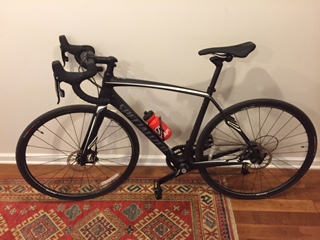
I call it the X wing. Though I kind of wish I had gotten a cheaper one at the moment, because of the sudden shift in my finances. But life isn’t predictable, and I have a nice bike. This is a fun bike to ride. It’s light (about 18 pounds, or 8 kg). It’s fast. It’s maneuverable. I really enjoy letting it out.
So I have a vague training plan. It’s annoying looking up triathlon training plans because they all seem to assume that the participant is training to go as fast as possible. I am not doing that. I’m training to finish. So I don’t need to do all the paced workouts. I just want to find something that says: if you can do this basic training plan, you’ll cross the finish line on race day. Maybe I’ll write some. and publish them. After all, I wrote our marathon training plan and it got us to the finish line at Marine Corps.
I like being a finisher. I have naturally gotten faster as time has gone by, because training a lot to finish races naturally tunes up a person’s body, and you can sustain a higher pace for longer. But being faster has never been a primary goal. Yes, a secondary goal, but not a primary one. I like just being a finisher. I like collecting medals and experiences and being able to say: “I did this thing. It was hard, and I persevered.” My goal is to complete difficult things.
I have told BB recently, “There’s a halfway decent chance I’m going to have to do a full Ironman.” I wouldn’t be ready for a couple years, certainly. But as I start to look at what I want to complete in life, now that endurance fitness is something I have decided I care about, I am realizing that I want to go very far. I want to do things that challenge me completely. I am pretty sure I am going to do a half-Ironman in the next year or two, unless I really hate the Olympic Tri. And once I’ve done that, if I like it, just maybe I’ll go on for a full.
Being a recreational endurance athlete has come to mean something special to me. It’s deeply entwined with my sobriety, my relationship, and my personal sense of self. I work hard at hard things. There’s no shortcut to a race. You have to run until it’s over to be a finisher. I am a finisher, now, of nine half marathons, and a full marathon. I have two more half marathons on my schedule at the moment. And another full marathon. And a triathlon.
I don’t remember where I read this, but it’s true: A marathon is not 26.2 miles. A marathon is hundreds of miles, and the last day is 26.2 of them. I think this is true for anything worth doing. You have to work like hell just to get ready for it. Then you have to do it. This is very much in line with the program of Alcoholics Anonymous.
Step three is making a decision. Not doing. Making a decision. Making the decision to go on and work the program in your life. It’s like signing up for the race. You made a decision to go do something. Now you have to go do the thing. And to do that, you have to prepare for the thing. And now, I’ve made the decision to be in a constant state of preparation. There is always another thing to do. There’s always maintenance work. There’s always progress.
I am preparing. To run. For life.
Medicine vs. Alcoholism.
Michael Phelps recently made news by saying he doesn’t know if he’s an alcoholic. That’s a fine answer to give to the question “Are you an alcoholic?” Most of us don’t know, or pretend not to know, or are in denial about what we are. And please don’t think I am diagnosing Michael Phelps. I have absolutely no idea if he is or isn’t. And it’s none of my business. Frankly, I don’t much care.
But I’ve been thinking about how medicine and science define us, and how terms change and what it means. Physicians and other health care practitioners don’t really use the term “alcoholic” anymore. They prefer the terms “alcohol abuse” and “alcohol dependence” and with these redefinitions, I think they’ve killed a lot of us. Medical professionals, by and large, have no idea what alcoholism is or how to treat it, and it appears that they never will.
That’s not a bad thing. Medicine has its place in recovery, certainly. As you all know, I took benzodiazepines in early recovery to prevent myself having potentially lethal seizures. Alcohol detoxification is dangerous, and medical professionals should be involved to help ensure we are safe as we go through it. But frankly, that’s about the extent of their utility.
And this is the reason: as the reductionistic process of medical science proceeds, the biology of addiction and the experience of addiction diverge. And so far at least, understanding the biology of addiction has not made recovery better, or more attainable. In fact, I would argue from my experience that too much medical care in early recovery is often really, really bad for us.
Expecting physicians to help us abstain is dangerous for many reasons. First of all, not everyone who needs to recovery from alcoholism necessarily exhibits “abuse” or “dependence” as scientists and physicians define it. Deciding you’re an alcoholic is only peripherally related to those concepts. We need to recover when we can no longer tolerate the way our lives intertwine with alcohol, whether that matches up with a textbook definition or not. And having a doctor tell us that we don’t meet definitions often convinces people badly in need of recovery that they are not yet at the point that they have to take action.
Second, even if we and the medical providers agree on our need for recovery, having our care (after the acute phase of detoxification) managed by someone else allows us to blame them for our relapses. The doctor didn’t cure me. It’s not my fault. It’s his responsibility, not mine. The medicine didn’t work. I still had cravings. They didn’t cure me. It’s all the disease convincing us to allow it to stay in command of our lives. It will latch on to any convenient excuse to compel us to keep drinking.
More times than I can count, I’ve seen people undergoing medicalized recovery treatments fail over and over again, always blaming the treatment program and not taking responsibility for their recovery. If we can find a way to keep drinking, if we can blame someone else, we will. We don’t recover until we’re willing to own that we are our own problems, and we have to find our own solutions. Doctors can’t cure us.
If you “don’t know” if you’re an alcoholic, I’d personally still recommend you take a good hard look at your relationship with alcohol. Recovery isn’t about volume and it isn’t about frequency and it isn’t about whether we fit the medical definitions of abuse or dependence. These are tools we alcoholics use to continue drinking. Not tools we use to recover.
Recovery, alcoholism, these things are about how we feel. Who we are. What things live inside us and what we decide we have to do about them. As an alcoholic, when someone comes to talk to me about their drinking, I am utterly uninterested in whether they fit definitions of abuse and dependence. They don’t matter. What matters is: have they come to an emotional, spiritual point in their lives where they’re willing to go to any lengths to give up drinking?
And as long as a person is interested in a physician doing the heavy lifting of their recovery, they haven’t come to that point yet. No matter what they say.

 Infactorium